
استمتع بـUnlimited مع Magzter GOLD
احصل على وصول غير محدود إلى أكثر من 9000 مجلة وصحيفة وقصة مميزة مقابل
يحاول ذهب - حر
'Jobs Have Happened, Privatisation Is No Panacea'
February 16, 2019
|Businessworld
Krishnamurthy Subramanian, the new Chief Economic Advisor (CEA) to the Government of India, first caught the attention of the Narendra Modi government when he, as an ISB professor, stoutly defended demonetization in various opeds. An IIT-IIM alumnus who also counts Raghuram Rajan as one of his mentors, Subramanian stands by his belief even when challenged with data and anecdotal evidence. In a conversation with BW Businessworld’s Suman K. Jha, the CEA defends the Modi government’s economic report card, offering rare insights.

How do you look at the economy’s evolution since this government came to power?
The overall economy has done really well. Based on the second revised estimates, the average GDP growth over the last five years has been 7.5 percent — which is the highest for any government since liberalization. And that growth has happened in an environment where the world economy has not been doing well. There are headwinds against globalization which have affected exports.
This growth has been built to a large extent on domestic consumption. This is not just based on the revised GDP series etc. If you use the data in the ASI, which basically goes back to 1981 and therefore it is an unbroken series and you look at the growth in the gross value added, in real terms that growth has been 7.5 percent. This data is available only till 2016-17, so once more ASI data comes up this can be checked.
Secondly, look at inflation. It’s a very pernicious tax that poor people pay. So, in 2014 the rates of inflation were 10-plus percent. In contrast, the latest inflation numbers are 2-3 percent. Overall, the average rate of inflation has been about 4.5 percent over the past five years. Now this matters a lot if you think about the quality of life of a common citizen.
If you look at inflation around 2014, the real rates of interest were negative. So you had around 8 percent nominal rate of interest and 10.5 percent inflation, or minus 2.5 percent real rates of interest. So we were putting in money and finding its value depreciating in terms of purchasing power. In contrast now, if you look at the nominal rate of interest which is 7 percent and if you take 4.5 percent as its average rate of inflation, you are looking at around 2.5 percent real rate of interest.
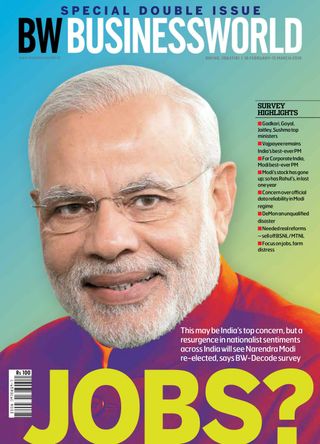

هذه القصة من طبعة February 16, 2019 من Businessworld.
اشترك في Magzter GOLD للوصول إلى آلاف القصص المتميزة المنسقة، وأكثر من 9000 مجلة وصحيفة.
هل أنت مشترك بالفعل؟ تسجيل الدخول
المزيد من القصص من Businessworld

BW Businessworld
THE STRONGEST MARKETING TOOL
As consumers grow more cautious, brands are winning trust by letting performance speak before promotion, says Gupta

3 mins
December 27, 2025

BW Businessworld
Healthcare Trends in 2026
AI is enhancing diagnostic abilities, hybrid care models are improving patient access and operational efficiency, and efforts are focused on supporting the healthcare workforce
3 mins
December 27, 2025

BW Businessworld
UP, UP AND AWAY
India's transport sectors surged in 2025, but numbers reveal momentum, strain, and large investment bets waiting to mature
5 mins
December 27, 2025

BW Businessworld
BUILDING BIG
India built big and priced higher in 2025. Can execution, affordability, and delivery finally catch up in 2026?
5 mins
December 27, 2025

BW Businessworld
GROWTH WITH CAVEATS
India's economy looks resilient on paper for FY26, but do the numbers hide deeper fiscal and trade stresses ahead?
5 mins
December 27, 2025

BW Businessworld
AI Rewiring Indian Healthcare Industry
From smart documentation and imaging to predictive analytics and telehealth, hospital leaders say AI is set to become the invisible backbone of India's care delivery
3 mins
December 27, 2025

BW Businessworld
Redefining India's Pre-owned Car Market In 2026
If the current signals stay on course, 2026 could be the point when the pre-owned segment becomes the most visible marker of India's move toward cleaner propulsion
3 mins
December 27, 2025

BW Businessworld
Our evolving relationship with luxury
For some time now, the Indian luxury market has been showing promise, despite sluggish demand across core global markets due to economic headwinds and geopolitical uncertainties. The way we consume luxury is shifting; consumers are preferring luxury experiences, such as holidays and dining out, over traditional luxury products. Accessible luxury and resale are also part of the luxury sector pie
4 mins
December 27, 2025

BW Businessworld
A Year of Strategic Reset
After years of rebound, expansion and experimentation, 2026 emerges as a defining year where Indian business sharpens priorities, tightens execution and aligns growth with long-term resilience
3 mins
December 27, 2025

BW Businessworld
THE END OF PRICE-LED MARKETING
Mathur untangles how transparency, certification and local relevance are winning Indian consumers
2 mins
December 27, 2025
Translate
Change font size