Prøve GULL - Gratis
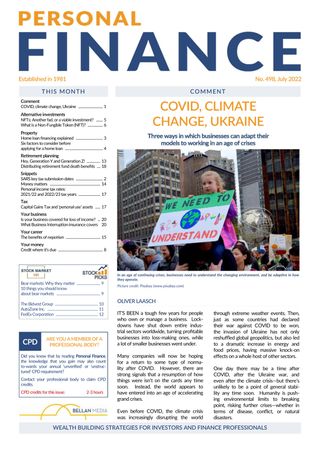
COVID, CLIMATE CHANGE, UKRAINE
Personal Finance
|July 2022
Three ways in which businesses can adapt their models to working in an age of crises
-

OLIVER LAASCH
IT'S BEEN a tough few years for people who own or manage a business. Lock-downs have shut down entire industrial sectors worldwide, turning profitable businesses into loss-making ones, while a lot of smaller businesses went under.
Many companies will now be hoping for a return to some type of normality after COVID. However, there are strong signals that a resumption of how things were isn't on the cards any time soon. Instead, the world appears to have entered into an age of accelerating grand crises.
Even before COVID, the climate crisis was increasingly disrupting the world through extreme weather events. Then, just as some countries had declared their war against COVID to be won, the invasion of Ukraine has not only reshuffled global geopolitics, but also led to a dramatic increase in energy and food prices, having massive knock-on effects on a whole host of other sectors.
One day there may be a time after COVID, after the Ukraine war, and even after the climate crisis-but there's unlikely to be a point of general stability any time soon. Humanity is pushing environmental limits to breaking point, risking further crises-whether in terms of disease, conflict, or natural disasters.
Businesses therefore need to be adaptive in how they operate. This means responding to current crises, being better prepared for future crises, and addressing their own role in generating these crises in the first place. With that in mind, here are three types of business models that companies should start adopting now.

1. Be responsive to current crises

Denne historien er fra July 2022-utgaven av Personal Finance.
Abonner på Magzter GOLD for å få tilgang til tusenvis av kuraterte premiumhistorier og over 9000 magasiner og aviser.
Allerede abonnent? Logg på
FLERE HISTORIER FRA Personal Finance
Personal Finance
Options vs futures: The derivatives showdown
OPTIONS AND futures are both derivative financial instruments, which means that their value is derived from an underlying asset such as shares, commodities, currencies, or indices.

3 mins
May 2026

Personal Finance
City Improvement Districts
A lifeline for Johannesburg, or a cop-out for the municipality?
5 mins
May 2026

Personal Finance
Who do I need to become to achieve success?
The identity shift that many entrepreneurs must make
5 mins
May 2026

Personal Finance
Al's impact on the future of work
How far does this revolution still have to run?
4 mins
May 2026

Personal Finance
Universal healthcare: A pipe dream, a possibility, or a necessity?
Unpacking the challenges facing South Africa's healthcare reform
4 mins
May 2026

Personal Finance
How to deal with losses
Treat them like employees ... sometimes they need to be paid
1 mins
May 2026

Personal Finance
The actual reasons why employees quit
The old adage that people leave managers, not companies, is true-but only up to a point
4 mins
May 2026

Personal Finance
'Future-proofing' commercial properties in times of uncertainty
Four tips to reduce your investment risk in this sector
4 mins
May 2026

Personal Finance
It's never too early (or too late) to start investing
The best time to start was when you received your first paycheque. The second-best time is now.
3 mins
May 2026

Personal Finance
'Aparthotels' The best of both worlds
Short-term rentals with professional management provide a novel way to invest in this growing market
3 mins
May 2026
Translate
Change font size