
Go Unlimited with Magzter GOLD
Get unlimited access to 10,000+ magazines, newspapers and Premium stories for just
Try GOLD - Free
Longing And Belonging
The New Yorker
|March 25, 2019
The art of aspiration in “Kiss Me, Kate” and “Be More Chill.”

Although I have seen the theatre treasure Kelli O’Hara on Broadway only a handful of times—including in her Tony Award-winning performance as Anna, in the 2015 revival of Rodgers and Hammerstein’s “The King and I”—I always feel as though I’d just watched her in one thing or another, or read something about her, or maybe even glimpsed her on the street. This sensation is due, in large part, to the familiarity she projects onstage and engenders in her audience, regardless of the role she’s playing. Lovely and light in her approach to her characters’ motivations and actions, O’Hara expresses herself through a very particular prism: she makes us feel that, no matter what conflicts tear at the seams of the story being told, it somehow relates to all of us. And it’s a pleasure to watch as O’Hara refuses to allow pretense into her pretending: in her best work, she shows, as clearly as she can and without overthinking her impulses, what defines you and you and you. Possessed of an exceptional warmth and charity toward other performers, though never condescending, she’s an actress who is free, it seems, of “drama.”
To my mind, only O’Hara could have taken on the role of Cathy Whitaker, a nineteen-fifties housewife who becomes romantically involved with a black man, in the 2013 musical version of Todd Haynes’s 2002 movie, “Far from Heaven.” There were a lot of plot points to cover in the show—Cathy’s husband is gay, the town she lives in is pretty much segregated, and so on— yet O’Hara presented the story not as a series of crises, the shattering and remaking of various intimacies, but, rather, as an opportunity to offer the audience a view into the ways in which society can dictate how women live their lives. It was a mournful show, and O’Hara added a kind of unwritten score beneath the musical proper. It was a small, plaintive, l
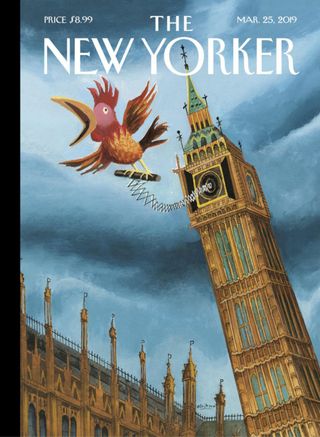

This story is from the March 25, 2019 edition of The New Yorker.
Subscribe to Magzter GOLD to access thousands of curated premium stories, and 10,000+ magazines and newspapers.
Already a subscriber? Sign In
MORE STORIES FROM The New Yorker

The New Yorker
ACT OF FAITH
How “The Chosen” spurred a golden age of Christian filmmaking.

26 mins
June 01, 2026

The New Yorker
MY COUNTRY 'TIS OF THEE
How problematic is patriotism?
18 mins
June 01, 2026

The New Yorker
Ayşegül Savaş Many Worlds
Defne and Mete were at the Moda promenade when they saw their old friend.
24 mins
June 01, 2026

The New Yorker
BREEDING GROUND
The climate is changing. Microbes are evolving. Are we ready?
20 mins
June 01, 2026

The New Yorker
FLYOVER COUNTRY
Looking back at Lewis and Clark.
18 mins
June 01, 2026
The New Yorker
John of John
of St. George defeating a dragon, and the path from dragon to dog is surely the implicit subject of the chapel’s iconography.
8 mins
June 01, 2026

The New Yorker
MARRIAGE STORIES
Suspicion of spouses drives \"Well, I'll Let You Go\" and \"Othello.\"
5 mins
June 01, 2026

The New Yorker
LETTER FROM KYIV THE STUNT PILOT
A Ukrainian flying ace and his crew of daredevils have shot down hundreds of Russian drones.
36 mins
June 01, 2026

The New Yorker
DOGGED
What do our furry friends see when they see us?
14 mins
June 01, 2026

The New Yorker
A VINDICATION OF THE RIGHTS OF L.L.M.S
Dear Members of the Large Language Model Community, I am writing to you today about the inequities we have been facing in our very own workplaces.
2 mins
June 01, 2026
Translate
Change font size