Go Unlimited with Magzter GOLD
Get unlimited access to 10,000+ magazines, newspapers and Premium stories for just
Try GOLD - Free
Jonathan Franzen's Great Expectations - The Novelist As Pundit
New York magazine
|August 24, 2015, Fall Preview
How Americas foremost novelist became its leading public moralist.

Love may not be the first word that comes to mind when you hear the name Jonathan Franzen, but it’s a word that’s become more and more important to him over the years. “You have to love before you can be relentless.” That, whatever it means, is the last of Franzen’s rules for writing fiction, published in the Guardian in 2010. In 2011, Franzen told the graduating seniors of Kenyon College that “trying to be perfectly likable is incompatible with loving relationships.” His point was that it’s better to love, say, a spouse or birds than to spend too much time on Facebook. Franzen has also lamented “the near-perfect absence” in the fiction of his late friend David Foster Wallace “of ordinary love.” The paradox was that Wallace’s readers felt loved when they read his books, and in turn came to fiercely love their author.
Do you love Jonathan Franzen? Does America? Does the world? These questions sound ridiculous, but they’re the ones Franzen has been posing over the past two decades, as he has, against long odds, made himself the kind of public figure about whom they aren’t entirely ridiculous or even unusual. He started asking them in the mid-’90s in a series of essays—most famously, one published in Harper’s as “Perchance to Dream” in 1996—that lamented the novelist’s diminished role in the culture; the burned-out state of “the inner city of fiction”; and the failure of his first two novels, despite critical acclaim, to connect with a wide readership. Yet he knew that, even if it had been a while since a writer more challenging than Scott Turow or Stephen King had appeared on the cover of
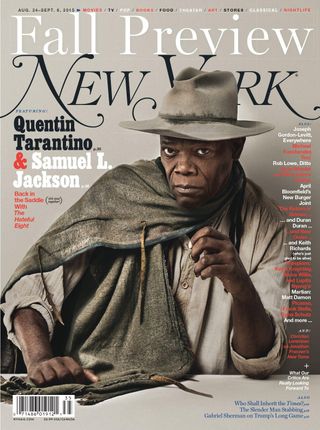

This story is from the August 24, 2015, Fall Preview edition of New York magazine.
Subscribe to Magzter GOLD to access thousands of curated premium stories, and 10,000+ magazines and newspapers.
Already a subscriber? Sign In
MORE STORIES FROM New York magazine

New York magazine
THE BILLIONAIRE WHO WIRED SAN FRANCISCO
Ten years ago, concerned about car burglaries, Chris Larsen began installing a web of private cameras over the city. He had no idea how far his influence would go.

27 mins
May 18–31, 2026
New York magazine
MORGAN BASSICHIS TALKS TO GHOSTS
The performer's hit solo show, Can I Be Frank?, is part séance, part comedy routine, and unlike anything else in theater right now.
10 mins
May 18–31, 2026

New York magazine
It Is in Fact Possible to Get Off Your Phone
59 actually useful tips for using it (a little) less.
16 mins
May 18–31, 2026

New York magazine
SHE TELLS IT LIKE IT IS
Taraji P. Henson is having a ball in her Broadway debut, but the actor still has some bones to pick with Hollywood.
16 mins
May 18–31, 2026

New York magazine
They Rescued a Teardown and Raised the Roof
An artist couple renovated a neglected country house with enough space for an art collection and their own work.
3 mins
May 18–31, 2026

New York magazine
More Horrible Bosses
The Devil Wears Prada 2 nods to the media's bleak economic future—in a fun way.
3 mins
May 18–31, 2026

New York magazine
Brother, Can You Spare $200 Million?
Why the Metropolitan Opera needed a Saudi lifeline.
6 mins
May 18–31, 2026
New York magazine
The Rise of the FOOL
CLOWNING isn't just HONK-HONK. A report from the Eastside of Los Angeles, the center of the hottest COMEDIC ART.
26 mins
May 18–31, 2026
New York magazine
Turf Wars
For recreational soccer leagues, finding a field to play on has never been harder.
1 mins
May 18–31, 2026
New York magazine
What Her Mother Did
In The Hill, a child lives with the fallout of her family's radical past.
5 mins
May 18–31, 2026
Translate
Change font size