Try GOLD - Free
Malachite, Part II- Banded Beauty From Russia And The Cargo
Rock&Gem Magazine
|December 2017
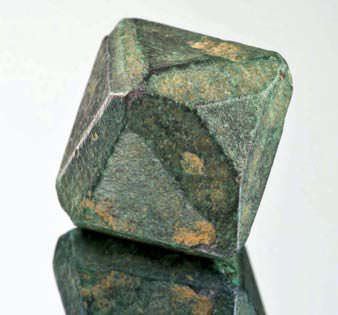
One of the earliest-known sources of malachite was mined by the Egyptians in the Sinai Desert thousands of years ago. Since that time, this lovely, green hydrous copper carbonate has been mined in quantity all over the world.

To describe more than a fraction of all the sources of this mineral would be impossible in a magazine article, but a handful of sources are astounding, due to the sheer quantity or unusual types of malachite they produced.
Russia’s Ural Mountains was once the source of tons of the world’s most beautiful banded malachite, and the copper mines of the Katanga (Shaba) Copperbelt of Central Africa are currently yielding huge masses of green copper carbonate.
Russia is unquestionably famous for its amazing banded malachite gem material. Artisans, decorators, and museum experts agree that Russian malachite is the most beautiful in the world. It was mined in such quantities that artisans were able to produce breathtaking malachite objects that are now found worldwide. Visit stately palaces in Mexico, England and Europe, and many state buildings and countless museums throughout the world, and you can view wonderful creations made of Russia’s malachite. These objects are highly prized and eagerly displayed, and their value borders on priceless.
Russian malachite exhibits light- to dark-green bands, some so dark as to be almost black. The bands can be any width, from under an inch to several inches wide. The curving, undulating bands are spectacular, taking many forms, from bull’s-eyes to graceful, sweeping curves.

This story is from the December 2017 edition of Rock&Gem Magazine.
Subscribe to Magzter GOLD to access thousands of curated premium stories, and 10,000+ magazines and newspapers.
Already a subscriber? Sign In
MORE STORIES FROM Rock&Gem Magazine
Rock&Gem Magazine
A New Amber Locality Fills a Gap
A sandstone quarry in central Ecuador has yielded the first significant deposit of Mesozoic amber from South America.

1 min
January / February 2026
Rock&Gem Magazine
Did "Left-Handed" Fish Leave Water Earlier than Thought?
Fossil evidence suggests that fish (or \"fishapods\") dragged themselves onto land during the middle Devonian Period.
1 min
January / February 2026

Rock&Gem Magazine
"Lab Quakes” Produce Surprising Results
When faults let loose and earthquakes result, the main effect we mortals experience is the violent shaking.
1 min
January / February 2026
Rock&Gem Magazine
This Egg is No Spring Chicken
How to date a dino egg
1 min
January / February 2026
Rock&Gem Magazine
Have we Already Mined the Critical Minerals We Need
Then why are we throwing them away?!
1 min
January / February 2026
Rock&Gem Magazine
One Toxic Worm
A critter that creates & tolerates orpiment!
1 min
January / February 2026
Rock&Gem Magazine
ROCK & GEM FIELD GUIDE: Silver
Silver (Ag) is a native element and one of Earth's most prized precious metals.
2 mins
January / February 2026
Rock&Gem Magazine
DINOSAURS OF THE HELL CREEK MUSEUM
In the Badlands of South Dakota, just outside the small town of Belle Fourche—pronounced “Bell Foosh”—a new attraction has taken shape that every dinosaur enthusiast should see. The Dinosaurs of the Hell Creek Museum is part hands-on exhibit, part science center and part active research lab.
3 mins
January / February 2026
Rock&Gem Magazine
The Lost Twins of Kongsberg
A Silver Story Resurfaced
3 mins
January / February 2026
Rock&Gem Magazine
Switzerland's ICE PALACE
Walk Inside a Glacier at The Top of Europe
7 mins
January / February 2026
Translate
Change font size