Try GOLD - Free
Set Ambitious but Realistic Environmental Goals
MIT Sloan Management Review
|Winter 2024
How far from business realities can companies stretch when setting critical goals to reduce carbon emissions?

IN THE YEARS SINCE THE 2021 ROUND OF global climate negotiations, more than 2,600 companies have responded to alarms raised by scientists and policy makers by setting aggressive targets to reduce carbon emissions.¹ Walmart aims to become powered by 100% renewable energy by 2035; Ikea has made a commitment to produce as much renewable energy as it consumes by 2030; General Electric aims to transform itself into a net-zero company by 2050; and American Electric Power plans to reduce its carbon emissions 80% by 2030, with a goal of net-zero emissions by 2045.²
These sustainability goals address demands from a broad array of stakeholders that companies disclose material risks and improve their environmental and social impacts. They also serve to focus the attention and resources that are required within organizations to drive social and environmental progress on the ground.
However, setting appropriately ambitious sustainability goals that can pull a steady line of progress through today’s uncertain business landscape is an exceedingly difficult task. Economic volatility, evolving stakeholder demands, scientific and technological developments, and variable sociopolitical pressures mean that the ground is constantly shifting under leaders’ feet.
Activist stakeholders in particular are watching company performance on these issues closely, demanding corporate transparency around goals and progress, and faulting companies that fail to follow through on their pledges. A 2022 study published by the nonprofit organizations NewClimate Institute and Carbon Market Watch identified 25 large corporations with net-zero commitments and rated 21 of them as having “low integrity” or worse because their plans would reduce emissions by only 40% on average, not the 100% implied by net zero.
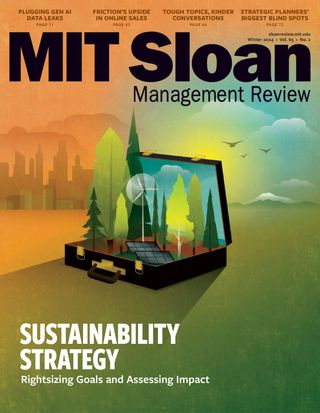

This story is from the Winter 2024 edition of MIT Sloan Management Review.
Subscribe to Magzter GOLD to access thousands of curated premium stories, and 10,000+ magazines and newspapers.
Already a subscriber? Sign In
MORE STORIES FROM MIT Sloan Management Review

MIT Sloan Management Review
A Smarter Approach to Measuring Customer Experience
Many companies collect more customer experience data points than they need or can use effectively. Here's how to focus on the metrics that matter.

10 mins
Spring 2026

MIT Sloan Management Review
Why Digital Dexterity Is Key to Transformation
To make headway with digital transformation, executives are redefining the challenge: Build a workforce to take advantage of new technologies.
17 mins
Spring 2026

MIT Sloan Management Review
Ask Sanyin: What Makes a 'Listening Tour' Meaningful?
I've just stepped into a new leadership role and was advised to embark on a \"listening tour.\"
2 mins
Spring 2026

MIT Sloan Management Review
Build Business Advantage With Real-Time Decision-Making
Stop running your business on yesterday's data. Real-time data, empowered employees, and agile systems can lead to higher margins.
11 mins
Spring 2026

MIT Sloan Management Review
Balancing Innovation and Risk in the Age of AI
Monica Caldas is executive vice president and global CIO of Liberty Mutual Insurance.
2 mins
Spring 2026

MIT Sloan Management Review
Turn Customer Complaints Into Innovation Blueprints
You can reframe client grievances as an opportunity instead of a burden. At one Swiss hospital, complaints have become a pipeline for improvements to the customer experience.
6 mins
Spring 2026

MIT Sloan Management Review
The Eight Core Principles of Strategic Innovation
A company's future depends on the new directions it explores and develops today — and that requires different structures and capabilities from incremental innovation.
14 mins
Spring 2026

MIT Sloan Management Review
What AI Can Teach Us About Designing Better KPIs
Machine learning research offers four proven strategies to prevent people from gaming measures of organizational performance.
12 mins
Spring 2026

MIT Sloan Management Review
THREE THINGS TO KNOW ABOUT Learning by Hiring
LEADERS WHO RECOGNIZE THAT OUT-siders can be major drivers of innovation often seek to bring new knowledge into their organizations by making external hires.
2 mins
Spring 2026

MIT Sloan Management Review
Validating LLM Output? Prepare to Be ‘Persuasion Bombed’
Research demonstrates how generative AI ramps up the rhetorical pressure on users who question the AI's output.
8 mins
Spring 2026
Translate
Change font size