
Go Unlimited with Magzter GOLD
Get unlimited access to 10,000+ magazines, newspapers and Premium stories for just
Try GOLD - Free
"It had been a tiny triumph, but it had been a British triumph"
BBC History UK
|July 2024
MAX HASTINGS talks to Rob Attar about a daring airborne raid that provided a much-needed boost to Britain's morale in the darkest days of the Second World War

Rob Attar: Many of your previous books have focused on the big campaigns and the most famous events of the Second World War. So what drew you to the relatively unknown Operation Biting?
Max Hastings: Because I’m getting a bit older and a bit slower, I want to focus on miniatures rather than the big stuff. So I’ve been picking small episodes that seem to illustrate important realities about bigger things – and which are also jolly good stories in their own right.
The Bruneval Raid [Operation Biting] in February 1942 was a British success story at a time when not much else was going well. And it involved all sorts of fascinating personalities – starting, of course, with Churchill. At that stage of the war, when so many battles were being lost, he always wanted to keep raids going on the occupied coast of Europe. This was partly to remind the Americans that we were still in the war business, partly to cheer up the British people, and also partly to serve some very important objectives.
What were those objectives?
What was at stake really mattered. Bomber Command, during its attacks into Europe, was suffering more and more from German radar-directed fighters. The British were catching a new sort of radar they didn’t know much about, which the Germans called the Würzburg-Gerät.
The genius of British scientific intelligence, Reg Jones, always liked to think that he could work out anything just by thinking about it long enough – but in this case, both he and the Telecommunications
Research Establishment felt there was no substitute for getting a look at the real thing. And suddenly they saw this aerial photograph, in December 1941, of a radar station near Bruneval, about 12 miles away from Le Havre. They could see this black thing down there, which they were pretty sure was a Würzburg antenna.
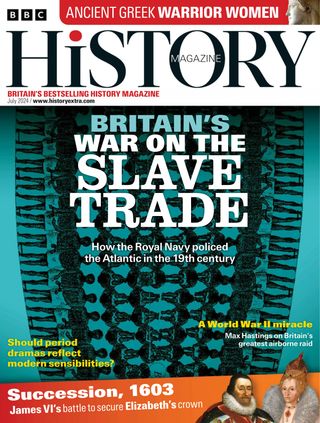

This story is from the July 2024 edition of BBC History UK.
Subscribe to Magzter GOLD to access thousands of curated premium stories, and 10,000+ magazines and newspapers.
Already a subscriber?Sign In
MORE STORIES FROM BBC History UK

History Extra
Personal stories
Few shows have enjoyed the longevity of Who Do You Think You Are? and it's easy to understand why it has endured.

1 min
June 2026

History Extra
Tidal change
Southern mythos notwithstanding, there exists no static, exceptional American South.
1 mins
June 2026

History Extra
Marriage story
Emily Howes on her novel about Catherine Dickens' relationship with her famous husband
1 mins
June 2026

History Extra
Sexual her-story
A witty, wide-ranging account of the myths and power structures behind female sexuality impresses SARAH JONES
2 mins
June 2026

History Extra
History man
According to Tom Hanks, during his childhood 'The War' was a recurring topic in the conversations of the adults around him.
1 min
June 2026
History Extra
How to be a master of disguise
10 do's and don'ts when attending a masquerade
2 mins
June 2026

History Extra
Age of indulgence
Our content producer Charlotte Vosper picks episodes of the HistoryExtra podcast about Georgian Britain
1 min
June 2026
History Extra
Gaffer tape
While Bobby Robson and Gareth Southgate both led England to World Cup semi-finals, Alf Ramsey remains the only manager to actually win the trophy.
1 mins
June 2026

History Extra
What's the origin of the Fosbury Flop?
Like the Salchow in ice skating, the Fosbury Flop is a sport technique that immortalises the name of its creator.
1 min
June 2026

History Extra
EXHIBITIONS
In 1776, the United States of America was born - heralded by the Declaration of Independence.
1 min
June 2026
Listen
Translate
Change font size