Try GOLD - Free
Mainstreaming Sustainable Development through Climate-Smart Agriculture By Promoting Evidence-Based Research
TerraGreen
|March 2023
The Resilience project supported by the Ministry of Foreign Affairs (Norway) has tested and validated selected integrated climate smart agriculture (CSA) technologies in Odisha and Assam states in India over the last four years. Farmer-led demonstration trials were conducted with the active support of project partners and multi-stakeholders. In this article, Udaya Sekhar Nagothu, Mehreteab Tesfai, and Amaresh Kumar Nayak present two good practices of CSA and their key research results.

At a United Nations (UN) summit in New York (UN, 2019), one of the world leaders asserted that “For us, sustainability is the navigation instrument, the compass into the future”. Unless sustainable development becomes a fundamental criterion in policy and practice in the future, protecting earth’s resources for future generations will not be possible. Thus, mainstreaming sustainable development in the policy agenda both at the international and national levels is vital. It is necessary to promote collective action/ cooperation and sharing of knowledge between countries, provinces, sectors, and stakeholders. Indeed, such emphasis is necessary to strengthen linkages and nexuses, moving from silos to integration and synergies, and the spirit of partnerships. Mainstreaming the three dimensions of sustainable development (i.e., environmental, economic, and social including gender integration) should be an integral part of national policies, plans, and strategies of countries.
Integrating Sustainable Development/Climate Resilience in Action/ Work/Decision-Making
The Resilience project (www. resilienceindia.org) supported by the Ministry of Foreign Affairs (Norway) has tested and validated selected integrated climate-smart agriculture (CSA) technologies in Odisha and Assam states in India over the last four years. Farmer-led demonstration trials were conducted with the active support of project partners and multi-stakeholders. In this article, two good practices of CSA and their key research results have been presented.
Direct seeded rice
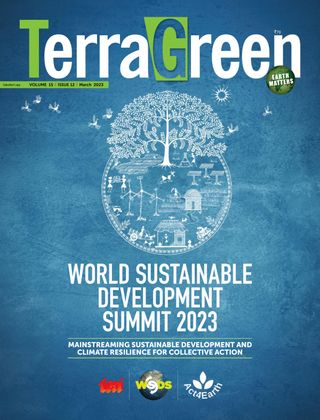

This story is from the March 2023 edition of TerraGreen.
Subscribe to Magzter GOLD to access thousands of curated premium stories, and 10,000+ magazines and newspapers.
Already a subscriber? Sign In
MORE STORIES FROM TerraGreen

TerraGreen
Motor Efficiency
The Silent Catalyst of India's Green Industrial Revolution

4 mins
January 2026

TerraGreen
Beauty That Betrays!
The Quiet Invasion of An Ornamental Plant
3 mins
January 2026
TerraGreen
Farming Innovation Addresses Food Shortages
Also Halves Methane Emissions
4 mins
January 2026

TerraGreen
Aravalli on the Edge
Saving India's Ancient Green Shield from Collapse
3 mins
January 2026

TerraGreen
From Orchard to Table
Apple Picking, Family Time, and Fall Colours
4 mins
January 2026

TerraGreen
Coral Reefs Could Feed Millions
If We Let Them Rebuild
3 mins
January 2026

TerraGreen
Resting on Deodars
How Fallen Trees are Being Reimagined as Urban Assets in Shimla
3 mins
January 2026

TerraGreen
India's Clean-Air Innovation at Risk
Nationwide Assessment by WeNaturalists
2 mins
January 2026

TerraGreen
CNFF-25
Highlights Environmental Concern Amid India's Cultural Heritage
3 mins
January 2026
TerraGreen
Green Farming through Circular Economy
Sustainable Practices for Waste Reduction
8 mins
January 2026
Translate
Change font size