Try GOLD - Free
Mercury returns to twilight
BBC Sky at Night Magazine
|April 2023
The inner wanderer graces our evening skies once again this month.

When most beginners start out in planetary astronomy, it's easy to default to the holy trinity' of Jupiter, Saturn and our neighbour Mars. Each boasts unique and relatively easy to observe features, from Saturn's rings and Jupiter's bands and Great Red Spot, to Mars's dusty surface. But why stop there? There are eight planets in our Solar System and many can be appreciated with beginner setups. The 'inner planets', Mercury and Venus, present new and exciting challenges to planetary astronomers. We explored Venus in last month's issue and now it's Mercury's turn for the spotlight.
Due to its proximity to the Sun, extra care must be taken to observe Mercury safely, which adds to the challenge. There are particular times that are best to view this elusive, mysterious planet, and this April we can seize the opportunity. Get ready to enjoy one of the Solar System's unsung heroes.
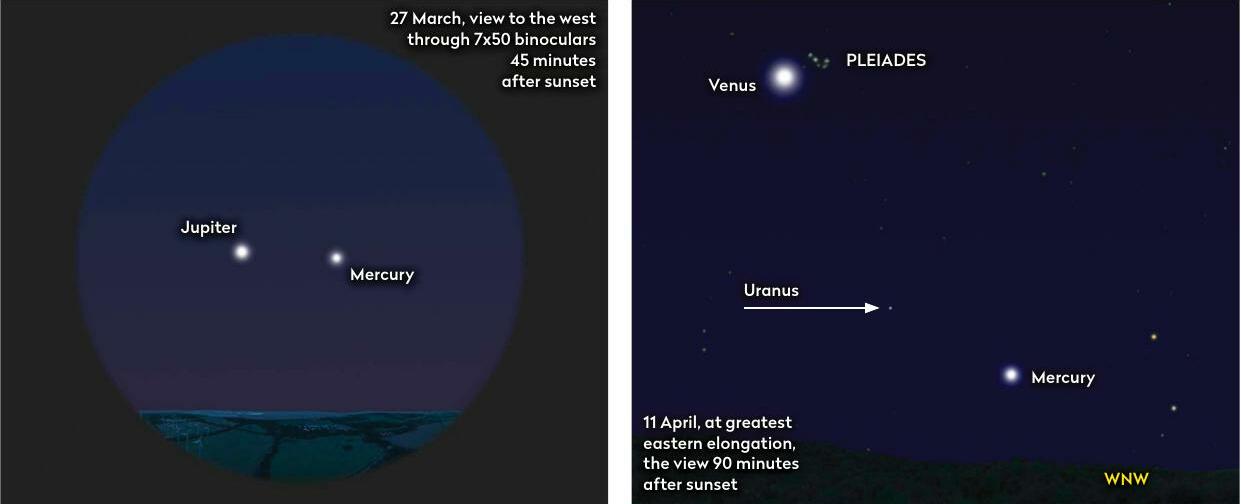
Following Mercury's path
The fastest planet in the Solar System, Mercury is named after the messenger of the Greek gods, renowned for speed. And time is certainly of the essence with this planet. To catch Mercury, we need to understand how its position relative to the Sun affects its visibility.
Mercury is 0.4 astronomical units (AU) away from the Sun and orbits at speeds of up to 47km per second, compared to Earth's relaxed pace of 30km per second. When it reaches its closest point to the Sun, Mercury is at its fastest and it then slows down slightly the further away it gets. As the innermost planet, it also has the shortest year, taking 88 Earth days to circle the Sun.

This story is from the April 2023 edition of BBC Sky at Night Magazine.
Subscribe to Magzter GOLD to access thousands of curated premium stories, and 10,000+ magazines and newspapers.
Already a subscriber? Sign In
MORE STORIES FROM BBC Sky at Night Magazine

BBC Sky at Night Magazine
Crush: Close Encounters with Gravity
Gravity is something that we're all innately familiar with. It keeps our feet on the ground, fights against a rocket trying to leave Earth and governs the movement of the planets and stars.

1 mins
April 2026

BBC Sky at Night Magazine
Exploring the Universe
There's no shortage of children's books about astronomy.
2 mins
April 2026
BBC Sky at Night Magazine
Make your Milky Way images pop
Simple, free processing techniques using FastStone Image Viewer
3 mins
April 2026

BBC Sky at Night Magazine
Nightfaring: In Search of the Disappearing Darkness
This book is a manifesto for dark skies, written as a travel memoir.
1 mins
April 2026
BBC Sky at Night Magazine
Flying saucers- The making of a modern myth
Our obsession with UFOs goes back further than you might think. Robert Pateman traces how early science fiction, dubious sightings and an alien-mad media led to the 1950s saucer fever
9 mins
April 2026

BBC Sky at Night Magazine
STAR OF THE MONTH
Alphecca, the brightest jewel in the Crown
1 min
April 2026

BBC Sky at Night Magazine
How to use a planisphere
Navigate the sky with the original stargazer's tool. No batteries, apps or Wi-Fi required!
3 mins
April 2026
BBC Sky at Night Magazine
Why rockets don't launch straight up
For a rocket to get its payload into space, it has to follow a curved path. But what would happen if it didn't?
2 mins
April 2026

BBC Sky at Night Magazine
Q&A WITH A DARK MATTER SPECIALIST
Dark matter makes up 27 per cent of all matter in the Universe. So why is it so hard to find? Meet one of the people making a map that leads us to it
3 mins
April 2026

BBC Sky at Night Magazine
Why I want to put a hotel on the Moon
Bored of the beach? Sick of city breaks? Step this way. Space entrepreneur Skyler Chan explains how he'll build a holiday destination on the Moon by 2030
2 mins
April 2026
Translate
Change font size