يحاول ذهب - حر
Nutrition For The Overwintering Of Small Stock: A Three-Phase Approach
April 2020
|Stockfarm
The principles of overwintering large and small stock are the same.

According to Dr Francois van de Vyver, national technical manager for ruminants at Nutri Feeds, the primary shortage in green veld during summer in the summer rainfall areas is phosphate, whereas winter veld lacks protein and energy and additional supplements are required.
“Although phosphate is the most important mineral that must be supplemented in summer, a lick must contain more than only phosphate; its calcium-phosphate balance also requires a closer look. In addition, the lick may contain other minerals such as magnesium and trace minerals such as selenium, zinc, copper and manganese. The area in which you farm will mainly determine which minerals will be included in such a lick.”
Lick in three steps
This phosphate lick, he says, is the first step in a three-phase lick programme recommended for livestock farmers throughout the year.
“In late summer and autumn, when the grass’ nutrients are moved to the roots, the veld’s protein and energy content decrease drastically. The timeous transitioning between a summer and winter lick during this period is crucial as it allows animals to adjust to the winter lick’s protein content.”
After the first frost, he says, the veld’s nutritional value declines even more radically and consists mainly of fibre. This is when a winter lick should be provided.
“A winter lick consists of a large amount of non-protein nitrogen (NPN) and urea. The animal’s nitrogen intake should allow the rumen micro-organisms to digest the high fibre content of poor-quality grazing efficiently. This is the second phase of the three-phase lick programme.”
Lick programme for small stock
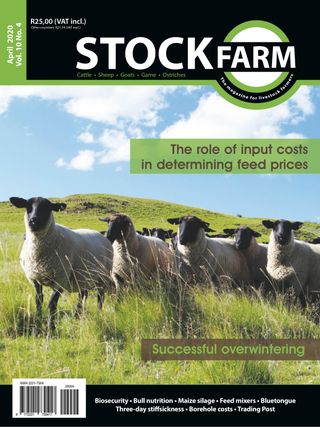

هذه القصة من طبعة April 2020 من Stockfarm.
اشترك في Magzter GOLD للوصول إلى آلاف القصص المتميزة المنسقة، وأكثر من 9000 مجلة وصحيفة.
هل أنت مشترك بالفعل؟ تسجيل الدخول
المزيد من القصص من Stockfarm
Stockfarm
Tackle mastitis in dairy COWS
Mastitis is one of the most significant challenges in the dairy industry, reducing milk yield and overall profitability.

5 mins
February 2026
Stockfarm
Ewe nutrition for a healthy lamb crop
Producers widely acknowledge that the success of any sheep enterprise depends heavily on the potential and management of the farm’s female animals.
4 mins
February 2026
Stockfarm
Does chop length really matter?
Chop length is a critical factor in producing successful silage. Mistakes made during this initial stage can have lasting, irreparable effects.
2 mins
February 2026
Stockfarm
Place these ticks on your autumn watch list
Heavy tick infestations and an increase in the incidence of tickborne diseases such as redwater, gallsickness, and heartwater remain a serious challenge for livestock producers in South Africa, particularly when environmental conditions favour these parasites. Effective control strategies and sound management practices are therefore essential.
2 mins
February 2026
Stockfarm
The grazing paradox: Towards better data
Producers are often under pressure to reassess their grazing strategies and consider dramatic management changes aimed at sustainability.
5 mins
February 2026

Stockfarm
Shearer training for improved performance
Lungani Maqakalana has sheep shearing in his blood. Both his father and uncle were shearers, and from a young age he aspired to follow in their footsteps.
4 mins
February 2026
Stockfarm
Misuse of an employer's property
An employer's property is an integral part of the business infrastructure. Any loss, damage, accidental misuse, intentional misuse, or waste of this property constitutes serious misconduct, placing unnecessary strain on the employer to repair or replace it.
2 mins
February 2026
Stockfarm
The dynamics of the South African lucerne hay industry: Grading and quality
In the January issue of Stockfarm, part one of this series explored the role of lucerne hay in South Africa's animal feed industry.
5 mins
February 2026
Stockfarm
Functional efficiency in small stock
Functional efficiency, the combination of structural soundness, adaptability, mobility, mothering ability, and reproductive capability, is as important as genetic merit for economically important, measurable traits.
3 mins
February 2026
Stockfarm
Managing breeding stock and unsold weaner calves
Persistent outbreaks of foot-and-mouth disease (FMD) have dealt a severe blow to the South African cattle industry.
1 mins
February 2026
Translate
Change font size