
استمتع بـUnlimited مع Magzter GOLD
احصل على وصول غير محدود إلى أكثر من 9000 مجلة وصحيفة وقصة مميزة مقابل
يحاول ذهب - حر
Good teaching is necessary for good research and vice-versa
March 2025
|DataQuest
Indian academic corridors are standing between two atriums. On the one hand, some struggle with concerns on integrity in academic research (Whether in publications or corporate projects). On the other hand, some are driving front-runner work in drug-discovery, cancer imaging, clinical research, road safety and environmental impact. Let’s find out where India is heading as we enter the Sophomore level in AI.
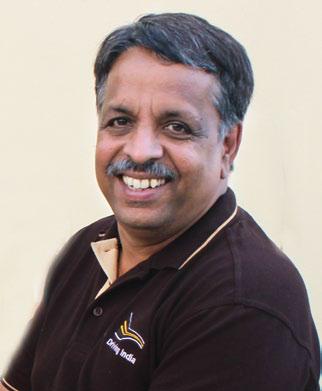
Can faculties also generate funds? Can PPP models work in academic institutions? Can labs and academicians contribute to big projects that affect healthcare, safety and industrial leaps? Prof P.J. Narayanan, Director of IIIT Hyderabad, breaks these questions down like a good researcher always does, and makes one think, like a good teacher always does.
Let’s talk about the elephant in the room first. What are your views on lack of integrity in academic research (with India coming under retraction spotlight for many papers, for citation manipulation, for low-quality work, peer-review gaming and plagiarism)?
It is very sad and unfortunate for India to get such notoriety with respect to academic honesty. We must establish models and incentives that promote honest work and just rewards. The regulatory mechanism insists on doctoral degrees for all faculty in all kinds of institutions. Good IIITH has developed the largest synthetic dataset for AI applications in drug design. Other data projects that we have been part of have shown to reduce road accidents and mortality by 40-50%.
Understanding and teaching abilities must suffice to do well in teaching institutions that form the bulk of our higher education institutions. Everyone wants a PhD despite own aspirations or guidance available. It is unfortunate some/several individuals try to take short cuts along the process. We must rethink the fundamental model here.
Any other factors that should be looked into?
Of late, institutions and individuals are ranked incessantly for multiple objectives. This also creates the pressure to do well on the metrics and the weak get forced into unethical means to boost ranking, including bogus publications and self-citation chains. The system should address this as a whole.

هذه القصة من طبعة March 2025 من DataQuest.
اشترك في Magzter GOLD للوصول إلى آلاف القصص المتميزة المنسقة، وأكثر من 9000 مجلة وصحيفة.
هل أنت مشترك بالفعل؟ تسجيل الدخول
المزيد من القصص من DataQuest

DataQuest
Polyglot Persistence- Not just an exotic idea anymore
SQL will continue to serve as the lingua franca but the world of data will speak in graphs, vectors, LLMs too- and relational databases will stay but not in the same chair. Here's why?

5 mins
January 2026

DataQuest
Bright frogs, Monarch butterflies, Black-yellow bees and industrial automation- same thing?
As counter-intuitive as it may sound- Is automation a stupid loud colour to wear that attracts predators because of bigger attack surfaces or is it strangely-aposematic enough to tell the bad actors - stay away? Specially when security is baked in and bold- and ready for any camouflage? And what happens when Quantum and third-party supply chains make their way into industrial forests? We may not have all the answers but how about a purple-team approach to begin with.
3 mins
January 2026

DataQuest
How Nagarro bridges the gap between AI ambition and enterprise reality
Nagarro's Viyom Jain explains how ambition meets reality in enterprise AI, and why trust, culture, and human context matter as much as algorithms.
5 mins
January 2026

DataQuest
Food fraud, shortage and wastage – on the chopping block
Can, and how would, technology (like Blockchain, IoT, AI) help in bringing us food that is transparent, clean-labelled, free of stuff we don't really want and made as per one's own palate? Darshan Krishnamurthy, Co-founder & CTO, Khetika shows us the ingredient-section in detail.
4 mins
January 2026

DataQuest
AI is not Valyrian. It's the new English.
While it may still be too early for people to say 'Avy jorrāelan' to a technology that is affecting their jobs in more ways than one, it is better if we face our fears with clarity, caution and confidence. How does that advice play out in a function that, itself, decides who works and where?
6 mins
January 2026

DataQuest
Lou Gerstner, architect of IBM's turnaround, dies at 83
Arvind Krishna, IBM's CEO, confirmed in an official message to employees that Lou Gerstner, IBM's Chairman and CEO from 1993 to 2002, has died. He was 83.
3 mins
January 2026

DataQuest
India's third tech wave: Tech predictions 2026 through an impact lens
Post-Y2K scale and the 2010s cloud era reshaped Indian tech. In 2026, ΑΙ becomes the third wave, separating hype from outcomes, pivots, and trust.
4 mins
January 2026

DataQuest
Top Tech Predictions 2026: The Lighthouse View
Spoiler-alert first- there is nothing new or plot-changing that is visible on the 2026 horizon. But a lot of new and big ships would be building pace on the waves that were built last year. And, perhaps, in new directions.
9 mins
January 2026

DataQuest
Tata Communications' Andrew Winney on why SASE is now non-negotiable
Andrew Winney of Tata Communications explains why perimeter security is broken, how SASE enables Zero Trust at scale, and what CISOs must prioritise next.
6 mins
January 2026

DataQuest
Tiny AI: The new oxymoron in town? Not really!
So far everything about AI has been BIG! Huge hype, gigantic investments, massive bets and colossal infrastructures. Despite all that, there is talk about Tiny AI. Or shall we say, because of all that.
7 mins
January 2026
Listen
Translate
Change font size