يحاول ذهب - حر
How IT became the third T and other stories
March 2025
|DataQuest
Teaching. Setting up institutes. Research. Writing. Authoring books. Consulting. Developing IT. Prof. S Sadagopan, Founding Director of IIIT Bangalore has had a rich, varied and meaningful life. Here he takes a trip down tech memory lane...
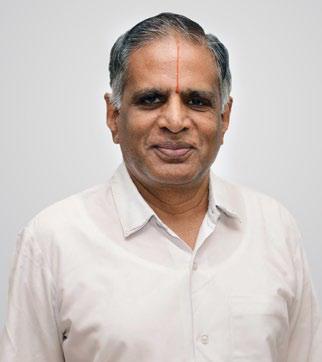
You studied at Purdue University in the 1970s and were associated with various prestigious institutions in the 1980s and 1990s. Can you speak a bit about that and your early days in your career?
Purdue University not only created the first Undergraduate Program in Computer Science but also ran a solid academic infrastructure PUCC Purdue University not only created the first Undergraduate Program in Computer Science but also ran a solid academic infrastructure PUCC (Purdue University Computer Center) that helped dozens of departments. I was very much influenced by it; I also contributed (thanks to my supervisor) towards the establishment of a campus-wide Optimization Library where I saw first-hand researchers from Engineering, Science, Agriculture and Pharmacy departments using large-scale optimization
I taught for 16 years at IIT Kanpur and 4 years at IIMB before joining IIITB in 1999. In the 1980s computing grew phenomenally—mini-computers and interactive computing at enterprise level and PCs at individual level—and got democratised (earlier it was available only to “rich” guys). The window of opportunity started for India in the 1980s.
I was a lucky academic to get associated with the key players—TCS, Wipro, HCL, Infosys, TVS Electronics, CMC—yes, there were both hardware & software players (though the country has forgotten the hardware players!).
I was also active with Dataquest, Computers Today & Computer Education for You!
Also, the seeds for large-scale computer applications—Railway Reservation System IMPRESS, Income Tax Computerization, LIC, Indian Airlines, SBI Automation—were sown. They were truly pioneers.
Academic Computing at IIT Kanpur, IIM Ahmedabad, TIFR, NCST was also maturing in the 1980s; computing was the academic infrastructure for exciting work in transportation, water resources, CAD/CAM, early Robotics, computational chemistry at IIT Kanpur.
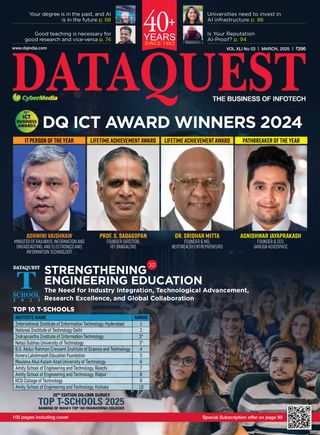

هذه القصة من طبعة March 2025 من DataQuest.
اشترك في Magzter GOLD للوصول إلى آلاف القصص المتميزة المنسقة، وأكثر من 9000 مجلة وصحيفة.
هل أنت مشترك بالفعل؟ تسجيل الدخول
المزيد من القصص من DataQuest

DataQuest
Polyglot Persistence- Not just an exotic idea anymore
SQL will continue to serve as the lingua franca but the world of data will speak in graphs, vectors, LLMs too- and relational databases will stay but not in the same chair. Here's why?

5 mins
January 2026

DataQuest
Bright frogs, Monarch butterflies, Black-yellow bees and industrial automation- same thing?
As counter-intuitive as it may sound- Is automation a stupid loud colour to wear that attracts predators because of bigger attack surfaces or is it strangely-aposematic enough to tell the bad actors - stay away? Specially when security is baked in and bold- and ready for any camouflage? And what happens when Quantum and third-party supply chains make their way into industrial forests? We may not have all the answers but how about a purple-team approach to begin with.
3 mins
January 2026
DataQuest
How Nagarro bridges the gap between AI ambition and enterprise reality
Nagarro's Viyom Jain explains how ambition meets reality in enterprise AI, and why trust, culture, and human context matter as much as algorithms.
5 mins
January 2026
DataQuest
Food fraud, shortage and wastage – on the chopping block
Can, and how would, technology (like Blockchain, IoT, AI) help in bringing us food that is transparent, clean-labelled, free of stuff we don't really want and made as per one's own palate? Darshan Krishnamurthy, Co-founder & CTO, Khetika shows us the ingredient-section in detail.
4 mins
January 2026
DataQuest
AI is not Valyrian. It's the new English.
While it may still be too early for people to say 'Avy jorrāelan' to a technology that is affecting their jobs in more ways than one, it is better if we face our fears with clarity, caution and confidence. How does that advice play out in a function that, itself, decides who works and where?
6 mins
January 2026

DataQuest
Lou Gerstner, architect of IBM's turnaround, dies at 83
Arvind Krishna, IBM's CEO, confirmed in an official message to employees that Lou Gerstner, IBM's Chairman and CEO from 1993 to 2002, has died. He was 83.
3 mins
January 2026
DataQuest
India's third tech wave: Tech predictions 2026 through an impact lens
Post-Y2K scale and the 2010s cloud era reshaped Indian tech. In 2026, ΑΙ becomes the third wave, separating hype from outcomes, pivots, and trust.
4 mins
January 2026

DataQuest
Top Tech Predictions 2026: The Lighthouse View
Spoiler-alert first- there is nothing new or plot-changing that is visible on the 2026 horizon. But a lot of new and big ships would be building pace on the waves that were built last year. And, perhaps, in new directions.
9 mins
January 2026

DataQuest
Tata Communications' Andrew Winney on why SASE is now non-negotiable
Andrew Winney of Tata Communications explains why perimeter security is broken, how SASE enables Zero Trust at scale, and what CISOs must prioritise next.
6 mins
January 2026

DataQuest
Tiny AI: The new oxymoron in town? Not really!
So far everything about AI has been BIG! Huge hype, gigantic investments, massive bets and colossal infrastructures. Despite all that, there is talk about Tiny AI. Or shall we say, because of all that.
7 mins
January 2026
Listen
Translate
Change font size