
استمتع بـUnlimited مع Magzter GOLD
احصل على وصول غير محدود إلى أكثر من 9000 مجلة وصحيفة وقصة مميزة مقابل
ARIZONA'S METEOR CRATER
September 2023
|Rock&Gem Magazine
Some 50,000 years ago, an asteroid sped through space at 30,000 miles per hour, headed straight for planet Earth.

Measuring about 150 feet in diameter and weighing 300,000 tons, it entered the Earth’s atmosphere at an altitude of 60 miles where the intense heat of atmospheric friction and compression caused it to glow. As its surface heated to 5000°F. (twice the melting point of iron), it began to melt, vaporize and fragment. Seconds later the remnants of the asteroid, preceded by a monumental atmospheric shock wave, slammed into Earth.
THE CRATER
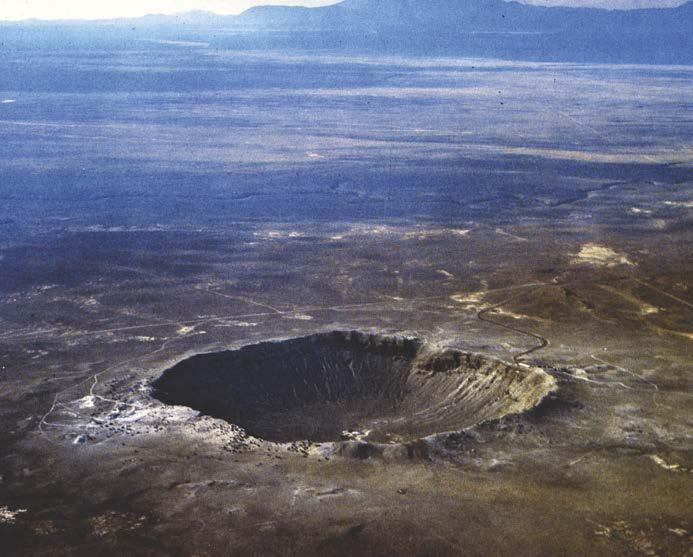
At the time, no humans were around to witness the impact. But today a quarter-million people each year visit the Arizona Meteor Crater, which is located in northern Arizona 35 miles east of Flagstaff and just south of the “Meteor Crater” exit on Interstate 40.
Seen from a distance, the crater rim appears as a barely noticeable low ridge. But from atop the rim, the view into and across the crater dramatically conveys the cataclysmic nature of the event that created it—a meteoric impact that released the energy of a 20-megaton hydrogen bomb.
This impact instantaneously ejected some 175 million tons of limestone and sandstone, leaving a crater three-quarters of a mile in diameter, a rim rising 200 feet above the surrounding plain, and a crater floor extending 700 feet below the plain. Erosion has since reduced the rim’s height by about 60 feet, while sedimentation has filled in 100 feet of the crater floor.
A WOULD-BE IRON MINE

هذه القصة من طبعة September 2023 من Rock&Gem Magazine.
اشترك في Magzter GOLD للوصول إلى آلاف القصص المتميزة المنسقة، وأكثر من 9000 مجلة وصحيفة.
هل أنت مشترك بالفعل؟ تسجيل الدخول
المزيد من القصص من Rock&Gem Magazine
Rock&Gem Magazine
A New Amber Locality Fills a Gap
A sandstone quarry in central Ecuador has yielded the first significant deposit of Mesozoic amber from South America.

1 min
January / February 2026
Rock&Gem Magazine
Did "Left-Handed" Fish Leave Water Earlier than Thought?
Fossil evidence suggests that fish (or \"fishapods\") dragged themselves onto land during the middle Devonian Period.
1 min
January / February 2026

Rock&Gem Magazine
"Lab Quakes” Produce Surprising Results
When faults let loose and earthquakes result, the main effect we mortals experience is the violent shaking.
1 min
January / February 2026
Rock&Gem Magazine
This Egg is No Spring Chicken
How to date a dino egg
1 min
January / February 2026
Rock&Gem Magazine
Have we Already Mined the Critical Minerals We Need
Then why are we throwing them away?!
1 min
January / February 2026
Rock&Gem Magazine
One Toxic Worm
A critter that creates & tolerates orpiment!
1 min
January / February 2026
Rock&Gem Magazine
ROCK & GEM FIELD GUIDE: Silver
Silver (Ag) is a native element and one of Earth's most prized precious metals.
2 mins
January / February 2026
Rock&Gem Magazine
DINOSAURS OF THE HELL CREEK MUSEUM
In the Badlands of South Dakota, just outside the small town of Belle Fourche—pronounced “Bell Foosh”—a new attraction has taken shape that every dinosaur enthusiast should see. The Dinosaurs of the Hell Creek Museum is part hands-on exhibit, part science center and part active research lab.
3 mins
January / February 2026
Rock&Gem Magazine
The Lost Twins of Kongsberg
A Silver Story Resurfaced
3 mins
January / February 2026
Rock&Gem Magazine
Switzerland's ICE PALACE
Walk Inside a Glacier at The Top of Europe
7 mins
January / February 2026
Translate
Change font size