يحاول ذهب - حر
Aristotle's Guide To Living Well
August/September 2022
|Philosophy Now
Lawrence Evans contemplates Aristotle's argument that happiness is the ultimate goal of human life, and that it can best be found in philosophical contemplation.
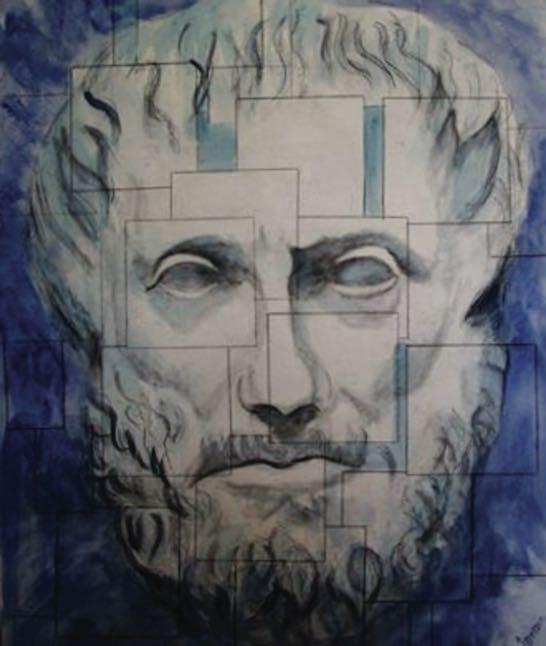
Aristotle's most famous work on ethics is the Nicomachean Ethics, which aims to describe the ultimate end and good for human beings.
One of the most puzzling features of this classic is that Aristotle seems to waver between two views. These are firstly that happiness involves the activity of the moral as well as the intellectual virtues (this is sometimes called 'inclusivism' by Aristotle scholars) and secondly that happiness consists in nothing but the intellectual activity of contemplation (sometimes called 'exclusivism'). In this article I will explore what he says about happiness, and ultimately conclude that for Aristotle perfect happiness indeed consists in philosophical contemplation.
Ultimate Happiness
At the beginning of the Nicomachean Ethics Aristotle first aims to show that there is an ultimate end (that is, goal) of life. This end, he says, is the chief good which is desirable for its own sake, and this is what we ultimately seek and desire in all our actions. Aristotle then says that everyone agrees that this highest good is happiness (Greek eudaimonia, literally meaning 'good spirits'), and that living and doing well are the same as being happy. Yet as a definition this alone is rather primitive, as it does not really tell us what happiness is.
Aristotle discusses three different lifestyles all traditionally thought to be happy: the life of pleasure, the political life, and the virtuous life. He rejects the identification of happiness with the life of pleasure because such a life is 'slavish' and 'suitable [only] for cattle'. Neither can happiness be equated with honour - usually considered the goal of political life - because that depends more on those who honour than on the one honoured.

هذه القصة من طبعة August/September 2022 من Philosophy Now.
اشترك في Magzter GOLD للوصول إلى آلاف القصص المتميزة المنسقة، وأكثر من 9000 مجلة وصحيفة.
هل أنت مشترك بالفعل؟ تسجيل الدخول
المزيد من القصص من Philosophy Now

Philosophy Now
Bilbo Theorizes About Wellbeing
Eric Comerford overhears Bilbo and Gandalf discussing happiness.

9 mins
December 2025 / January 2026

Philosophy Now
What Women?
Marcia Yudkin remembers almost choking at Cornell
11 mins
December 2025 / January 2026
Philosophy Now
Islamic Philosophers On Tyranny
Amir Ali Maleki looks at tyranny from an Islamic perspective.
4 mins
December 2025 / January 2026

Philosophy Now
Peter Singer
The controversial Australian philosopher defends the right to choose to die on utilitarian grounds
5 mins
December 2025 / January 2026

Philosophy Now
Another Conversation with Martin Heidegger?
Raymond Tallis talks about communication problems.
7 mins
December 2025 / January 2026

Philosophy Now
Letters
When inspiration strikes, don't bottle it up. Email me at rick.lewis@philosophynow.org Keep them short and keep them coming!
17 mins
December 2025 / January 2026
Philosophy Now
The Philosophy of William Blake
Mark Vernon looks at the imaginative thinking of an imaginative artist.
9 mins
December 2025 / January 2026

Philosophy Now
Philosophical Haiku
Peering through life’s lens God in nature is deduced: The joy of being.
1 mins
December 2025 / January 2026

Philosophy Now
Philosophy Shorts
More songs about Buildings and Food' was the title of a 1978 album by the rock band Talking Heads. It was about all the things rock stars normally don't sing about. Pop songs are usually about variations on the theme of love; tracks like Rose Royce's 1976 hit 'Car Wash' are the exception. Philosophers, likewise, tend to have a narrow focus on epistemology, metaphysics and trifles like the meaning of life. But occasionally great minds stray from their turf and write about other matters, for example buildings (Martin Heidegger), food (Hobbes), tomato juice (Robert Nozick), and the weather (Lucretius and Aristotle). This series of Shorts is about these unfamiliar themes; about the things philosophers also write about.
2 mins
December 2025 / January 2026

Philosophy Now
Hedonic Treadmills in the Vale of Tears
Michael Gracey looks at how philosophers have pursued happiness.
8 mins
December 2025 / January 2026
Translate
Change font size