
استمتع بـUnlimited مع Magzter GOLD
احصل على وصول غير محدود إلى أكثر من 9000 مجلة وصحيفة وقصة مميزة مقابل
يحاول ذهب - حر
"Non-free programs are a threat to everyone's freedom"
February 2023
|Open Source For You
Richard Matthew Stallman (aka RMS) can be best described as a genius or a maverick. He graduated from Harvard in physics while working at the Artificial Intelligence Lab in Massachusetts Institute of Technology. In 1984, he started developing the GNU operating system; then in 1985 he founded the Free Software Foundation and invented the concept of copyleft—a legal mechanism to protect the modification and redistribution rights of free software. How have things progressed? How happy is he with the current state of affairs? Given the increased awareness and use of free software, we had (wrongly) assumed that he would be happy with the progress. He not only reiterated the weakness in defence of freedom but also outlined the threat humanity faces when “progress” (in the purely practical sense) is promoted at the neglect of freedom. Let’s see what he has to say.
-

Q. For the benefit of our readers, who are new to the concept, what exactly is ‘free’ software?
A. It’s best described by the phrase, “Free as in Freedom, and not Free as in Free Beer.” So, when I talk about free software (aka Swatantra software), I am not referring to the cost of the software but to the level of freedom it provides to the user.
Q. How satisfied are you with the progress in the free software world?
A. We are moving towards horrible tyranny. People are being pressurised to use devices having non-free software for their day-to-day activities. And non-free software is malware. We have listed over 500 examples on gnu.org/ malware. If a company has control over the software you are using, then it is almost sure to use that control to mistreat you. However, it is possible to refuse, as I do that myself.
I refuse to have a portable phone as every portable phone is a tracking device, which can be modified into a listening device. These so-called smartphones—I call them ‘snoop’ phones—invite you to talk to various online services or ‘disservices.’ But in the process, they snoop on you terribly; they can manipulate and pressurise you. It’s not an acceptable kind of technology.
Q. How do you define malware?A. Mal
ware is software designed to mistreat, harm, or annoy the user. Users might be expected to stop this abuse if they could control what the software does.
Q. Do you consider marketing messages as malware?
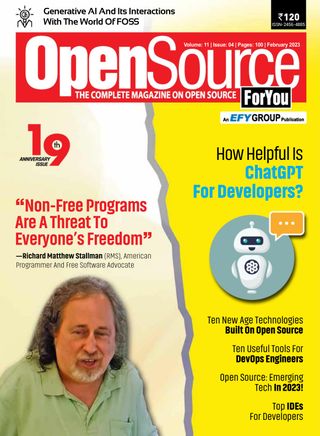

هذه القصة من طبعة February 2023 من Open Source For You.
اشترك في Magzter GOLD للوصول إلى آلاف القصص المتميزة المنسقة، وأكثر من 9000 مجلة وصحيفة.
هل أنت مشترك بالفعل؟ تسجيل الدخول
المزيد من القصص من Open Source For You

Open Source For You
Top 10 Open Source Tools for System and IT Administrators
All reputed online services have committed system and IT administrators working behind the scenes. Here are ten open source tools they should be aware of, as these can help them monitor, automate, as well as manage complex infrastructure with relative ease.

6 mins
February 2026
Open Source For You
Google opens access to its Gemini Deep Research Agent
Google has opened access to its Gemini Deep Research Agent for the first time, allowing developers to integrate advanced autonomous research capabilities directly into their applications.
1 min
February 2026

Open Source For You
NVIDIA buys SchedMD, keeps Slurm open source and vendor neutral
NVIDIA has acquired AI software company SchedMD, signalling a deeper commitment to open source technologies as competition intensifies across the artificial intelligence ecosystem.
1 min
February 2026

Open Source For You
How Open Source Tools Power Modern IT Operations
Open source tools have not replaced enterprise IT platforms; they have become the connective layer that makes modern operations possible.
6 mins
February 2026
Open Source For You
Mandiant's Auralnspector enhances Salesforce security
Google-owned cybersecurity firm Mandiant has released AuraInspector, a free, open source command-line tool designed to identify dangerous access control misconfigurations in Salesforce environments, marking a significant move to democratise enterprise-grade security testing.
1 min
February 2026
Open Source For You
Google launches Universal Commerce Protocol to power agentic AI commerce
Google has introduced the Universal Commerce Protocol (UCP), a new open standard that enables AI agents to autonomously perform end-to-end commerce activities, spanning product discovery, purchasing, checkout, payments, and postpurchase experiences.
1 min
February 2026

Open Source For You
Zero Trust CI/CD: The Death of Static Secrets
In an era where data breach costs continue to hit record highs, shifting to a secretless CI/CD pipeline is the most effective step to safeguard digital infrastructure.
7 mins
February 2026

Open Source For You
Quantum Algorithms: The Future of Computing
Explore the essence of quantum algorithms, their groundbreaking applications, recent innovations, and the challenges that remain.
8 mins
February 2026

Open Source For You
Bringing Clarity to the Chaos in AI
AI feels powerful, yet most teams struggle because they cannot define what intelligence they really need. But there are ways to address this challenge.
5 mins
February 2026

Open Source For You
Top researchers return to OpenAI
OpenAI has welcomed back three high-profile researchers, Barret Zoph, Luke Metz, and Sam Schoenholz, following their brief tenure at former OpenAI CTO Mira Murati's AI startup, Thinking Machines.
1 min
February 2026
Translate
Change font size