
Mit Magzter GOLD unbegrenztes Potenzial nutzen
Erhalten Sie unbegrenzten Zugriff auf über 9.000 Zeitschriften, Zeitungen und Premium-Artikel für nur
Versuchen GOLD - Frei
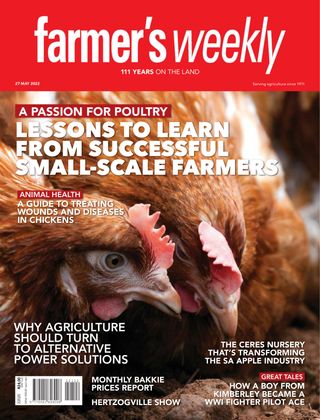
First-aid basics for small-scale poultry farmers
Farmer's Weekly
|May 27 2022
Commercial poultry producers have their own vets on call, but it's not always easy for small-scale farmers to reach a vet in an emergency. In the final segment in our series on livestock first aid, Prof Cheryl McCrindle looks at fundamental healthcare for chickens.

The term 'small-scale poultry farmer' covers micro-, small- and medium-sized broiler and egg production units. The South African Poultry Association classifies a small-scale broiler unit as one that delivers fewer than 4 000 birds per cycle. In contrast, small-scale egg production, according to South African agriculturalist Dr Gavin MacGregor, can start with nine point-of-lay pullets. Many semi-intensive free-range poultry operations are also classified as small-scale.
If your enterprise falls into one of these categories, you're more likely to be working with your local state veterinarian or animal health technician than a private practitioner. Veterinarians have an in-depth understanding of the chemistry, usage, dosage and withdrawal times of scheduled medications. It's therefore advisable to include them in the planning of a first-aid kit for your animals.
FAST FACTS
Management plays an essential role in the prevention of diseases in chickens.
The withdrawal time for antibiotics is longer in eggs than it is in poultry meat.
The most common injuries in chickens are caused by bird-on-bird pecking.
PLANNING
The nature of your enterprise and the likelihood of specific diseases occurring will dictate what you include in your first-aid kit. For example, the withdrawal time for certain antibiotics is far longer for eggs than it is for poultry meat, and discarding eggs intended for human consumption is not financially viable. Conversely, a few decorative roosters, hens, and chicks around a farmyard restaurant are likely to be around until they die of old age, so they can be given as many antibiotics as they require!

Diese Geschichte stammt aus der May 27 2022-Ausgabe von Farmer's Weekly.
Abonnieren Sie Magzter GOLD, um auf Tausende kuratierter Premium-Geschichten und über 9.000 Zeitschriften und Zeitungen zuzugreifen.
Sie sind bereits Abonnent? Anmelden
WEITERE GESCHICHTEN VON Farmer's Weekly

Farmer's Weekly
Tropical avo smoothie
Escape to the tropics with this luxurious, creamy, and vibrant smoothie! Blending rich avocado and sweet mango with zesty lime, fragrant mint, and a punch of tangy granadilla, this recipe transforms into a nutrient-packed and silky-smooth treat.

1 min
January 16-23, 2026
Farmer's Weekly
THE HITCHING POST
I am a 60-year-old white woman who loves camping, animals, the outdoors and watching sport.
2 mins
January 16-23, 2026

Farmer's Weekly
The enduring legacy of Tiyo Soga
In the 1850s, Tiyo Soga, a Xhosa man, became the first ordained black South African minister. But as Mike Burgess writes, his legacy would also be determined by his all-round intellectual abilities honed by a solid Scottish education.
4 mins
January 16-23, 2026

Farmer's Weekly
Isuzu D-Max shows single cabs can be comfortable companions
Bakkie manufacturers don't give single cabs to the media due to them generally being regarded as workhorses without the bells and whistles from fancier double cabs. The Citizen's Charl Bosch was gobsmacked when a single cab arrived for a three-month stay.
2 mins
January 16-23, 2026
Farmer's Weekly
South Africa eyes home-grown rice as ARC expands research efforts
South Africa is taking bold steps toward reducing its dependence on rice imports by exploring the viability of home-grown upland rice. Through a major research drive led by the Agricultural Research Council's Small Grain division, scientists and industry partners are testing rice varieties capable of thriving in South Africa's diverse soils and increasingly water-scarce climate. Anelisa Gusha reports.
3 mins
January 16-23, 2026

Farmer's Weekly
Spanish tortilla
Bring the authentic flavours of Spain to your table with this robust and satisfying Spanish tortilla.
1 min
January 16-23, 2026

Farmer's Weekly
New year brings marvellous new titles
Patricia McCracken, like many of us, has settled back into the grind of the new year and picked up a diverse selection of books ranging from travel, to fiction, to non-fiction and a delightful local children's adventure.
2 mins
January 16-23, 2026
Farmer's Weekly
Nitrogen 'switch' unlocks greener crops
A ground-breaking discovery by molecular biology professors Kasper Røjkjær Andersen and Simona Radutoiu at Aarhus University in Denmark offers a significant step toward developing self-fertilising grain crops, potentially revolutionising agriculture to be greener and more climate-friendly.
1 min
January 16-23, 2026

Farmer's Weekly
Sweet prospects: the current state of litchi production in South Africa
Bram Snijder, agricultural consultant and chairperson of the South African Litchi Growers' Association, spoke to Octavia Avesca Spandiel about the litchi industry embracing new opportunities, tackling challenges, implementing innovation, and reaching markets both locally and internationally.
6 mins
January 16-23, 2026

Farmer's Weekly
How AFGRI uses technology to unlock farm finance from asset to market
As modern farming becomes more capital-intensive and digitally driven, AFGRI is reinventing agricultural finance by linking technology directly to lending decisions.
5 mins
January 16-23, 2026
Translate
Change font size