
Mit Magzter GOLD unbegrenztes Potenzial nutzen
Erhalten Sie unbegrenzten Zugriff auf über 9.000 Zeitschriften, Zeitungen und Premium-Artikel für nur
Versuchen GOLD - Frei
Zeolite Mineral Group
Rock&Gem Magazine
|April 2020
MOLECULAR STRUCTURE AND MATCHING PHYSICAL ATTRIBUTES DEFINE AND UNIFY

Scientists have identified about 5,000 different mineral species. With so many minerals, it’s not surprising for several to have closely matching physical and chemical similarities. Scientists have established a grouping system for species with closely matching properties to provide for ease of study. Some groups only have three species, the minimum required. Other groups like the mica and autunite groups have more than 40 members.
The zeolite group is unusual, as it is considered to be two separate groups. Zeolites in the main group have all the required properties to be in that group. Other zeolites have the same properties, save for one or two that are different enough to be treated separately. Combined, the two groups include more than 75 members. Zeolites form when hot volcanic rocks react with groundwaters. The more prolific sources of zeolite minerals are in areas of vast volcanism. They also occur in ore veins and sedimentary rocks.
There is also some confusion about zeolite minerals. Collectors often assume any mineral found in a zeolite environment is a zeolite, but it’s not so. Such beauties as cavansite and apophyllite are two species mistakenly thought to be zeolites. Because of this, the second group of non-zeolites is often treated with the zeolites. To help distinguish between them, we’ll offer two companion articles, “Zeolites” and “Non-Zeolite” in future issues of Rock & Gem.
In a brief article like this, it would be a physical impossibility to describe every one of the 75 or so known zeolites. Some are rare and seldom seen. Others are known only to the micro-mounter using special equipment. In this article, we’ll treat zeolites most often seen at shows and are enjoyed by the average collector.
DEFINING ASPECTS OF ZEOLITES
The first obvious question is, “What’s a zeolite?” The name comes from
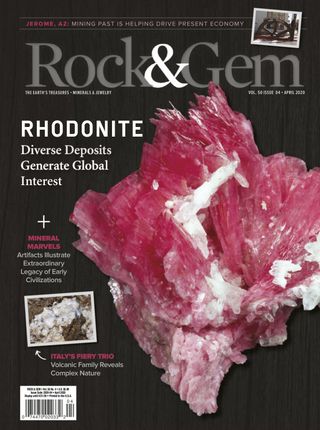

Diese Geschichte stammt aus der April 2020-Ausgabe von Rock&Gem Magazine.
Abonnieren Sie Magzter GOLD, um auf Tausende kuratierter Premium-Geschichten und über 9.000 Zeitschriften und Zeitungen zuzugreifen.
Sie sind bereits Abonnent? Anmelden
WEITERE GESCHICHTEN VON Rock&Gem Magazine

Rock&Gem Magazine
THIS SUMMER, PICK STONY FLOWERS
Several rock and mineral formations look for all the world like flowers frozen in stone: chrysanthemum stones, flower agate, desert roses and poppy jasper.

6 mins
June 2026

Rock&Gem Magazine
An Ocean's Worth of Water in Earth's Deep Mantle
Water is key to life as we know it. When seeking life beyond our planet, Earth and planetary scientists always seek out planets and moons suspected to harbor liquid water either on the surface or beneath icy crusts.
1 min
June 2026

Rock&Gem Magazine
Hexagonal Diamonds?
Only available from the lab!
1 min
June 2026

Rock&Gem Magazine
While the World Drowns, Greenland Rises
With a mile-thick ice sheet covering 80% of its surface, Greenland accounts for a fifth of current sea level rise as that ice melts on an increasingly warm Earth.
1 min
June 2026
Rock&Gem Magazine
Argyle Diamonds
When the Argyle mine in Western Australia closed in 2020, it marked the end of one of the most remarkable chapters in modern mineral history.
2 mins
June 2026

Rock&Gem Magazine
CHANGING MINERAL MARKETS
As Rock & Gem celebrates its 55th anniversary—no small feat for a print magazine in the digital age—the hottest commodities on today’s mineral markets are lithium, the rare-earth elements and gold.
3 mins
June 2026

Rock&Gem Magazine
Grandpa's Agate Diggings
Finding Moss Agate on the Grande Ronde River
7 mins
June 2026

Rock&Gem Magazine
Does This Fossil Reveal a Whole New Kingdom of Life?
They would have looked strange in the so-called Rhynie chert landscape of the ancient Scottish Highlands 407 million years ago.
1 min
June 2026

Rock&Gem Magazine
From Maps to Satellites: Rockhounding's Tech Evolution
Rock and mineral collecting has come a long way, but the biggest changes have really occurred in just the past few decades.
5 mins
June 2026

Rock&Gem Magazine
BELLY of the DRAGON
A Rockhound's Guide
4 mins
June 2026
Translate
Change font size