Mit Magzter GOLD unbegrenztes Potenzial nutzen
Erhalten Sie unbegrenzten Zugriff auf über 9.000 Zeitschriften, Zeitungen und Premium-Artikel für nur
Versuchen GOLD - Frei
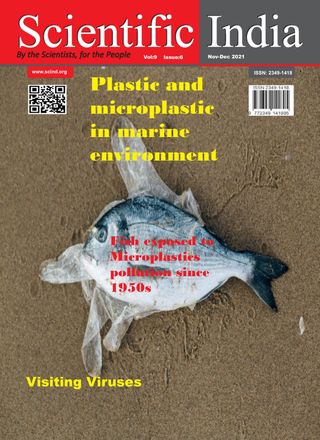
Plastic and microplastic in marine environment
Scientific India
|November - December 2021
Modern lifestyles and Malmost all product categories incorporated plastic. It is one of the most widely used materials on earth. In contrast to metals, plastic is lightweight, strong, malleable material that is cheap. As useful as these characteristics are when plastics are used in everyday life, they can also be very hazardous when they are discarded into the environment. Because plastics are nearly indestructible and contain toxic material, plastic can seriously damage the environment (UNEP, 2005).

Plastic is the most prevalent type of marine debris found in our ocean and Great Lakes. Plastic debris can come in all shapes and sizes, but those that are less than five millimeters in length (or about the size of a sesame seed) are called “microplastics.”
Microplastics come from a variety of sources, including from larger plastic debris that degrades into smaller and smaller pieces. In addition, microbeads, a type of microplastic, are very tiny pieces of manufactured polyethylene plastic that are added as exfoliants to health and beauty products, such as some cleansers and toothpastes.
How is plastic made, and what kinds are there?
Various synthetic organic compounds can be considered plastic, and these can be manufactured by polymerization and can consist of repeating units (monomers) that are joined together to form copolymers. Plastic is a synthetic organic polymer made from petroleum and serves an extremely wide variety of purposes, including packaging, building and constructions household items, sports equipment, vehicles electronics and agriculture. The amount of plastic produced every year is more than 300 million tons, half of which is used for small single-use items like shopping bags, cups and straws.

Diese Geschichte stammt aus der November - December 2021-Ausgabe von Scientific India.
Abonnieren Sie Magzter GOLD, um auf Tausende kuratierter Premium-Geschichten und über 9.000 Zeitschriften und Zeitungen zuzugreifen.
Sie sind bereits Abonnent? Anmelden
WEITERE GESCHICHTEN VON Scientific India

Scientific India
Astronomers discover dying stars eating their planets
Anew study from astronomers at UCL (University College London) and the University of Warwick suggests that aging stars may be destroying the giant planets orbiting closest to them.

1 mins
November-December 2025

Scientific India
The Gut-Brain Connection: How Our Second Brain May Hold the Key to Preventing Neurodegeneration
For decades, the prevailing narrative of neurodegenerative diseases like Alzheimer's and Parkinson's was centred around isolated confinement within the brain.
4 mins
November-December 2025

Scientific India
Active and Intelligent Bioplastic Packaging: Materials, Benefits, Applications, Challenges, and Future Prospects
Bioplastic-based active and intelligent packaging represents one of the most transformative innovations in modern food preservation.
2 mins
November-December 2025

Scientific India
Gut Microbes and Yoga: The Hidden Harmony for Healthy Aging and Well-Being
The human gut is home to trillions of microorganisms, including bacteria, viruses, fungi, and archaea. In fact, the number of microbial cells in your body might outnumber your human cells by about 10 to 1! About 70% of your immune system is located in your gut. Your gut microbes help train your immune system to differentiate between harmful invaders and harmless substances, thus playing a big role in preventing autoimmune diseases. Just like a rainforest, the gut microbiota is a diverse and complex ecosystem. A healthy gut has a balanced mix of different types of microbes, which can help prevent the overgrowth of harmful bacteria.
6 mins
November-December 2025

Scientific India
Market Trends and Future Prospects of Bioplastics in the Global Packaging Industry
Across retail shelves, e-commerce parcels, and ready-to-eat food containers, packaging is undergoing one of the most rapid material transitions of the 21st century.
5 mins
November-December 2025
Scientific India
From Waste to Harvest: The Power of Human Urine as an Eco-Friendly Fertilizer
As the global population continues to grow, so too does the demand for food.
4 mins
November-December 2025

Scientific India
Sugar-free sweeteners may still be harming your liver
Sweeteners such as aspartame, found in Equal packets, sucralose (Splenda), and sugar alcohols are widely promoted as healthier options than foods made with refined sugar (glucose).
2 mins
November-December 2025

Scientific India
Colon cancer is surging in younger adults and doctors are alarmed
Colorectal cancer has long been viewed as a condition that primarily affects older adults.
3 mins
November-December 2025

Scientific India
How Eating Your Vitamin C Builds Healthier Skin From Within
For decades, the skincare aisle has promised younger-looking skin from the outside in, with vitamin C serums occupying a prized place on the shelf.
1 mins
November-December 2025

Scientific India
A Simple Blood Test Could Transform Alzheimer's Diagnosis
For decades, diagnosing Alzheimer's disease has relied heavily on memory tests, clinical judgment, and a long wait for symptoms to become unmistakable. Now, a groundbreaking blood test being rolled out across the UK could dramatically change that narrative bringing earlier, more accurate diagnosis within reach of routine healthcare.
2 mins
November-December 2025
Translate
Change font size