
Mit Magzter GOLD unbegrenztes Potenzial nutzen
Erhalten Sie unbegrenzten Zugriff auf über 9.000 Zeitschriften, Zeitungen und Premium-Artikel für nur
Versuchen GOLD - Frei
WE BUILT CAPACITY BY COUPLING DIGITAL WITH PHYSICAL
DataQuest
|July 2023
According to Arvind Sivaramakrishnan, Chief Information Officer, Karkinos Healthcare: Medicine is art. Digital is science. When we couple all of this, we find that these are complementary skills. One is feeding the other. This is not either or. Edited excerpts from a video interview...

Did the healthcare industry upgrade itself during the pandemic?
Yes. But more than that I would say is that the realization of digital transformation took place. A lot of these solutions, particularly the biggest one that everybody spoke of, teleconsulting, existed for the last many years. There was always a high degree of scepticism on it. There was a feeling of how can healthcare be delivered without the touch and feel and physical presence? That's one aspect from the consumer side.
From the provider side, the maturity of providing it as real as the physical was lacking. There was a lack of sophistication on both sides. The pandemic forced a situation where we didn't have an option. There was that immediate race of getting it all perfected. Perfected also from a legal standpoint, thanks to the government.
Looking at the healthcare institutions and delivery sector, one realized that by coupling digital with physical, there was that ability for building capacity that did not exist in the physical world. The next aspect was the need to perfect operations so that physical and digital are one and the same. One is not less than the other. Take either one depending on the best fit for the presentation of the clinical condition.
Then comes in the sophistication of the bandwidth and the tools that are used. For example, when we are talking, we cannot have something blurred, break in voice or signal distortions. Because this is not a social encounter but a clinical encounter where a certain amount of looking and perceiving is equally important. Comes with it the tools and techniques that are used to record these encounters and thereby a better understanding and realization of electronic medical records.
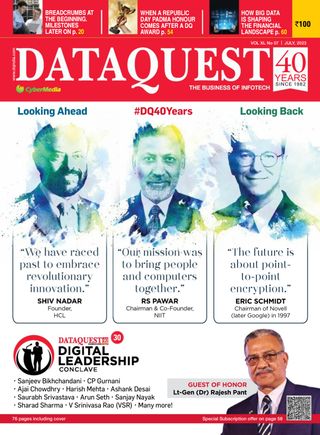

Diese Geschichte stammt aus der July 2023-Ausgabe von DataQuest.
Abonnieren Sie Magzter GOLD, um auf Tausende kuratierter Premium-Geschichten und über 9.000 Zeitschriften und Zeitungen zuzugreifen.
Sie sind bereits Abonnent? Anmelden
WEITERE GESCHICHTEN VON DataQuest

DataQuest
Polyglot Persistence- Not just an exotic idea anymore
SQL will continue to serve as the lingua franca but the world of data will speak in graphs, vectors, LLMs too- and relational databases will stay but not in the same chair. Here's why?

5 mins
January 2026

DataQuest
Bright frogs, Monarch butterflies, Black-yellow bees and industrial automation- same thing?
As counter-intuitive as it may sound- Is automation a stupid loud colour to wear that attracts predators because of bigger attack surfaces or is it strangely-aposematic enough to tell the bad actors - stay away? Specially when security is baked in and bold- and ready for any camouflage? And what happens when Quantum and third-party supply chains make their way into industrial forests? We may not have all the answers but how about a purple-team approach to begin with.
3 mins
January 2026

DataQuest
How Nagarro bridges the gap between AI ambition and enterprise reality
Nagarro's Viyom Jain explains how ambition meets reality in enterprise AI, and why trust, culture, and human context matter as much as algorithms.
5 mins
January 2026

DataQuest
Food fraud, shortage and wastage – on the chopping block
Can, and how would, technology (like Blockchain, IoT, AI) help in bringing us food that is transparent, clean-labelled, free of stuff we don't really want and made as per one's own palate? Darshan Krishnamurthy, Co-founder & CTO, Khetika shows us the ingredient-section in detail.
4 mins
January 2026

DataQuest
AI is not Valyrian. It's the new English.
While it may still be too early for people to say 'Avy jorrāelan' to a technology that is affecting their jobs in more ways than one, it is better if we face our fears with clarity, caution and confidence. How does that advice play out in a function that, itself, decides who works and where?
6 mins
January 2026

DataQuest
Lou Gerstner, architect of IBM's turnaround, dies at 83
Arvind Krishna, IBM's CEO, confirmed in an official message to employees that Lou Gerstner, IBM's Chairman and CEO from 1993 to 2002, has died. He was 83.
3 mins
January 2026
DataQuest
India's third tech wave: Tech predictions 2026 through an impact lens
Post-Y2K scale and the 2010s cloud era reshaped Indian tech. In 2026, ΑΙ becomes the third wave, separating hype from outcomes, pivots, and trust.
4 mins
January 2026

DataQuest
Top Tech Predictions 2026: The Lighthouse View
Spoiler-alert first- there is nothing new or plot-changing that is visible on the 2026 horizon. But a lot of new and big ships would be building pace on the waves that were built last year. And, perhaps, in new directions.
9 mins
January 2026

DataQuest
Tata Communications' Andrew Winney on why SASE is now non-negotiable
Andrew Winney of Tata Communications explains why perimeter security is broken, how SASE enables Zero Trust at scale, and what CISOs must prioritise next.
6 mins
January 2026

DataQuest
Tiny AI: The new oxymoron in town? Not really!
So far everything about AI has been BIG! Huge hype, gigantic investments, massive bets and colossal infrastructures. Despite all that, there is talk about Tiny AI. Or shall we say, because of all that.
7 mins
January 2026
Translate
Change font size