Versuchen GOLD - Frei
How to manage heat stress in cattle
Farmer's Weekly
|February 14, 2025
With rising global temperatures due to climate change, heat stress in livestock is a growing concern. Ranier van Heerden, Evonik’s business manager for ruminant solutions in sub-Saharan Africa, shared insights with Octavia Avesca Spandiel on early signs of heat stress in cattle, its physiological effects, and practical management strategies, offering valuable advice to help farmers mitigate this issue.
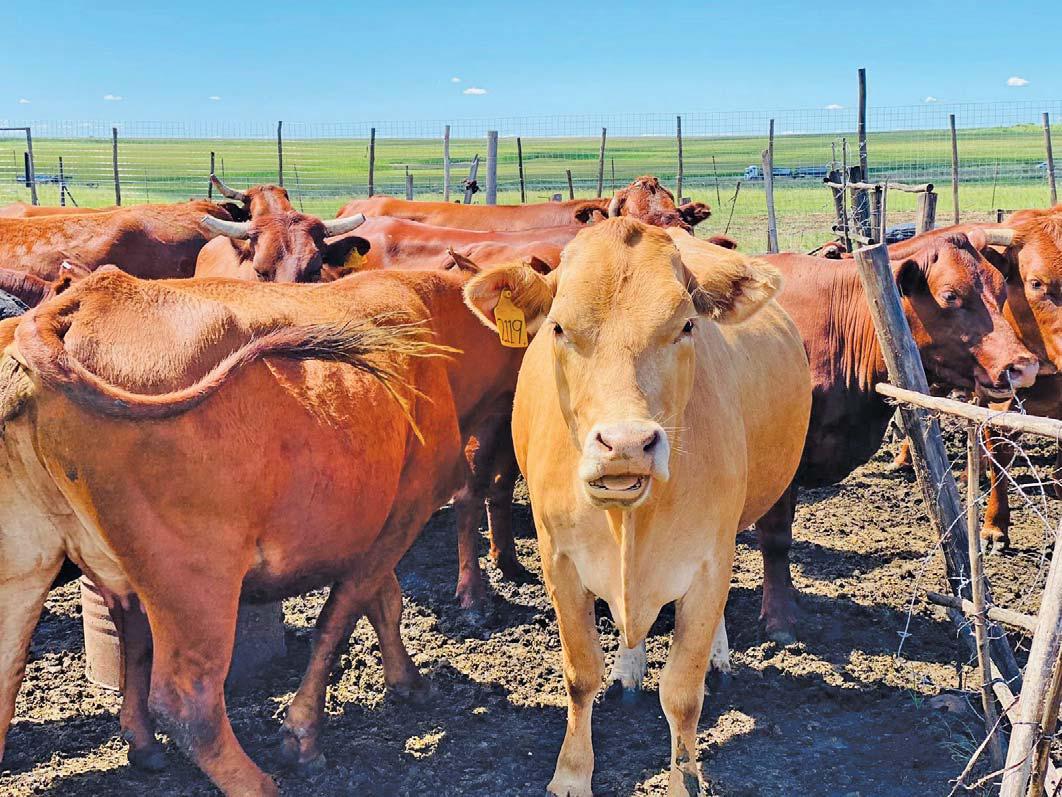
Heat stress in livestock poses a significant challenge for farmers, especially in regions with persistently high temperatures. As climate change exacerbates these conditions, it is becoming increasingly critical for farmers to recognise, manage and mitigate the impacts of heat stress to protect their livestock and maintain productivity.
EARLY SIGNS OF HEAT STRESS
Ranier van Heerden, business manager for ruminant solutions in sub-Saharan Africa at global chemicals company Evonik, says the early detection of heat stress in livestock is pivotal in mitigating its negative effects. Changes in behaviour are often the first indicators of heat stress.
"Animals will actively seek shade, pant excessively, and salivate more than usual.
In dairy cows, a drop in DMI [dry matter intake] and [subsequently] milk production could be a clear sign," he explains.
However, some of the subtler signs of heat stress can be difficult to detect. "Conditions like subacute ruminal acidosis in dairy cows, inflammation, insulin sensitivity and/or other metabolic disturbances often go unnoticed but can severely affect performance and reproduction. In addition, low conception rates and an increase in incidences of abortions are often observed," he adds.
Environmental factors also play a key role in how heat stress manifests in different regions.
Van Heerden says coastal areas with higher humidity levels pose different challenges when compared with inland areas.
"Humidity levels significantly impact how animals cope with heat stress, as high humidity reduces the body's ability to efficiently dissipate heat through evaporation," he explains.
IMPACT ON PRODUCTIVITY AND REPRODUCTION
The physiological effects of heat stress are far-reaching and directly influence productivity and reproduction.


Diese Geschichte stammt aus der February 14, 2025-Ausgabe von Farmer's Weekly.
Abonnieren Sie Magzter GOLD, um auf Tausende kuratierter Premium-Geschichten und über 9.000 Zeitschriften und Zeitungen zuzugreifen.
Sie sind bereits Abonnent? Anmelden
WEITERE GESCHICHTEN VON Farmer's Weekly

Farmer's Weekly
Tropical avo smoothie
Escape to the tropics with this luxurious, creamy, and vibrant smoothie! Blending rich avocado and sweet mango with zesty lime, fragrant mint, and a punch of tangy granadilla, this recipe transforms into a nutrient-packed and silky-smooth treat.

1 min
January 16-23, 2026
Farmer's Weekly
THE HITCHING POST
I am a 60-year-old white woman who loves camping, animals, the outdoors and watching sport.
2 mins
January 16-23, 2026

Farmer's Weekly
The enduring legacy of Tiyo Soga
In the 1850s, Tiyo Soga, a Xhosa man, became the first ordained black South African minister. But as Mike Burgess writes, his legacy would also be determined by his all-round intellectual abilities honed by a solid Scottish education.
4 mins
January 16-23, 2026

Farmer's Weekly
Isuzu D-Max shows single cabs can be comfortable companions
Bakkie manufacturers don't give single cabs to the media due to them generally being regarded as workhorses without the bells and whistles from fancier double cabs. The Citizen's Charl Bosch was gobsmacked when a single cab arrived for a three-month stay.
2 mins
January 16-23, 2026
Farmer's Weekly
South Africa eyes home-grown rice as ARC expands research efforts
South Africa is taking bold steps toward reducing its dependence on rice imports by exploring the viability of home-grown upland rice. Through a major research drive led by the Agricultural Research Council's Small Grain division, scientists and industry partners are testing rice varieties capable of thriving in South Africa's diverse soils and increasingly water-scarce climate. Anelisa Gusha reports.
3 mins
January 16-23, 2026

Farmer's Weekly
Spanish tortilla
Bring the authentic flavours of Spain to your table with this robust and satisfying Spanish tortilla.
1 min
January 16-23, 2026

Farmer's Weekly
New year brings marvellous new titles
Patricia McCracken, like many of us, has settled back into the grind of the new year and picked up a diverse selection of books ranging from travel, to fiction, to non-fiction and a delightful local children's adventure.
2 mins
January 16-23, 2026
Farmer's Weekly
Nitrogen 'switch' unlocks greener crops
A ground-breaking discovery by molecular biology professors Kasper Røjkjær Andersen and Simona Radutoiu at Aarhus University in Denmark offers a significant step toward developing self-fertilising grain crops, potentially revolutionising agriculture to be greener and more climate-friendly.
1 min
January 16-23, 2026

Farmer's Weekly
Sweet prospects: the current state of litchi production in South Africa
Bram Snijder, agricultural consultant and chairperson of the South African Litchi Growers' Association, spoke to Octavia Avesca Spandiel about the litchi industry embracing new opportunities, tackling challenges, implementing innovation, and reaching markets both locally and internationally.
6 mins
January 16-23, 2026

Farmer's Weekly
How AFGRI uses technology to unlock farm finance from asset to market
As modern farming becomes more capital-intensive and digitally driven, AFGRI is reinventing agricultural finance by linking technology directly to lending decisions.
5 mins
January 16-23, 2026
Listen
Translate
Change font size