Mit Magzter GOLD unbegrenztes Potenzial nutzen
Erhalten Sie unbegrenzten Zugriff auf über 9.000 Zeitschriften, Zeitungen und Premium-Artikel für nur
Versuchen GOLD - Frei
OPPENHEIMER, TRINITY SITE AND TRINITITE
Rock&Gem Magazine
|July 2024
The widely acclaimed, 2023 Hollywood biographical movie Oppenheimer recently won seven Academy Awards including Best Picture and Best Actor (Cillian Murphy).

This blockbuster focuses on American theoretical physicist J. Robert Oppenheimer's role in leading the effort during World War II to design, build and successfully test an atomic bomb.
The development of the bomb was a milestone in history and science. And the most celebrated, sought-after, and readily available material reminder of that era is a greenish, quartz-based glass called trinitite.
FISSION AND FUSION
Trinitite was created at 5:29 a.m. on July 16, 1945, when a plutonium-implosion fission device was detonated at Trinity Site in the New Mexico desert north of Alamogordo-an event unforgettably portrayed in the Oppenheimer movie. With a TNT-equivalent energy yield of 125 kilotons, the blast's 3000°F temperatures completely vaporized the 100-foot-tall, steel detonation tower.
Two months later, Time magazine described Trinity Site's ground zero as a shallow, 2,400-foot-wide blast crater that appeared as "a lake of green jade."
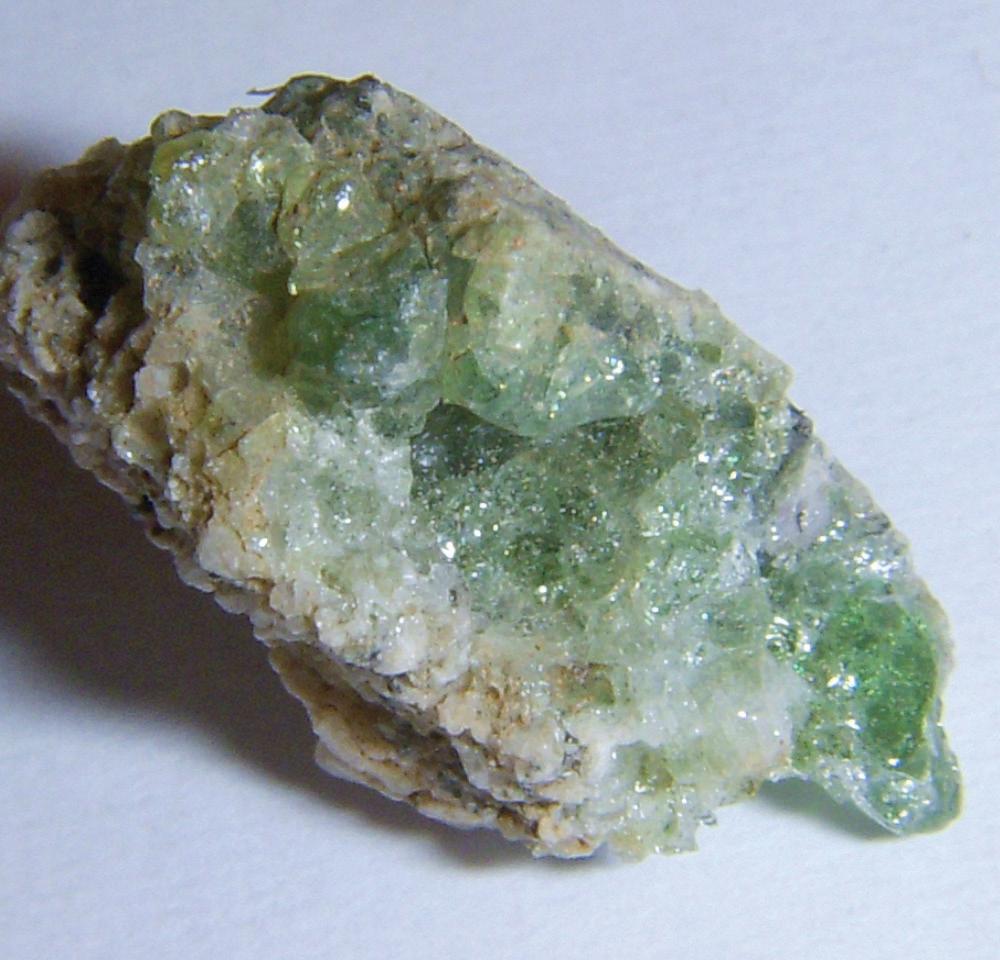
The abundant, jade-like material that imparted a greenish color to the crater floor was initially named everything from "atomsite" and "a-bombite" to "Alamogordo glass," but the name that stuck was "trinitite." Scientists first assumed that trinitite was created when the heat of detonation fused the desert sand. But according to current theory, the greenish glass formed when sand was drawn up into the atomic fireball where it fused before falling in small, molten blobs to solidify on the desert floor.
TRINITITE
Classified as a man-made glass of indefinite composition and amorphous structure, trinitite consists mainly of quartz with lesser amounts of feldspar, hornblende and pyroxene minerals-the same basic composition as the original sand.

Diese Geschichte stammt aus der July 2024-Ausgabe von Rock&Gem Magazine.
Abonnieren Sie Magzter GOLD, um auf Tausende kuratierter Premium-Geschichten und über 9.000 Zeitschriften und Zeitungen zuzugreifen.
Sie sind bereits Abonnent? Anmelden
WEITERE GESCHICHTEN VON Rock&Gem Magazine
Rock&Gem Magazine
A New Amber Locality Fills a Gap
A sandstone quarry in central Ecuador has yielded the first significant deposit of Mesozoic amber from South America.

1 min
January / February 2026
Rock&Gem Magazine
Did "Left-Handed" Fish Leave Water Earlier than Thought?
Fossil evidence suggests that fish (or \"fishapods\") dragged themselves onto land during the middle Devonian Period.
1 min
January / February 2026

Rock&Gem Magazine
"Lab Quakes” Produce Surprising Results
When faults let loose and earthquakes result, the main effect we mortals experience is the violent shaking.
1 min
January / February 2026
Rock&Gem Magazine
This Egg is No Spring Chicken
How to date a dino egg
1 min
January / February 2026
Rock&Gem Magazine
Have we Already Mined the Critical Minerals We Need
Then why are we throwing them away?!
1 min
January / February 2026
Rock&Gem Magazine
One Toxic Worm
A critter that creates & tolerates orpiment!
1 min
January / February 2026
Rock&Gem Magazine
ROCK & GEM FIELD GUIDE: Silver
Silver (Ag) is a native element and one of Earth's most prized precious metals.
2 mins
January / February 2026
Rock&Gem Magazine
DINOSAURS OF THE HELL CREEK MUSEUM
In the Badlands of South Dakota, just outside the small town of Belle Fourche—pronounced “Bell Foosh”—a new attraction has taken shape that every dinosaur enthusiast should see. The Dinosaurs of the Hell Creek Museum is part hands-on exhibit, part science center and part active research lab.
3 mins
January / February 2026
Rock&Gem Magazine
The Lost Twins of Kongsberg
A Silver Story Resurfaced
3 mins
January / February 2026
Rock&Gem Magazine
Switzerland's ICE PALACE
Walk Inside a Glacier at The Top of Europe
7 mins
January / February 2026
Listen
Translate
Change font size