
Mit Magzter GOLD unbegrenztes Potenzial nutzen
Erhalten Sie unbegrenzten Zugriff auf über 9.000 Zeitschriften, Zeitungen und Premium-Artikel für nur
Versuchen GOLD - Frei
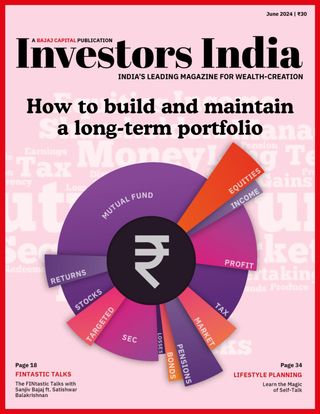
How To Build And Maintain A Long-Term Portfolio
Investors India
|June 2024
Building a robust long-term portfolio involves two steps. First, you must decide on your asset allocation-essentially the distribution of your investments across various asset classes such that it aligns with your financial goals and risk tolerance.

Second, within each asset class, you must decide on sub-asset allocations. Building a robust portfolio also requires following the core and satellite portfolio approach.
Third, maintaining a robust portfolio requires periodic (at least an annual) review and rebalancing. Let us take a deeper dive into each of these steps.
When should you rebalance?
You should rebalance at least once every year.
You may rebalance on a particular date, such as your birthday, or the start of the calendar or financial year.
You may also rebalance when the allocation of a particular asset class has moved by, say, 5 percentage points.
For instance, if your allocation to equities is 60 per cent and it moves to 65 per cent, you may rebalance.
The final method is to use a mix of both the approaches: rebalance on a particular date every year but also rebalance if your asset allocation has moved by a certain number of percentage points.
Asset allocation
The appropriate asset allocation for an investor should depend on their risk appetite and risk-taking ability. While the two terms may appear very similar, there is a subtle difference between the two.
Risk appetite: This is essentially your psychological comfort with investment risks. Some investors remain unfazed by significant market downturns. They do not worry even if their portfolio dips by 3040 per cent. By contrast, others feel anxious after a 10 per cent decline.
Risk-taking ability: This aspect is influenced by factors such as the investor's age and potential future earnings. Typically, a younger individual with a long earning horizon possesses a higher risktaking capacity. If there is a market downturn and the portfolio takes a nosedive, youngsters have time on their side. They can wait until their portfolio recovers.

Diese Geschichte stammt aus der June 2024-Ausgabe von Investors India.
Abonnieren Sie Magzter GOLD, um auf Tausende kuratierter Premium-Geschichten und über 9.000 Zeitschriften und Zeitungen zuzugreifen.
Sie sind bereits Abonnent? Anmelden
WEITERE GESCHICHTEN VON Investors India
Investors India
Insurance News
PFRDA allows NPS subscribers to withdraw upto 80% of pension corpus

2 mins
January 2026

Investors India
Laughter is the Best Medicine
We are living in a health-conscious society.
7 mins
January 2026
Investors India
Mutual Fund
SEBI cuts expense ratios for Mutual Funds SEBI has reduced the expense ratio in mutual funds by up to 15 bps.
3 mins
January 2026
Investors India
Tale of 3 Bubbles: Gold, Indian IPO & AI
The most often asked questions in all discussion over the past few months are about views on gold prices, Indian IPO's and AI Stocks.
5 mins
January 2026

Investors India
Avoid exiting factor funds during periods of cyclical underperformance
Over the past 12 months, several smart-beta equity funds in India have delivered returns that trail broad market indices such as the Nifty 50 and the Sensex.
6 mins
January 2026

Investors India
Household Capex: The elephant in the room
There is always talk about Public and Private capex in the market narratives.
3 mins
January 2026
Investors India
Planning Your Child's Future? Here's how child insurance plans have an edge over other investments
“We both work and saving money for our kids is our top priority.”
3 mins
January 2026

Investors India
Why Patience Beats Prediction in Investing
India's economic narrative this year has been shaped by a strong pro-growth agenda from the government, which has translated into better-than-expected GDP numbers.
1 mins
January 2026
Investors India
ASK THE EXPERT
Sir, I have renewed my subscription to Bajaj Capital Investors India Magazine for next 3 years and have received a torch light as a complimentary gift.
4 mins
January 2026

Investors India
Life and health insurance myths that could cost you dearly
Purchasing health insurance for oneself and one's family is regarded as the initial stage of financial planning. Even still, a lot of us disregard it for trivial reasons. Anybody, anywhere, at any time, could have a medical emergency. Be ready to cover the growing hospital expenses before they negatively impact your investment account.
5 mins
January 2026
Listen
Translate
Change font size