Versuchen GOLD - Frei
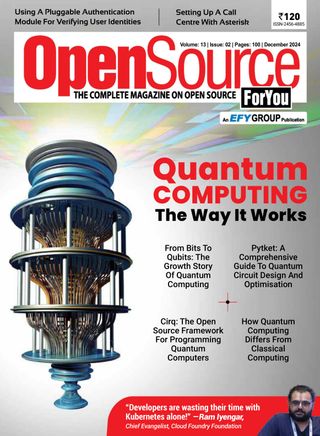
Pytket: A Comprehensive Guide to Quantum Circuit Design
Open Source For You
|December 2024
Pytket stands out as a powerful toolkit in the realm of quantum computing, offering a suite of features that cater to both researchers and industry practitioners. Its key strengths include optimisation, platform-agnostic support, flexible quantum circuit design and hybrid algorithm support. These features make Pytket a versatile tool for various quantum computing applications, from machine learning and cryptography to optimisation problems in industrial settings.

Pytket, developed by Cambridge Quantum, is a versatile quantum circuit toolkit designed for the efficient design, manipulation, and execution of quantum circuits across multiple quantum computing platforms. Known for its contributions to quantum software and technology, Cambridge Quantum created Pytket to tackle significant challenges in quantum computing, particularly circuit optimisation, which is crucial for the effectiveness and reliability of quantum algorithms on real-world hardware.
What sets Pytket apart is its strong emphasis on optimisation. Given the limitations of current quantum hardware, including qubit quantity, quality, noise, and error rates, Pytket provides solutions for minimising gate counts and circuit depth-two critical factors that enhance algorithm performance and reduce errors. Its platform-agnostic nature allows seamless integration with various quantum backends such as IBM Q, Rigetti, and Google Cirq, enabling researchers to experiment with different hardware without the need for extensive modifications to their circuit designs. This flexibility has established Pytket as a preferred toolkit for researchers and developers seeking robust optimisation tools.
Importance of quantum circuit toolkits
Quantum circuit toolkits are essential in transitioning from theoretical quantum algorithms to practical implementations. As quantum technology matures, tools like Pytket address key issues stemming from hardware limitations. Quantum systems are prone to errors, and the coherence time of qubits is often limited, necessitating careful optimisation of quantum circuits to execute efficiently while minimising noise and computational overhead.

Diese Geschichte stammt aus der December 2024-Ausgabe von Open Source For You.
Abonnieren Sie Magzter GOLD, um auf Tausende kuratierter Premium-Geschichten und über 9.000 Zeitschriften und Zeitungen zuzugreifen.
Sie sind bereits Abonnent? Anmelden
WEITERE GESCHICHTEN VON Open Source For You

Open Source For You
Top 10 Open Source Tools for System and IT Administrators
All reputed online services have committed system and IT administrators working behind the scenes. Here are ten open source tools they should be aware of, as these can help them monitor, automate, as well as manage complex infrastructure with relative ease.

6 mins
February 2026
Open Source For You
Google opens access to its Gemini Deep Research Agent
Google has opened access to its Gemini Deep Research Agent for the first time, allowing developers to integrate advanced autonomous research capabilities directly into their applications.
1 min
February 2026

Open Source For You
NVIDIA buys SchedMD, keeps Slurm open source and vendor neutral
NVIDIA has acquired AI software company SchedMD, signalling a deeper commitment to open source technologies as competition intensifies across the artificial intelligence ecosystem.
1 min
February 2026

Open Source For You
How Open Source Tools Power Modern IT Operations
Open source tools have not replaced enterprise IT platforms; they have become the connective layer that makes modern operations possible.
6 mins
February 2026
Open Source For You
Mandiant's Auralnspector enhances Salesforce security
Google-owned cybersecurity firm Mandiant has released AuraInspector, a free, open source command-line tool designed to identify dangerous access control misconfigurations in Salesforce environments, marking a significant move to democratise enterprise-grade security testing.
1 min
February 2026
Open Source For You
Google launches Universal Commerce Protocol to power agentic AI commerce
Google has introduced the Universal Commerce Protocol (UCP), a new open standard that enables AI agents to autonomously perform end-to-end commerce activities, spanning product discovery, purchasing, checkout, payments, and postpurchase experiences.
1 min
February 2026

Open Source For You
Zero Trust CI/CD: The Death of Static Secrets
In an era where data breach costs continue to hit record highs, shifting to a secretless CI/CD pipeline is the most effective step to safeguard digital infrastructure.
7 mins
February 2026

Open Source For You
Quantum Algorithms: The Future of Computing
Explore the essence of quantum algorithms, their groundbreaking applications, recent innovations, and the challenges that remain.
8 mins
February 2026

Open Source For You
Bringing Clarity to the Chaos in AI
AI feels powerful, yet most teams struggle because they cannot define what intelligence they really need. But there are ways to address this challenge.
5 mins
February 2026

Open Source For You
Top researchers return to OpenAI
OpenAI has welcomed back three high-profile researchers, Barret Zoph, Luke Metz, and Sam Schoenholz, following their brief tenure at former OpenAI CTO Mira Murati's AI startup, Thinking Machines.
1 min
February 2026
Listen
Translate
Change font size