
Mit Magzter GOLD unbegrenztes Potenzial nutzen
Erhalten Sie unbegrenzten Zugriff auf über 9.000 Zeitschriften, Zeitungen und Premium-Artikel für nur
Versuchen GOLD - Frei
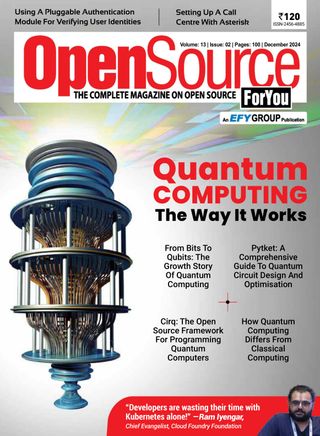
Quantum Machine Learning: An Overview
Open Source For You
|December 2024
Quantum machine learning (QML) is a burgeoning field at the intersection of quantum computing and artificial intelligence. In recent years, the integration of quantum mechanics with machine learning algorithms has sparked substantial interest among researchers and technologists alike. Here's a quick look at the essentials of creating quantum algorithms for AI models, their practical use cases on open source platforms, and best practices for implementing these advanced algorithms.

Quantum machine learning (QML) combines the principles of quantum computing with machine learning algorithms to create models that can process and analyse large datasets more efficiently than classical computers. The inherent parallelism and entanglement properties of quantum computing enable it to perform complex computations at unprecedented speeds. This capability is particularly beneficial in the context of machine learning, where large scale data processing and model training are often bottlenecks.
In recent years, advances in quantum computing have made QML a practical reality. Companies like IBM, Google, and Microsoft have developed quantum processors and platforms that are accessible to researchers and developers. These platforms provide the necessary tools to design, test, and deploy quantum algorithms for various applications, including AI models. The momentum behind QML is driven by its potential to solve problems that are currently intractable for classical computers, such as optimising large datasets, enhancing pattern recognition, and improving predictive models.
Reference architecture for quantum machine learning solutions
Designing an effective QML solution requires a well thought out architecture that leverages both quantum and classical resources. A typical reference architecture for QML involves several key components.
Quantum processing unit (QPU): The core of the quantum machine learning system is the QPU, which performs the quantum computations. Companies like IBM and D-Wave offer cloud-based access to their QPUs, allowing developers to run quantum algorithms without needing their own quantum hardware.

Diese Geschichte stammt aus der December 2024-Ausgabe von Open Source For You.
Abonnieren Sie Magzter GOLD, um auf Tausende kuratierter Premium-Geschichten und über 9.000 Zeitschriften und Zeitungen zuzugreifen.
Sie sind bereits Abonnent? Anmelden
WEITERE GESCHICHTEN VON Open Source For You

Open Source For You
Ukraine builds sovereign AI using Google's Gemma
Ukraine has launched a landmark national AI initiative, building a fully sovereign large language model (LLM) using Google's open source Gemma framework.

1 min
January 2026

Open Source For You
Kubernetes vs Docker Swarm: Choosing the Right Orchestration Tool
This overview of the differences between Kubernetes and Docker Swarm will help DevOps developers determine the right container orchestration tool for their project.
5 mins
January 2026

Open Source For You
Quantum Programming: Speaking the Language of Qubits
Quantum software tools are evolving and will soon make quantum computing easily accessible. With tools like Qiskit and Cirq, anyone can begin exploring the quantum world, experiment with algorithms, and contribute to a rapidly evolving field.
7 mins
January 2026

Open Source For You
Building a Real-Time Grocery Price Comparison System
This real-time grocery price comparison system has been designed for leading Indian e-commerce platforms. Built on microservices architecture, the system leverages FastAPI for backend services and Selenium for dynamic web scraping to deliver accurate, up-to-date pricing data.
7 mins
January 2026
Open Source For You
The Role of Generative AI in the AWS Database Migration Service
The integration of generative AI in the AWS Database Migration Service enhances schema conversion, making data migrations more accurate, speedy, and efficient.
7 mins
January 2026

Open Source For You
Proxmox unveils open source Datacenter Manager
Proxmox has officially launched the first full and stable version of its Datacenter Manager, positioning itself as a robust open source alternative for private cloud deployments.
1 min
January 2026
Open Source For You
Linux Foundation lauds Japan's OSS boom but warns of governance and security gaps
Linux Foundation Research has released its latest report, ‘The State of Open Source Japan 2025: Accelerating Business Value through Strategic Open Source Engagement’.
1 min
January 2026

Open Source For You
Improving Microservices Performance with Django
Django, along with other open source tools like Redis, PostgreSQL, Celery and NGINX, helps address the challenges of request overhead and latency in microservices architecture.
4 mins
January 2026

Open Source For You
Manim: Creating Dynamic Visual Animations
Learn about how Manim, a Python library, converts code into captivating animations, and why it has become the preferred choice for educators, developers, and content creators worldwide.
4 mins
January 2026

Open Source For You
openSUSE empowers Linux developers with Intel NPU access
The openSUSE project has begun distributing packaging for the Intel Neural Processing Unit (NPU) driver, enabling small-scale AI development on Linux.
1 min
January 2026
Listen
Translate
Change font size