
Vuélvete ilimitado con Magzter GOLD
Obtenga acceso ilimitado a más de 9000 revistas, periódicos e historias Premium por solo
Intentar ORO - Gratis
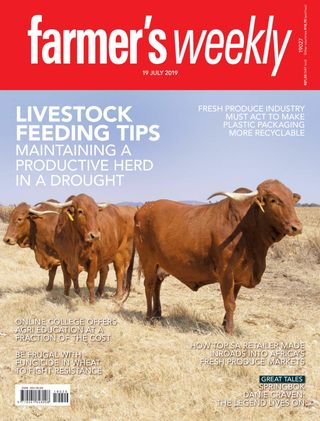
First-Hand Experience Of An African Retail Giant
Farmer's Weekly
|July 19, 2019
South Africa’s Shoprite Group has had to jump over numerous hurdles to expand its network of stores across Africa. Today, as the largest retailer on the continent, the group sources produce from 450 South African farmers and 700 farmers from elsewhere in Africa. Dr Johan van Deventer, general manager of Freshmark, the group’s fresh produce division, believes that trustworthy relationships have been at the heart of this success. He spoke to Lindi Botha.

WHAT ARE YOUR GREATEST DIFFICULTIES IN EXPORTING FRESH PRODUCE TO THE REST OF AFRICA?
The African market presents numerous challenges. One of these is being able to offer consistent, quality exports, as this builds trust in the marketplace and with consumers, ensuring a loyal customer base.
Cold chain maintenance forms part of this; we require reliable logistics, which often means higher costs for us. Supplyline cost is a big drawback: a refrigerated container from South Africa to Spain costs $1 500 to $2 000 [between R26 700 and R35 500], but from South Africa to Angola it costs $5 000 [about R88 800]. This means we have to ensure that within the total package we offer we can still make a profit. But our margins are not what they would be in South Africa.
We source as many products locally as we can and only import those that cannot be grown in those countries.
Because we have to contend with unreliable power supply in many African countries, with high generator costs, we limit what has to be kept in cold storage.
The market also requires functional packaging that is reusable as far as possible. In South Africa, we use plastic crates that are returnable and refundable, which saves millions of rand in packaging costs. Such systems are not in place in the rest of Africa, so we rely on cardboard boxes, which can be recycled and used for other purposes afterwards.
Harbour costs and inefficiencies are a major difficulty in Africa. Exporting into the continent often requires crossing a number of borders, so our paperwork must be correct and submitted on time to ensure we have the correct permits, or we risk losing entire containers of perishable foods. To keep costs low, we use the shortest route possible to a market, using the most affordable mode of transport.

Esta historia es de la edición July 19, 2019 de Farmer's Weekly.
Suscríbete a Magzter GOLD para acceder a miles de historias premium seleccionadas y a más de 9000 revistas y periódicos.
¿Ya eres suscriptor? Iniciar sesión
MÁS HISTORIAS DE Farmer's Weekly

Farmer's Weekly
Tropical avo smoothie
Escape to the tropics with this luxurious, creamy, and vibrant smoothie! Blending rich avocado and sweet mango with zesty lime, fragrant mint, and a punch of tangy granadilla, this recipe transforms into a nutrient-packed and silky-smooth treat.

1 min
January 16-23, 2026
Farmer's Weekly
THE HITCHING POST
I am a 60-year-old white woman who loves camping, animals, the outdoors and watching sport.
2 mins
January 16-23, 2026

Farmer's Weekly
The enduring legacy of Tiyo Soga
In the 1850s, Tiyo Soga, a Xhosa man, became the first ordained black South African minister. But as Mike Burgess writes, his legacy would also be determined by his all-round intellectual abilities honed by a solid Scottish education.
4 mins
January 16-23, 2026

Farmer's Weekly
Isuzu D-Max shows single cabs can be comfortable companions
Bakkie manufacturers don't give single cabs to the media due to them generally being regarded as workhorses without the bells and whistles from fancier double cabs. The Citizen's Charl Bosch was gobsmacked when a single cab arrived for a three-month stay.
2 mins
January 16-23, 2026
Farmer's Weekly
South Africa eyes home-grown rice as ARC expands research efforts
South Africa is taking bold steps toward reducing its dependence on rice imports by exploring the viability of home-grown upland rice. Through a major research drive led by the Agricultural Research Council's Small Grain division, scientists and industry partners are testing rice varieties capable of thriving in South Africa's diverse soils and increasingly water-scarce climate. Anelisa Gusha reports.
3 mins
January 16-23, 2026

Farmer's Weekly
Spanish tortilla
Bring the authentic flavours of Spain to your table with this robust and satisfying Spanish tortilla.
1 min
January 16-23, 2026

Farmer's Weekly
New year brings marvellous new titles
Patricia McCracken, like many of us, has settled back into the grind of the new year and picked up a diverse selection of books ranging from travel, to fiction, to non-fiction and a delightful local children's adventure.
2 mins
January 16-23, 2026
Farmer's Weekly
Nitrogen 'switch' unlocks greener crops
A ground-breaking discovery by molecular biology professors Kasper Røjkjær Andersen and Simona Radutoiu at Aarhus University in Denmark offers a significant step toward developing self-fertilising grain crops, potentially revolutionising agriculture to be greener and more climate-friendly.
1 min
January 16-23, 2026

Farmer's Weekly
Sweet prospects: the current state of litchi production in South Africa
Bram Snijder, agricultural consultant and chairperson of the South African Litchi Growers' Association, spoke to Octavia Avesca Spandiel about the litchi industry embracing new opportunities, tackling challenges, implementing innovation, and reaching markets both locally and internationally.
6 mins
January 16-23, 2026

Farmer's Weekly
How AFGRI uses technology to unlock farm finance from asset to market
As modern farming becomes more capital-intensive and digitally driven, AFGRI is reinventing agricultural finance by linking technology directly to lending decisions.
5 mins
January 16-23, 2026
Translate
Change font size