Intentar ORO - Gratis
Veld Survey Raises Questions About Rotational Grazing
Farmer's Weekly
|August 2, 2019
Dr Heidi-Jayne Hawkins, head of research at Conservation South Africa and an associate at the Department of Biological Sciences at the University of Cape Town, spoke to Roelof Bezuidenhout about research findings indicating that rotational grazing management has little effect on veld characteristics across the farm fence lines of South Africa.

HOW WAS THE STUDY CONDUCTED?
Forty-eight working livestock farms were surveyed nationally to identify farmers practising a range of livestock farming approaches, from continuous and low density, to holistic planned grazing (HPG) and ultra-high-density grazing. The farms covered more than 1 300km² across five biomes and a rainfall gradient of between 150mm/year and 850mm/ year. Having identified 23 farms with high-density grazing and fence lines with neighbours having similar fire regimes, we tested the perception that intensive grazing sustains higher animal numbers, while increasing grass cover and reducing bare ground and woody plant cover, using remotely sensed (satellite) vegetation indices and on-the-ground inspections.
The available fence lines were clustered around the transition between the Grassland and Nama Karoo biomes. An important selection criterion was that farms were managed under a particular grazing management for more than 15 years and have livestock, including cattle, sheep and/or goats where 75% of their diet comprised natural vegetation. A few farms stocked a diversity of game in very low numbers (on average 2% of total farm LSUs). Fourteen of the farms were selected as representing grazing management most strongly aligned to HPG or with very high grazing densities (highly rotational). The rationale behind this was that these farms were likely to have more extreme management differences to their neighbours, and if grazing management has any effect on vegetation, it would be most evident at these fence lines.
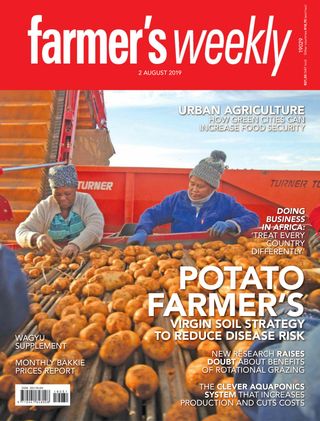

Esta historia es de la edición August 2, 2019 de Farmer's Weekly.
Suscríbete a Magzter GOLD para acceder a miles de historias premium seleccionadas y a más de 9000 revistas y periódicos.
¿Ya eres suscriptor? Iniciar sesión
MÁS HISTORIAS DE Farmer's Weekly

Farmer's Weekly
The foot-and-mouth disease threat is growing
Foot-and-mouth disease poses a growing threat to the livestock industry, especially communal farmers, with devastating economic consequences unless awareness and compliance improve, writes Shane Brody.

3 mins
January 30 - February 06, 2026

Farmer's Weekly
Shipping conditions to ease in 2026, but risk remains high
Early signs suggest a more favourable export season for South African producers, as easing global shipping congestion and improved performance by Transnet point to higher throughput at local ports. Lindi Botha reports.
2 mins
January 30 - February 06, 2026

Farmer's Weekly
A path of accelerating land reform in South Africa
Delivering the ANC's January 8th Statement a few weeks ago, President Cyril Ramaphosa noted, amongst other things, that: “Land reform remains one of the most urgent tasks of the National Democratic Revolution. While progress has been made, much more is required to give effect to the constitutional requirement for redress and equitable access to land.”
2 mins
January 30 - February 06, 2026
Farmer's Weekly
Reflections on 2025 and the policy space for 2026
The year 2025 was a year characterised initially by a wave of misinformation, particularly relating to legislation and tariff issues. This year some big moves are expected in the trade space.
3 mins
January 30 - February 06, 2026
Farmer's Weekly
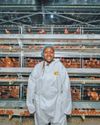
From planning to peak lay: building a profitable egg business
Mpumalanga poultry farmer Lebogang Mashego spoke to Octavia Avesca Spandiel, and shared practical insights on planning, building systems that work, breed choice, feed management, and markets to build a profitable and sustainable egg business.
5 mins
January 30 - February 06, 2026

Farmer's Weekly
Impofu Wind Farm becomes a canvas for community connection through Enel's Blowing Art Initiative
Enel Green Power South Africa has introduced the Blowing Art Initiative at the Impofu Wind Farm in the Eastern Cape, a creative community project that turns renewable energy infrastructure into a living gallery.
2 mins
January 30 - February 06, 2026

Farmer's Weekly
Geely is intent on hanging around
Having fallen off the radar around a decade ago following a short local stint, Chinese manufacturer Geely has announced its proposed return to South Africa towards the end of 2026. The Citizen's Jaco van der Merwe reports.
4 mins
January 30 - February 06, 2026

Farmer's Weekly
Great reads to enjoy during ‘me-time'
Patricia McCracken has plucked an assortment of fascinating titles covering different areas of interest, from coastal exploration and dining in the wild, to African traditions surrounding love and marriage.
3 mins
January 30 - February 06, 2026
Farmer's Weekly
Thokoman Peanut Butter marks 25-year milestone with R500 000 commitment to food security
Thokoman Peanut Butter, one of South Africa's biggest producers of peanut butter, celebrates 25 years of consistent quality and community support, marking the occasion with a significant R500 000 partnership with Hot 102.7's Hot Cares initiative for 2026.
2 mins
January 30 - February 06, 2026
Farmer's Weekly
South Africa's famous wandering hippo
From 1928 to 1931, a hippopotamus trekked 1 600km from what was then northern Natal to the Eastern Cape's Keiskamma River near Peddie, where it was shot dead by a posse of farmers. As Mike Burgess writes, this journey would immortalise the hippo in South African history.
3 mins
January 30 - February 06, 2026
Translate
Change font size