Intentar ORO - Gratis
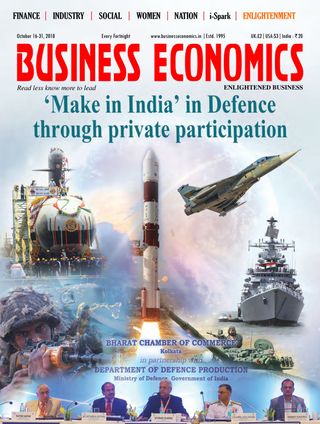
Indigenous Defence: An Overview
BUSINESS ECONOMICS
|October 16 - 31, 2018
Indias armed forces, the third largest in the world, have the eighth largest defence budget. Indigenously developed weapons have contributed to the country's arsenal.

India focused on defence innovations after it achieved independence. The Defence Research and Development Organisation (DRDO), which is the flagship organisation responsible for defence innovations was formed in 1958. Before that, the Defence Science Organisation aimed to provide scientific and technological support to the Indian Armed Force. DRDO currently operates through a network of around 47 laboratories and establishments located nationwide and are manned by over 34,000 personnel, including 16,000 scientific technical persons.
In the context of developing new indigenous technologies, India is working on its research and development (R&D) and getting a robust technology transfer system. The ‘Make in India’ initiative must boost indigenous initiatives. A brief account of various defence innovations in India is given below.
1947-1960
The military hardware of the erstwhile British controlled Indian armed forces was divided between the newly created states of India and Pakistan. After independence, the Indian government adopted a five-year planning approach that also focused on promotion of indigenous technologies. During this period, the Indian armed forces were involved in a number of significant military operations, notably, the Indo-Pakistani War of 1947 and the Operation Polo. From the 1950s, numerous contracts with foreign firms enabled the production and development of vehicles and guns, battle tanks, infantry combat vehicles, fighter and trainer aircrafts, and frigates and submarines. Such development was carried out by the state-run agencies that collaborated with foreign firms and carried out the bulk of this production in the Indian ordinance factories and defence public sector undertakings.
1961-1980
Arjun Tank Project

Esta historia es de la edición October 16 - 31, 2018 de BUSINESS ECONOMICS.
Suscríbete a Magzter GOLD para acceder a miles de historias premium seleccionadas y a más de 9000 revistas y periódicos.
¿Ya eres suscriptor? Iniciar sesión
MÁS HISTORIAS DE BUSINESS ECONOMICS

BUSINESS ECONOMICS
How to stay healthy and safe during the coldest winter in over a decade
West Bengal is currently experiencing a severe cold wave, with dense fog and plunging temperatures disrupting daily life across the state. Air quality has deteriorated sharply, while sub-Himalayan districts are witnessing even lower temperatures. Light snowfall is also possible in higher reaches. The India Meteorological Department (IMD) has warned that the cold spell is likely to persist throughout the week, with foggy conditions significantly affecting visibility and travel.

2 mins
January 01 - 31, 2026
BUSINESS ECONOMICS
New Labour Laws: Truly transformational, but employers must act responsibly for workers’ benefit
On November 21, the Government of India announced the implementation of four Labour Codes with the stated objective of simplifying and streamlining the country's labour laws.
4 mins
January 01 - 31, 2026
BUSINESS ECONOMICS
Policy Shifts, Privatization Pressures and ECL Pays the Price:The Coal Industry at a Crossroads
Recently, at a meeting of the Joint Consultative Committee held at the headquarters of the stateowned coal company Eastern Coalfields Limited (ECL), the management informed trade union representatives that salaries for the month of November would not be paid on time.
4 mins
January 01 - 31, 2026

BUSINESS ECONOMICS
Emerging shift in India's real estate market: From volume to value
India's residential real estate market has entered a new era; one not measured by the number of units sold but by the amount of revenue generated. According to the FY 26 residential market projections of JLL India, a global real estate services company, the total housing sales value across India's top seven cities is expected to touch Rs 6.65 lakh crore this year - a sharp 19% jump over last year.
8 mins
January 01 - 31, 2026

BUSINESS ECONOMICS
Branding isn't just for sneakers - it's for nations also: Dhruv Bhalla
When a corporate logo flies, we understand the game.
2 mins
January 01 - 31, 2026

BUSINESS ECONOMICS
Housing market boom driven by premium and luxury homes priced above ₹5 crore
A few weeks ago, the World Inequality Report 2026 was released.
3 mins
January 01 - 31, 2026
BUSINESS ECONOMICS
The Rupee's Verdict: Exposing India's decade of economic illusion
Over the past decade, the Indian rupee has borne witness to a sustained depreciation from around ₹60 per US dollar in 2014 to nearly 95 per dollar by December 2025.
4 mins
January 01 - 31, 2026

BUSINESS ECONOMICS
Will Pakistan again control Bangladesh?
India Bangladesh relations, which was deteriorating with the ousting of Shiekh Hasina last year, took a nosedive early this week when a youth leader Hadi, who was part of the movement that led to Hasina fleeing for India, was murdered. The finger of suspicion was pointed at Indian intelligence people (RAW) in Bangladesh and its associates. There were arson and lynching and murder of Hindus and the Indian government sent stern warnings to the Bangladesh authorities to enforce control.
2 mins
January 01 - 31, 2026

BUSINESS ECONOMICS
Inaugural Address at the 16th World Confluence by Dr. C. V. Ananda Bose, Hon'ble Governor of West Bengal
Hon'ble Governor Dr. C. V. Ananda Bose inaugurates 16th World Confluence on Humanity, Power & Spirituality
2 mins
January 01 - 31, 2026

BUSINESS ECONOMICS
West Bengal must place greater emphasis on Micro and Small units and Sunrise sectors
The Government of West Bengal (WB) held a Business & Industry Conclave on December 18.
3 mins
January 01 - 31, 2026
Translate
Change font size