Intentar ORO - Gratis
Can The Multiverse Give You An Afterlife?
Philosophy Now
|April/May 2017
Rui Vieira says yes it can, of sorts.

The idea of an afterlife is central to many of the world’s religions, and understandably so, since the thought that eternal oblivion might await us after death can be terrifying. But to many skeptics the notion of an afterlife as put forth by most religions seems implausible, leaving eternal oblivion as the only possibility. However, they need not be so pessimistic. Maybe science itself could provide us with a coherent, even plausible, account of a kind of cosmological afterlife, especially if we throw some philosophy of mind into the mix.
How might science help assuage our fear of death? Modern physics has provided us with theories which claim that we may be living in a multiverse, in which our universe is only one among a potentially infinite number of universes. A mind-bending consequence of this is that there would be universes similar or even physically identical to ours containing duplicates of you and me. As some have wondered, if there are copies of you and me in these other universes, could we not view their continued existence as an afterlife of sorts, once our current life in this universe has ceased?
But would such a copy of me be me? Perhaps; but the idea can be made more plausible if it’s combined with a particular philosophy of mind and of the corresponding self in which neither is reducible to matter. So before addressing the cosmology, we must first address the problem of consciousness as it relates to matter.
The Mind & The Brain
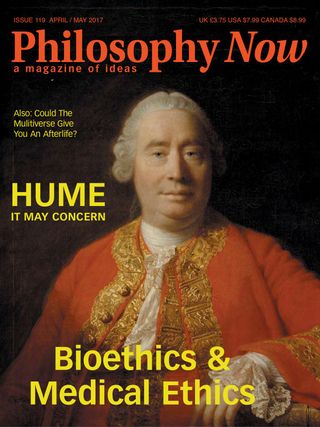

Esta historia es de la edición April/May 2017 de Philosophy Now.
Suscríbete a Magzter GOLD para acceder a miles de historias premium seleccionadas y a más de 9000 revistas y periódicos.
¿Ya eres suscriptor? Iniciar sesión
MÁS HISTORIAS DE Philosophy Now

Philosophy Now
Nosferatu
Stefan Bolea considers two very different artistic approaches to love and death.

6 mins
April/May 2025

Philosophy Now
Heidegger's Ghost
Raymond Tallis wonders where Heidegger's body went when he was philosophising.
7 mins
April/May 2025

Philosophy Now
Is Comedy Good For Us?
Damaris Stock has a laugh with Plato and friends.
10 mins
April/May 2025

Philosophy Now
In Defense of Idleness
Wendell O'Brien says, 'Just Don't Do It'.
10 mins
April/May 2025

Philosophy Now
Leaving Nothing to Chance by Carl Knight
LEAVING NOTHING TO Chance (2025) by Carl Knight, is an informed, proficient and lucid defence of luck egalitarianism.
3 mins
April/May 2025

Philosophy Now
Star Maker by Olaf Stapledon
THE 1937 SCIENCE FICTION novel Star Maker was written by philosophy professor Olaf Stapledon in the dark days as Europe awaited the onslaught of Nazi Germany. This casts a shadow over the whole book.
6 mins
April/May 2025

Philosophy Now
Love & Emptiness in the Sufi Tradition
Medha Ninad Tambe meditates on Rumi, love and self-negation.
7 mins
April/May 2025

Philosophy Now
The Hedgehog's Dilemma: A Metaphor About the Challenges of Human Intimacy
Krishna Chaubey explains Arthur Schopenhauer's poignant thought experiment.
4 mins
April/May 2025

Philosophy Now
The Mirror & the Flame
Rebwar Fatah imagines Attar's & Hegel's shared path.
4 mins
April/May 2025
Philosophy Now
Free and Equal by Daniel Chandler
DANIEL CHANDLER, AN economist and philosopher based at the London School of Economics, begins Free and Equal: What Would a Fair Society Look Like? (2023) by asking an intriguing question. How is it, he wonders, that the most influential political philosopher of the last century has had almost no practical impact on politics or policy? The philosopher in question is John Rawls, whose magnum opus was A Theory of Justice (1971).
5 mins
April/May 2025
Translate
Change font size