Intentar ORO - Gratis
THE NEXT GIANT LEAPS
BBC Focus - Science & Technology
|Summer 2020
From spider robots to antennas on the Cornish coast, these UK-based projects are laying the groundwork for a permanent station on the Moon. Wallace and Gromit would be proud…

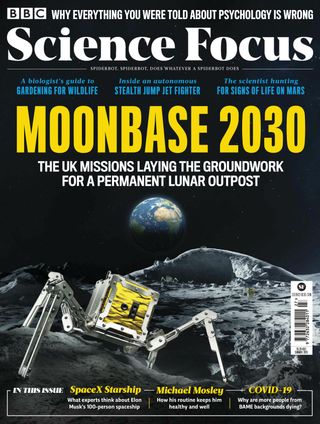
A bout this time next year, a small robotic spider may be taking its first tentative steps on the Moon. It’s not exactly The Spiders From Mars, but the late David Bowie will have played a part in getting it there.
Pavlo Tanasyuk, CEO and founder of the British company Spacebit, remembers once listening to David Bowie’s The Rise And Fall Of Ziggy Stardust And The Spiders From Mars and wondering about one-day building rovers with legs rather than wheels. The idea lay dormant until Tanasyuk was visiting a friend at the Japan Aerospace Agency (JAXA), and mentioned his long-held idea of a spider robot on Mars or the Moon. The friend responded immediately with the Japanese proverb of the asagumo, the morning spider who brings fortune. “That’s when it clicked and I decided that we actually should be doing this rover,” says Tanasyuk.
He incorporated the UK company Spacebar to begin developing the asagumo spider robot. The launch is now scheduled for July 2021, onboard the Peregrine lander that has been developed by the private American company Astrobotic. Peregrine will be flown on a Vulcan Centaur rocket, and if all goes to plan, asagumo will be the UK’s first lunar lander.
Walking on the Moon is tricky because of the regolith, which is the layer of rock fragments and dust that covers the lunar surface. For a walking rover, the dangers are two-fold. First, the legs can sink into this layer, impeding the movement. Second, the dust and fragments can get into the articulated parts of the legs and the motors, causing them to cease up.

Esta historia es de la edición Summer 2020 de BBC Focus - Science & Technology.
Suscríbete a Magzter GOLD para acceder a miles de historias premium seleccionadas y a más de 9000 revistas y periódicos.
¿Ya eres suscriptor? Iniciar sesión
MÁS HISTORIAS DE BBC Focus - Science & Technology

BBC Science Focus
ARE PSYCHOPATHS REALLY THAT GOOD AT LYING?
Picture infamous psychopaths from fiction, such as the eerily cold and calculating Patrick Bateman in the film adaptation of American Psycho, and they certainly seem like master deceivers. But what about real-life psychopaths? Research confirms that psychopaths are more inclined to lie to get what they want, and that they typically display a striking fearlessness - as if they have ice running through their veins.

1 min
January 2026
BBC Science Focus
WHY DO WE HAVE TWO OF SOME ORGANS, BUT ONLY ONE OF OTHERS?
The majority of animals on Earth, humans included, are bilaterally symmetrical. It means we can be divided roughly into two mirror-image sides. Evolutionary biologists believe that it has been like that for at least 300 million years, and because life organised this way survived, so did symmetrical design. Hence, two eyes, two ears, two lungs and two kidneys.
1 min
January 2026

BBC Science Focus
WHY DO CATS PREFER TO SLEEP ON THEIR LEFT?
I've said it before, and I'll keep saying it again and again and again: who knows why cats do anything?
1 min
January 2026

BBC Science Focus
FORGET COUNTING CALORIES TRY THIS INSTEAD...
Calorie counting isn't just difficult, it's riddled with problems that make it practically useless for anyone trying to lose weight.But there are alternatives
9 mins
January 2026

BBC Science Focus
SIGNS OF LIFE
The more planets we find outside our Solar System, the better our chances are of finding life on one of them. But if there really is life out there, how do we spot it?
8 mins
January 2026
BBC Science Focus
WHAT ACTUALLY MAKES SOMEBODY COOL?
Most of us have probably wanted to be cool at some point in our lives, and these efforts can have a big influence on the things we buy, the way we dress, the hobbies we invest in, the people we look up to and even the words we use.
2 mins
January 2026

BBC Science Focus
It's TIME to WAKE UP and SMELL the roses
What if the pursuit of happiness in the traditional sense – chasing wealth or power – is the very thing stopping you from being happy? Researchers are beginning to understand that spending time enjoying the simple things might be the secret ingredient to enjoying a happy, healthy life
8 mins
January 2026

BBC Science Focus
THE AARDVARK
In a time when people are being asked to consider eating insects, we should, perhaps, learn a thing or two from the aardvark (Orycteropus afer), Africa’s ant-guzzling gourmand. On an average night, the big-schnozzed mammal devours up to 50,000 of the crunchy critters.
2 mins
January 2026

BBC Science Focus
ADD WEIGHT TO LOSE WEIGHT
A very basic kind of wearable could make your New-Year-weight-loss plans stick
3 mins
January 2026

BBC Science Focus
AHEAD OF THEIR TIME
The Maya civilisation is known for its art and architecture.
8 mins
January 2026
Translate
Change font size