Vuélvete ilimitado con Magzter GOLD
Obtenga acceso ilimitado a más de 9000 revistas, periódicos e historias Premium por solo
Intentar ORO - Gratis
Own Your Words to Gain Authority
MIT Sloan Management Review
|Spring 2024
Managers undermine their credibility when they speak for others too frequently.

How often do you find yourself voicing someone else’s ideas, thoughts, or demands at work? Whether you are conveying your CEO’s wishes to a colleague or explaining to your team that “sales needs an update,” speaking for others — what researchers call managerial ventriloquism — is a common practice in organizations. It can be valuable, and even essential, to fulfilling the role of a manager. But when done badly, it can harm managers’ credibility, damage company culture, and hurt their organizations’ reputation and profits.
The practice of invoking distant interests by making statements like “The CEO needs this by the close of play” or “The board needs answers immediately” is commonplace and natural. But when managers rely on this approach to excess, it is usually an indicator of one of two issues in the organization: Either managers possess too little autonomy and are compelled to speak the words of others (typically, the organization’s leaders), or, as is the case in most organizations, the habit of ventriloquism has become so ingrained that managers act as others’ mouthpieces without giving the practice much thought. So by routinely saying “The CEO needs …,” for instance, a manager can create the perception, both in their own mind and among colleagues, that they lack authority. Over time, speaking for others in this way engenders a managerial culture where responsibility is forever being passed on to someone else, with no one willing to take ownership of decisions.
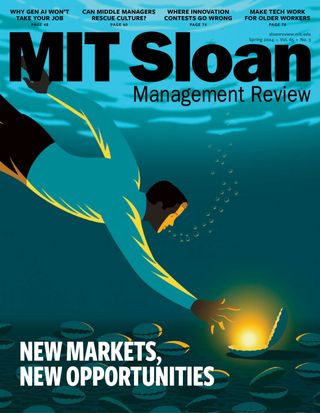

Esta historia es de la edición Spring 2024 de MIT Sloan Management Review.
Suscríbete a Magzter GOLD para acceder a miles de historias premium seleccionadas y a más de 9000 revistas y periódicos.
¿Ya eres suscriptor? Iniciar sesión
MÁS HISTORIAS DE MIT Sloan Management Review

MIT Sloan Management Review
Assess What Is Certain in a Sea of Unknowns
Understanding what won't change clarifies what might — and strengthens decision-making in volatile times.

13 mins
winter 2026

MIT Sloan Management Review
Ask Sanyin: Why Is It So Hard to Pull the Plug on a Project?
We're finding it difficult to wind down projects that no longer serve our priorities.
2 mins
winter 2026

MIT Sloan Management Review
Integrate Sustainability and Innovation to Find New Opportunities
Five common innovation practices can help leaders pursue sustainability as a growth strategy.
12 mins
winter 2026

MIT Sloan Management Review
The Case for Quiet Corporate Activism
Leaders concerned that they will be penalized for championing sustainability and diversity can still sustain their commitments.
11 mins
winter 2026

MIT Sloan Management Review
The Perils of Algorithmic Pricing
Some revenue management systems based on algorithms may lead to unintended collusion and antitrust violations.
9 mins
winter 2026

MIT Sloan Management Review
Broadening Future Perspectives at the Bank of England
Leaders at the U.K’s central bank sought to broaden their thinking about future risks and opportunities. Here’s how they built longer-term horizon-scanning capabilities and what they learned along the way.
9 mins
winter 2026

MIT Sloan Management Review
How Nesting Changes Platform Strategy
Should your platform host another platform — or be hosted by one? Here's how to think through the choices.
14 mins
winter 2026
MIT Sloan Management Review
Are You an Authentic Leader or an Authentic Jerk?
Leaders who are true to their values can inspire trust and respect, but not if \"being yourself\" becomes the problem.
13 mins
winter 2026

MIT Sloan Management Review
How to Make Scenario Planning Stick
Developing future scenarios can deepen leaders’ strategic insights. Establishing scenario planning as an ongoing capability and reaping its full benefits require linking it to other processes.
16 mins
winter 2026

MIT Sloan Management Review
A Faster Way to Build Future Scenarios
This streamlined approach to scenario planning incorporates AI and helps managers navigate future uncertainties more efficiently.
13 mins
winter 2026
Listen
Translate
Change font size