Intentar ORO - Gratis
Escalate Conflict to Keep Readers Turning Pages
Writer’s Digest
|May - June 2024
Draw readers in through physical, emotional, mental, and spiritual conflict.

Every great story depends on conflict to propel it forward. Conflict is found in your book's overarching concept-the big idea-expressed in a way that highlights the tug-of-war between opposing forces. The more profound the conflict, the more compelling the read. Conflicts can be transcendent, fueling the plot of a sweeping epic novel or memoir, or they can be of limited scope, telling an important story by focusing on a single example. Broadly, there are four categories of conflict:
Your story can focus on any one of these categories, some combination of them, or all of them.
Deciding whether a conflict is suitable for a certain story is a complex task. Not only do certain genres come with specific reader expectations, but the conflict has to be relatable.
All Conflicts Are Internal
On the face of it, it would seem that there are two kinds of conflicts: external and internal. However, it is people's reactions to an incident, not the incident itself, that generates a conflict. In other words, all conflicts are internal. If someone doesn't care about a situation, you don't have a conflict. This means, of course, that we need to understand what makes people care. Consider what other authors (see chart on next page) have observed about the anatomy of conflict, starting with one of America's founding fathers, Thomas Paine, who said, "The harder the conflict, the more glorious the triumph."
Storytelling Requires Conflict
It's easy to mistake premise for conflict. Consider this: In Victorian England, a couple meets and falls in love.
Do you see the problem? There's no conflict.
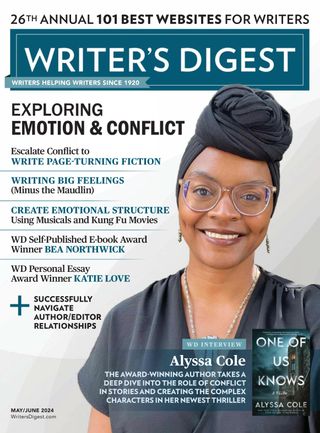

Esta historia es de la edición May - June 2024 de Writer’s Digest.
Suscríbete a Magzter GOLD para acceder a miles de historias premium seleccionadas y a más de 9000 revistas y periódicos.
¿Ya eres suscriptor? Iniciar sesión
MÁS HISTORIAS DE Writer’s Digest
Writer’s Digest
Fate and Prophesy
Defying destiny may be just as hazardous as succumbing to it.”

5 mins
May / June 2026

Writer’s Digest
How to Pitch in Person Without Losing the Plot
Conference-ready tips to make sure your story stands out.
5 mins
May / June 2026
Writer’s Digest
How to Handle Money as a Writer
That is, in case you actually make any ...
8 mins
May / June 2026

Writer’s Digest
Dress Your Manuscript for the Job You Want It to Have
Dress Your Manuscript for the Job You Want It to Have How often have you heard the adage “dress for the job you want”? Probably often enough that it’s a cliché.
5 mins
May / June 2026

Writer’s Digest
Mike Chen
The award-winning science-fiction author discusses the importance of fandom, writing for IP giants like Star Wars, and tackling his biggest project yet: a space opera.
13 mins
May / June 2026
Writer’s Digest
Outlaw Openers
There was a time when starting a sentence with And, But, or So felt like breaking the law.
2 mins
May / June 2026

Writer’s Digest
Collaborate to Create
Why co-authoring nonfiction is a pro strategy worth considering.
7 mins
May / June 2026
Writer’s Digest
The Life-Changing Magic of Tidying Up Your Writing Portfolio
Creating an organized online home for your nonfiction writing samples gives you a strategic advantage.
5 mins
May / June 2026
Writer’s Digest
20 Elevator Pitches for Recently Published Books
One of the most important professional skills an author can develop is the ability to craft an enticing elevator pitch for their book.
5 mins
May / June 2026
Writer’s Digest
On Writing & Newsroom Autobiography
Today, the rise of 24-hour cable news has dramatically reshaped how we consume information.
2 mins
May / June 2026
Listen
Translate
Change font size