Essayer OR - Gratuit
The Gaps In Closing The Ozone Hole
Down To Earth
|September 16, 2019
The cooling industry which first drilled the hole in the ozone layer is now burning the whole planet

The Ozone problem is joined at the hip of the world’s growing obsession for cool-ing. The cooling industry—refrigeration, air-conditioning, and insulation—first burned the hole in the ozone layer and is now heating up the planet. Hydrofluorocarbons (HFCS) and electricity used to run cooling devices are major greenhouse gas (GHG) emitters. To address this, the Montreal Protocol, the only universally adopted treaty, expanded its scope and ambition in 2016 by introducing the Kigali Amendment. It stemmed out of the guilt that its success in removing ozone-depleting chemicals from our cooling devices has filled the atmosphere with highly potent GHGs. So the Kigali Amendment will not just be a fight to protect the ozone layer, but will also be leveraged to fight climate change. But bridging the gap between ozone and climate challenges is not going to be easy. The Kigali Amendment is fiendishly complicated—given its technical and political nuances—but it broadly caps and reduces the use of HFCS in a gradual process.
The agreement recognizes the linkages between the transition in refrigerants and energy efficiency of air-conditioners (ACS). It aims to improve energy efficiency because the world will need more mechanical cooling as the climate gets hotter, electricity generation to keep the ACs running is a critical climate concern. Cooling accounts for 10 percent of all global electricity consumption as per the International Energy Agency.
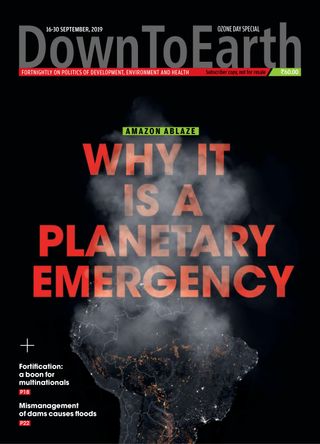

Cette histoire est tirée de l'édition September 16, 2019 de Down To Earth.
Abonnez-vous à Magzter GOLD pour accéder à des milliers d'histoires premium sélectionnées et à plus de 9 000 magazines et journaux.
Déjà abonné ? Se connecter
PLUS D'HISTOIRES DE Down To Earth

Down To Earth
JINALI MODY - ENTREPRENEUR
In September 2025, UN Environment Programme announced Mumbai-based Jinali Mody, founder of material-science startup Banofi Leather, as a Young Champion of the Earth.

2 mins
January 01, 2026

Down To Earth
IT'S AN ENDLESS BATTLE
A decade spent tackling waste still feels vanishingly small
2 mins
January 01, 2026

Down To Earth
'NUMB, AND UNABLE TO ACT
As disasters grow more frequent, I find myself wondering how long I can continue living here, waiting for the next storm
2 mins
January 01, 2026

Down To Earth
SAJANA SAJEEVAN - CRICKETER
In April 2024, Sajana Sajeevan got her maiden call up to the national women's cricket team on the back of a 12-year domestic career that began in the paddy fields of Wayanad, Kerala.
4 mins
January 01, 2026

Down To Earth
NILA MADHAB PANDA - FILMMAKER
Few storytellers bring dramatic despair of ecological loss to the big screen like Nila Madhab Panda. The national-award winning filmmaker often makes nature his central character, be it in his 2017 film Kadvi Hawa or in the 2023 web series The Jengaburu Curse.
4 mins
January 01, 2026

Down To Earth
CHETAN SINGH SOLANKI: SCIENTIST | SOCIAL ENTREPRENEUR
For the past five years, Chetan Singh Solanki has been on a singular journey.
2 mins
January 01, 2026

Down To Earth
ʻLIVING SLOWLY, RELUCTANTLY
The pleasures and burdens of attempting a sustainable life in a fast-moving world
2 mins
January 01, 2026

Down To Earth
KIRAN RAO
Filmmaker and producer Kiran Rao has mastered the art of mainstreaming social commentary, as seen in her early films like Dhobi Ghat and more recently in Laapataa Ladies and Humans in the Loop.
4 mins
January 01, 2026

Down To Earth
I SEE THE RISE OF DEFENDERS
When a species disappears from a land, the loss extends far beyond the species itself.
2 mins
January 01, 2026

Down To Earth
MANISH MEHROTRA - CHEF | RESTAURATEUR
Manish Mehrotra is globally recognised for his innovative approach to preserving India's culinary heritage.
4 mins
January 01, 2026
Translate
Change font size