Essayer OR - Gratuit
CAPITULATION IS CONTAGIOUS
The Atlantic
|March 2025
By killing a cartoon that lampooned its owner, The Washington Post set a dangerous precedent.
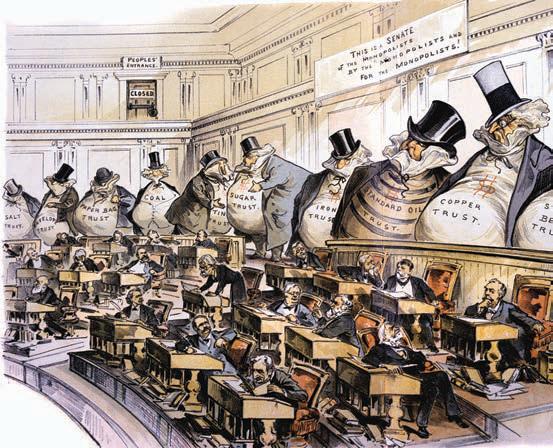
Joseph Keppler's "The Bosses of the Senate" (1889)
At the height of his powers, Jay Gould was known by many names, few of them flattering. People called him the Skunk of Wall Street, the Napoleon of Finance, and Mephistopheles himself. Gould, alongside rivals such as Cornelius Vanderbilt and John D. Rockefeller, was a captain of industry—or, as they would all come to be known, a robber baron.
These men were stupendously powerful, and ruthlessly devoted to the perpetuation of their own wealth and influence. They battled one another for control of America's railways. They hoarded gold, manipulated markets, and exploited workers. They bribed journalists to win favorable coverage and, when that didn't work, threatened the writers and editors who displeased them.
These threats carried weight. Rockefeller's Standard Oil could crush a newspaper by pulling advertising if it didn't like what it saw. Eventually Gould and Rockefeller bought or otherwise invested in newspapers, in an attempt to exert greater influence over how they were covered. Gould even bought a majority interest in Western Union, which gave him power to control the flow of vital information.
Even so, muckrakers such as Ida Tarbell took on Standard Oil. Cartoonists such as Thomas Nast and Joseph Keppler lampooned the unconstrained power of the industrialists and the corruption of Tammany Hall and its leader, William "Boss" Tweed. Tweed was fixated on the political cartoons that mocked him. "I don't care so much what the newspapers write about memy constituents can't read," he said. "But, damn it, they can see pictures."

Cette histoire est tirée de l'édition March 2025 de The Atlantic.
Abonnez-vous à Magzter GOLD pour accéder à des milliers d'histoires premium sélectionnées et à plus de 9 000 magazines et journaux.
Déjà abonné ? Se connecter
PLUS D'HISTOIRES DE The Atlantic
The Atlantic
You Had to Be There
An emerging field of history asks if we can ever really understand how our forebears experienced love, anger, fear, and sorrow.

23 mins
January 2026

The Atlantic
By the Horns
The week before the biggest bullfight of her career, in Cádiz, Spain, this past July, 24-year-old Miriam Cabas posted a carefully produced video on Instagram.
1 mins
January 2026

The Atlantic
The New German War Machine
After World War II, Germany embraced pacifism as a form of atonement. Now the country is arming itself again.
18 mins
January 2026
The Atlantic
The Eloquence
The prime minister was watching a disaster movie when we found him.
4 mins
January 2026

The Atlantic
What's for Dinner, Mom?
The women who want to change the way America eats
12 mins
January 2026
The Atlantic
How Terror Works
A 1947 German novel explores the sometimes corrosive, sometimes energizing nature of fear.
8 mins
January 2026

The Atlantic
Yesterday's Idea of a Modern Man
Sam Shepard, a self-made cowboy, was also a poet of masculine angst.
7 mins
January 2026

The Atlantic
ACCOMMODATION NATION
America's colleges have an extra-time-on-tests problem.
11 mins
January 2026

The Atlantic
Respect the Drummer
A new history of rock, told through its overlooked heroes
5 mins
January 2026

The Atlantic
THE MOST POWERFUL MAN IN SCIENCE
WHY IS ROBERT F. KENNEDY JR. SO CONVINCED HE'S RIGHT?
42 mins
January 2026
Listen
Translate
Change font size