試す 金 - 無料
Why SA Leads The World In Effective Lucerne Hay Grading
Farmer's Weekly
|March 9, 2018
Lucerne is one of the most important hay crops in South Africa, but differences in quality can have a marked effect on livestock performance and profitability, especially in the dairy industry. Annelie Coleman asked agricultural economist Walter van Niekerk and lucerne specialist Dr Gerrie Scholtz about the benefits of the National Lucerne Trust’s lucerne grading system.
-

Lucerne hay is used in all livestock production, but is a particularly valuable resource in the dairy cattle industry. However, the quality of the feed is directly related to nutritional value.
For this reason, the National Lucerne Trust’s new lucerne hay quality index (NLQI) has become an indispensable tool for ascertaining the quality of lucerne, according to Walter van Niekerk, an agricultural economist at the University of the Free State.
STEADY IMPROVEMENT
Also known as alfalfa, lucerne (Medicago sativa) is a perennial flowering plant in the pea family Fabaceae. It was one of the earliest crops cultivated specifically for animal feed, and was grown for that purpose by the ancient Greeks and Romans.
By the time it was introduced into Germany in the 1500s, hybridisation had already occurred, resulting in, among others, M. falcate, an animal fodder crop tolerant to cold, drought and resistant to disease. More hybrid species followed, including the French or Mediterranean-type, Provence, which is of great importance in South Africa.
Today, lucerne growers have a wide variety of cultivars to choose from, and base their selection on factors such as dormancy or activity rating, crown height, fit for purpose (hay production or grazing), disease resistance, insect pest resistance, and forage yield. Plant breeding efforts use scientific methodology and technology to develop improved varieties.
Lucerne hay is commonly included in the diets of lactating dairy cows as it is a rich source of protein and energy. It ferments quickly and has a wide mineral profile while providing the fibre required for rumen health and butterfat synthesis in milk.
“Adding lucerne hay to dairy cow diets improves the digestibility of the total diet, resulting in increased dry material intake and subsequent higher milk production,” explains Van Niekerk.
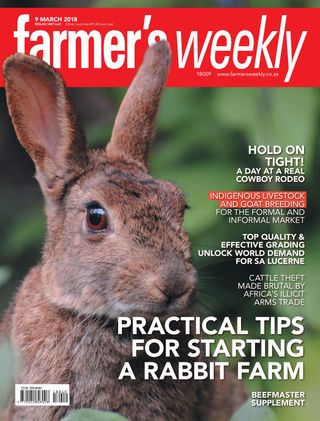

このストーリーは、Farmer's Weekly の March 9, 2018 版からのものです。
Magzter GOLD を購読すると、厳選された何千ものプレミアム記事や、10,000 以上の雑誌や新聞にアクセスできます。
すでに購読者ですか? サインイン
Farmer's Weekly からのその他のストーリー
Farmer's Weekly
The high cost of cheap stitches
There is a particular brand of anxiety found in unrequited loyalty.

1 mins
February 27 - March 06, 2026

Farmer's Weekly
Zambia's silent crisis: why heat stress is the new frontier for public health
As temperatures in Zambia near 40°C, farmers face a hidden health emergency. Research led by medical scientist Anayawa Nyambe, a researcher at the University of Zambia, shows heat stress is driving widespread illness and cognitive decline in rural workers, yet the national health system remains largely blind to the risk.
5 mins
February 27 - March 06, 2026

Farmer's Weekly
Keeping a close eye out for heatstroke in pigs
With hot months ahead, pig farmers should be on the lookout for heatstroke in their pigs.
3 mins
February 27 - March 06, 2026

Farmer's Weekly
The foot-and-mouth disease threat is growing
Foot-and-mouth disease poses a growing threat to the livestock industry, especially communal farmers, with devastating economic consequences unless awareness and compliance improve, writes Shane Brody.
3 mins
January 30 - February 06, 2026

Farmer's Weekly
Shipping conditions to ease in 2026, but risk remains high
Early signs suggest a more favourable export season for South African producers, as easing global shipping congestion and improved performance by Transnet point to higher throughput at local ports. Lindi Botha reports.
2 mins
January 30 - February 06, 2026

Farmer's Weekly
A path of accelerating land reform in South Africa
Delivering the ANC's January 8th Statement a few weeks ago, President Cyril Ramaphosa noted, amongst other things, that: “Land reform remains one of the most urgent tasks of the National Democratic Revolution. While progress has been made, much more is required to give effect to the constitutional requirement for redress and equitable access to land.”
2 mins
January 30 - February 06, 2026
Farmer's Weekly
Reflections on 2025 and the policy space for 2026
The year 2025 was a year characterised initially by a wave of misinformation, particularly relating to legislation and tariff issues. This year some big moves are expected in the trade space.
3 mins
January 30 - February 06, 2026
Farmer's Weekly
From planning to peak lay: building a profitable egg business
Mpumalanga poultry farmer Lebogang Mashego spoke to Octavia Avesca Spandiel, and shared practical insights on planning, building systems that work, breed choice, feed management, and markets to build a profitable and sustainable egg business.
5 mins
January 30 - February 06, 2026

Farmer's Weekly
Impofu Wind Farm becomes a canvas for community connection through Enel's Blowing Art Initiative
Enel Green Power South Africa has introduced the Blowing Art Initiative at the Impofu Wind Farm in the Eastern Cape, a creative community project that turns renewable energy infrastructure into a living gallery.
2 mins
January 30 - February 06, 2026

Farmer's Weekly
Geely is intent on hanging around
Having fallen off the radar around a decade ago following a short local stint, Chinese manufacturer Geely has announced its proposed return to South Africa towards the end of 2026. The Citizen's Jaco van der Merwe reports.
4 mins
January 30 - February 06, 2026
Translate
Change font size