試す 金 - 無料
How Startups And SME's Can Leverage Open Source CRM To Increase Business
DataQuest
|February 2018
Often CRM is looked upon as a viable tool for larger businesses and enterprises while SME’s and Start-ups often view it as a considerable investment

While CRM has proven its versatile potential for large enterprises in areas beyond sales, marketing and customer service requirements, it is yet to make its contribution felt among the start-ups and SME’s who currently rely largely on the ERP software.
Open source CRM is a financially and technically viable solution compared to ERP for start-ups and small enterprises. While ERP assists with maintaining essential business data and records, CRM can help in vital data management, analysis and predictive insights into key business areas like marketing, customer engagement, sales, vendor relationships, employees and talent management and training, thus contributing to the overall business growth.
ADVANTAGES OF USING OPEN SOURCE SOFTWARE
Cost: Open source CRM is a good solution for SMEs and start up’s to achieve business success at reduced expenses. With availability of the source codes and absence of a license fee, the open source CRM is virtually free and requires a minimal investment into hardware, customization and integration.
Quality: Despite being developed by community, the open source CRM software in recent years boasts of a rigorous inspection and quality assurance process. Nearly all new releases and stable versions are exposed to a battery of tests for software quality before being launched.
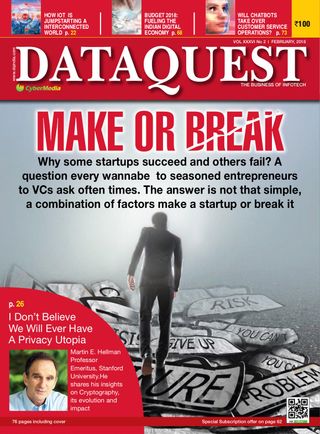

このストーリーは、DataQuest の February 2018 版からのものです。
Magzter GOLD を購読すると、厳選された何千ものプレミアム記事や、10,000 以上の雑誌や新聞にアクセスできます。
すでに購読者ですか? サインイン
DataQuest からのその他のストーリー

DataQuest
Engineering India's Al-First Data Centres at Hyperscale
Rohan Sheth explains how AI and HPC are reshaping India's data centres, from density and cooling to power economics, sustainability, and hyperscale decision criteria.

4 mins
February 2026

DataQuest
From copilots to colleagues: Why agentic AI is forcing enterprises to rethink control, trust, and culture
As AI agents shift from assisting to acting, enterprises must redesign governance, data controls, and security guardrails so autonomy stays auditable, reversible, and trusted.
2 mins
February 2026

DataQuest
Reclaiming Control in the AI Era: A Conversation with Kalyan Kumar, CPO, HCLSoftware
Enterprises are reassessing cloud-first strategies as AI becomes core to operations. HCLSoftware's Kalyan Kumar explains why sovereignty, choice and control now shape decisions.
5 mins
February 2026

DataQuest
When infrastructure learns: The rise of the Al-native core
AI-native infrastructure is moving from concept to operational reality, reshaping how organisations build, govern, and scale intelligence across their digital core.
6 mins
February 2026

DataQuest
Bridging the gap between connectivity and compute at scale
As AI scales in India, data centres are evolving into high-density, low-latency platforms that unify connectivity, compute, and sustainability at national scale.
4 mins
February 2026

DataQuest
PUE is not a grapefruit metric, anymore
So what are the new high-hanging fruits for data centre strategists today? And are players going after them?
4 mins
February 2026

DataQuest
Even if Al demand fades, India need not worry - about data centres
For every megawatt (MW) of installed colocation capacity, users here generate approximately 13.2 PB of data monthly- compared to 0.3 PB for Australia and just 0.01 PB for Singapore. India's data centre growth is not dependent on one tech lever. Plus, it is phased and modular and not kneejerk. Manoj Paul explains these contours in detail.
7 mins
February 2026

DataQuest
AI infrastructure and systemic risk
What has been the biggest change in data centre industry-specially after AI workloads? Is Al-bubble a big risk for data centre infra- how much will it affect data centres if something cracks?
1 min
February 2026

DataQuest
Inside the Shift to High-Density, Al-Ready Data Centres
CtrlS' Vipin Jain discusses what it truly takes to build AI-ready data centres in India, balancing high density, liquid-ready cooling, resilience, and ESG accountability.
4 mins
February 2026

DataQuest
Sustainability is now the headline, not a footnote
Sanjay Agrawal, Head Presales and CTO at Hitachi Vantara India and SAARC opines that the conversation is moving beyond headline metrics like PUE toward a broader view of how data lifecycle management and infrastructure efficiency reduce the overall environmental footprint. Let's see why and how- while also touching upon adjacent (or not-so-adjacent) factors like redundancies, availability and AI-readiness
3 mins
February 2026
Translate
Change font size