試す 金 - 無料
Ewe Nutrition For Optimal Lamb Production
Stockfarm
|August 2020
Sheep producers are often heard complaining about ewes that produce thick and sticky, slow-flowing colostrum, with a subsequent negative effect on lambs. Several studies indicate that this problem can be directly attributed to poor nutrition during late gestation.

In an article titled ‘Colostrum production in ewes: A review of regulatory mechanisms and of energy supply’ by Banchero et al., published in Animal in 2015, the authors point out that lamb losses in extensive production systems can largely be attributed to colostrum availability. Colostrum production, in turn, is directly dependent on the nutrition that ewes receive in the last weeks prior to lambing.
The energy requirements of ewes expecting multiplets are significantly higher than those carrying single lambs. The problem is exacerbated by the fact that these ewes simply do not have enough space in their rumen to ingest sufficient roughage to meet their energy requirements.
Grazing alone is therefore insufficient in meeting these ewes’ requirements and an energy supplement in the last week of gestation is essential. The extra energy ensures better colostrum production and makes the colostrum more fluid, thus promoting ingestion.
Nutrition for colostrum production
According to the authors, the majority of energy-rich grains tend to increase colostrum production by between 90 and 185%. They concluded that short-term supplementation of energy-rich grains is therefore a cost-effective way of managing ewes under extensive grazing conditions and limiting lamb losses.
They caution, though, that adequate protein intake is just as vital, seeing as over or underfeeding protein can affect the amount of colostrum produced at birth.
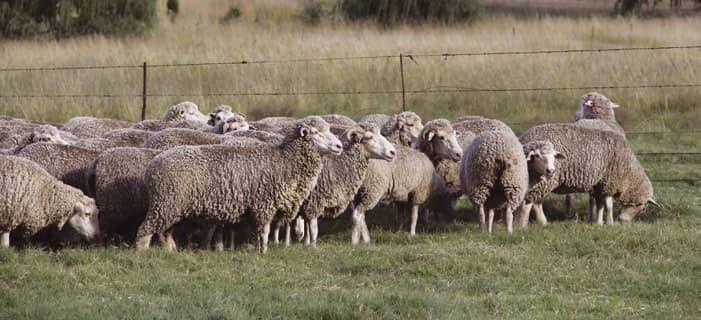
Nutrition during late gestation

このストーリーは、Stockfarm の August 2020 版からのものです。
Magzter GOLD を購読すると、厳選された何千ものプレミアム記事や、10,000 以上の雑誌や新聞にアクセスできます。
すでに購読者ですか? サインイン
Stockfarm からのその他のストーリー

Stockfarm
World School Milk Day: A national celebration of dairy
The Department of Basic Education (DBE), in partnership with Milk SA's Consumer Education Project (CEP), marked the national celebration of World School Milk Day (WSMD) at Mandlomsobo Primary School in Bronkhorstspruit on 26 September.

2 mins
January 2026

Stockfarm
A breed that you like will work with you
Data can't fix what selection broke, and your grandpa knew it.
4 mins
January 2026
Stockfarm
2025 Santam Agriculture Silage Competition: Wet conditions, winning silage
Plaas Media's twelfth Santam Agriculture National Silage Competition once again showcased impressive expertise among its participants.
4 mins
January 2026
Stockfarm
Unravelling the regulations for dairy and imitation dairy products
Regulation R1510 of 22 November 2019, which governs dairy and imitation dairy products, recently took centre stage during a webinar hosted by the Dairy Standard Agency (DSA). Thabang Rampa, manager of regulatory affairs at the DSA, provided a technical interpretation of key sections of the regulation, aimed at improving industry's understanding of the prescribed minimum compositional and labelling requirements.
3 mins
January 2026

Stockfarm
2025 ARC National Master Dairyman Awards: Top dairy farmers honoured
The Agricultural Research Council (ARC) announced the winners of its 2025 National Master Dairyman Awards during a ceremony held in November at Lanzerac Estate in Stellenbosch.
2 mins
January 2026
Stockfarm
Abattoirs: The hidden pulse of meat safety
In conversations regarding the meat supply chain, the first and final links tend to take prominence, while the work performed by the middlemen often goes unnoticed. Yet every link plays a vital role. The real question is: Do we truly understand the value each link adds? Or has ‘value addition’ become shorthand for 'price addition, leaving producers and consumers feeling the financial strain?
5 mins
January 2026
Stockfarm
Silage equipment you can't do without
Silage is an invaluable resource on many livestock farms but producing it is not always simple or cheap.
3 mins
January 2026
Stockfarm
The value of a vaccination programme for cattle
Vaccination is essential for any cattle operation, especially given the increasing risk of disease outbreaks. According to Dr Paul Reynolds, a veterinarian at the Warden and Vrede Animal Hospitals, vaccines are never developed arbitrarily. Each exists because a specific disease threat warranted it.
4 mins
January 2026
Stockfarm
Silage competition winners: Key success factors
The Santam Agriculture National Silage Competition once again delivered impressive results, maintaining its high standards and enthusiastic participation. This year’s judging spanned six key categories: nutrient composition, fermentation quality, aerobic stability, top-layer losses, compaction or density, and visual assessment.
2 mins
January 2026
Stockfarm
Why use a silage inoculant?
Producing high-quality silage is critical for any livestock operation, especially in regions where seasonal forage shortages are common. One of the most effective ways to improve silage fermentation and preservation is with a silage inoculant.
2 mins
January 2026
Translate
Change font size