試す 金 - 無料
SCREEN TIME.
The New Yorker
|April 28, 2025
Motherhood in an age of reproductive surveillance.
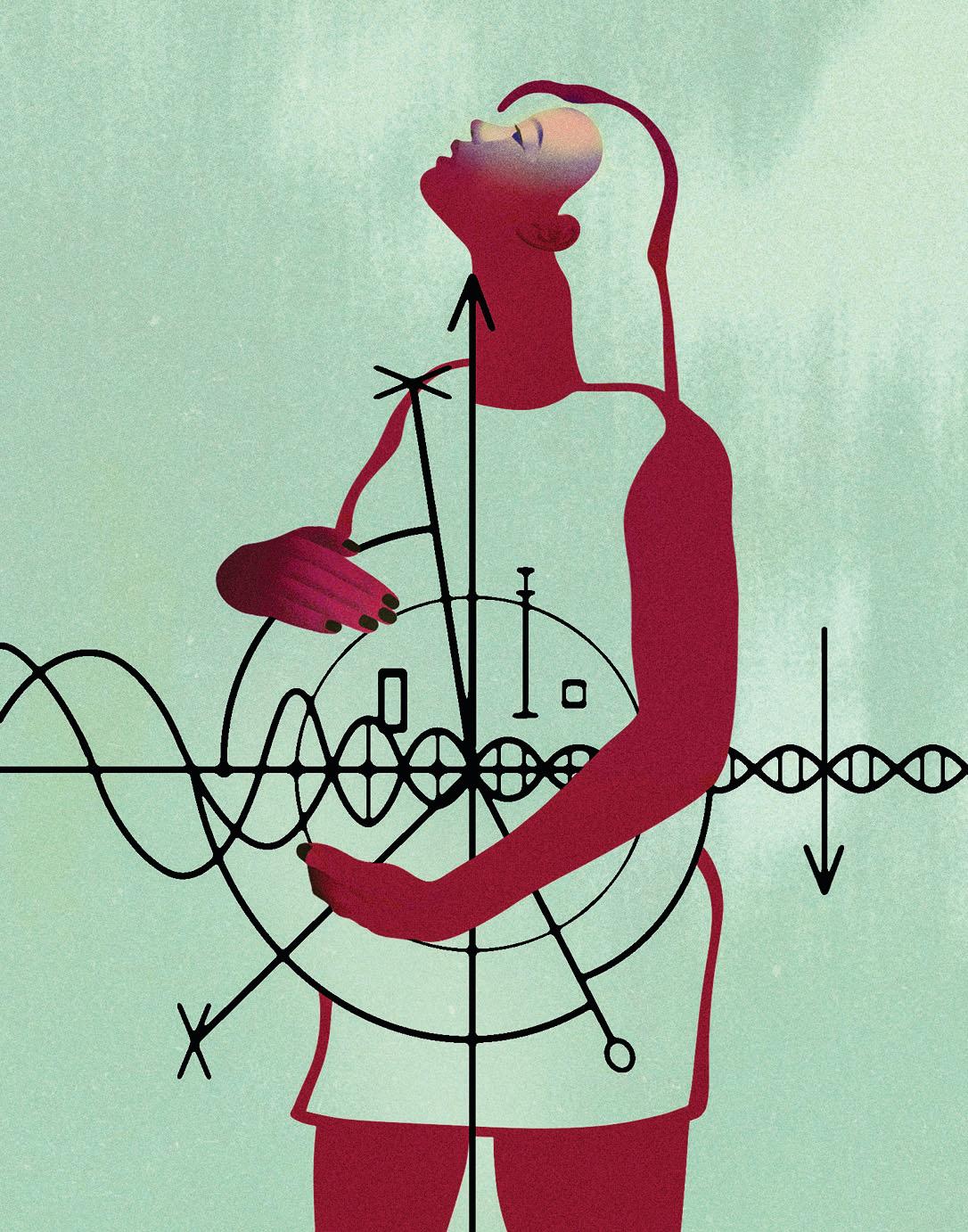
When the writer Amanda Hess was twenty-nine weeks pregnant with her first child, her doctor, looking at an ultrasound, “saw something he did not like.” He suspected a rare genetic condition; Hess underwent an amniocentesis and then an MRI. She sought out a second opinion—which augured catastrophe and, it turned out, was completely wrong—and a third, steadying one. Her son was eventually given a diagnosis of Beckwith-Wiedemann syndrome, which puts babies at higher risk for hypoglycemia and certain cancers and makes their little bodies grow fast; often, their tongues become too large for their mouths, requiring corrective surgery.
Extensive testing showed no genetic or environmental cause for her son's condition, yet Hess felt somehow culpable. “I worried over what I had done to trigger it, over the dark secret of my body that had determined his suffering,” she writes in her memoir, “Second Life: Having a Child in the Digital Age” (Doubleday). Her apprehensions were reinforced by her medical chart, which logged ominous-seeming F.Y.I.s that included “Advanced maternal age” (she was thirty-five), “Teratogen exposure” (owing to a tablet of the anti-anxiety medication Ativan, taken at the six-week mark), and “Anxiety during pregnancy.” These facts revealed nothing about her baby’s prospects, yet they followed Hess around like a misdemeanor rap sheet. Immediately after her son's birth, by C-section, a labor-and-delivery nurse turned to her—“the paralyzed, split-open, twenty-second-old mother”—and asked, “When did you stop taking the Ativan in pregnancy?”


このストーリーは、The New Yorker の April 28, 2025 版からのものです。
Magzter GOLD を購読すると、厳選された何千ものプレミアム記事や、10,000 以上の雑誌や新聞にアクセスできます。
すでに購読者ですか? サインイン
The New Yorker からのその他のストーリー
The New Yorker
MY BALENCIAGA HAN ONG
My mother and I were living on the Upper West Side in New York, with my aunt Fely, who was at work—she was the chief thoracic surgeon at Mount Sinai—when I heard that the film star Nora Aunor had passed.

29 mins
March 23, 2026

The New Yorker
BACK TO BASICS
Zac Posen's path from making ball gowns to remaking the Gap.
32 mins
March 23, 2026
The New Yorker
THE DOCTOR IS IN
What Egon Schiele saw at the hospital.
6 mins
March 23, 2026

The New Yorker
MICROBE AGGRESSION
\"Project Hail Mary.\"
6 mins
March 23, 2026
The New Yorker
THE PRICE OF INDEPENDENCE
Who bankrolled the American Revolution?
14 mins
March 23, 2026

The New Yorker
ALTER EGOS
Lisa Kudrow comes back to \"The Comeback.\"
27 mins
March 23, 2026
The New Yorker
RELATIVITY
\"You Got Older\" and \"What We Did Before Our Moth Days.\"
7 mins
March 23, 2026

The New Yorker
OODLES OF DOODLES
How so-called designer dogs have upended the purebred world.
26 mins
March 23, 2026
The New Yorker
LISTEN TO YOURSELVES
Adam Phillips's playful campaign against psychoanalytic orthodoxy.
10 mins
March 23, 2026

The New Yorker
THE END OF IMPERIALISM
What's behind Trump's new world disorder?
16 mins
March 23, 2026
Listen
Translate
Change font size