試す 金 - 無料
Metaphors & Creativity
Philosophy Now
|December 2024 / January 2025
Ignacio Gonzalez-Martinez has a flash of inspiration about the role metaphors play in creative thought.
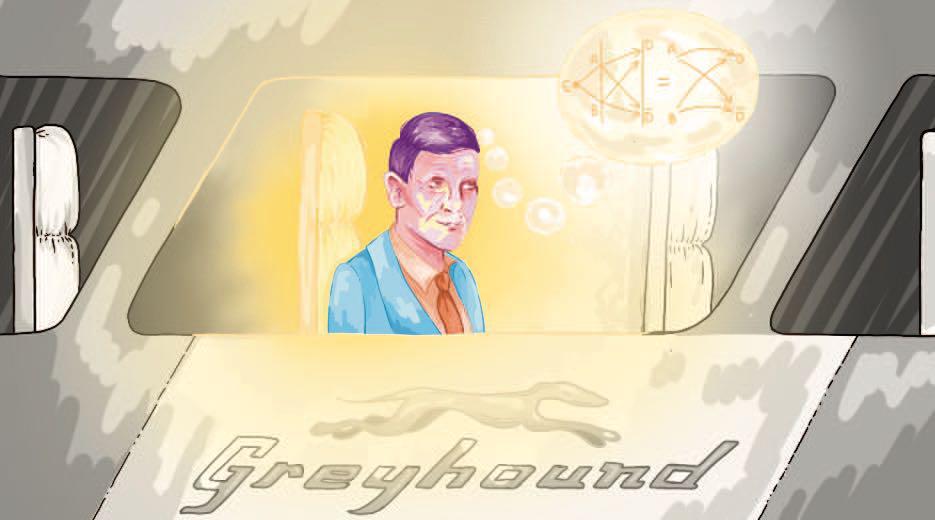
The equivalence between Richard Feynman’s and Julian Schwinger’s distinct formulations of quantum electrodynamics was by no means obvious. The two physicists themselves saw their methods as competing instead of being complementary. However, after becoming familiar with both approaches, Freeman Dyson had a ‘flash of illumination’ about how to reconcile them, while travelling home in a Greyhound bus. Thus it came to pass that Dyson secured yet another place for himself in the history of physics. And in his book The Emperor’s New Mind (1989), Roger Penrose recounts Henri Poincaré’s narrative of the moment when his search for ‘Fuchsian functions’ came to completion while in the middle of a geological expedition. It turned out, exclaimed Poincaré, that “the transformations I had used to define the Fuchsian functions were identical with those of non-Euclidean geometry.” The answer was ‘staring at him in the face all along’, as they say.
Such ‘flash of inspiration’ narratives, in which a coveted creative breakthrough almost violently irrupts into the mind of an ecstatic subject, surely are the archetypal depiction of creativity. This archetype suggests, not particularly subtly, that creative insight is a phenomenon that happens to the subject, not something the subject deliberately produces. Framed in this way, the mystery surrounding creativity becomes, who or what plays the active role in it?
Hypotheses about what lies at the onset of creativity abound. Sometimes people report that ideas ‘come down’ to them, even when they’re not conscious. An example of this is the story told by the German physicist August Kekulé, who claimed to have envisioned the hexagonal structure of the benzene molecule while he was sleeping. In his dream, dancing atoms formed a closed string that subsequently transmuted into a snake eating its own tail.

このストーリーは、Philosophy Now の December 2024 / January 2025 版からのものです。
Magzter GOLD を購読すると、厳選された何千ものプレミアム記事や、10,000 以上の雑誌や新聞にアクセスできます。
すでに購読者ですか? サインイン
Philosophy Now からのその他のストーリー
Philosophy Now
Bilbo Theorizes About Wellbeing
Eric Comerford overhears Bilbo and Gandalf discussing happiness.

9 mins
December 2025 / January 2026

Philosophy Now
What Women?
Marcia Yudkin remembers almost choking at Cornell
11 mins
December 2025 / January 2026
Philosophy Now
Islamic Philosophers On Tyranny
Amir Ali Maleki looks at tyranny from an Islamic perspective.
4 mins
December 2025 / January 2026

Philosophy Now
Peter Singer
The controversial Australian philosopher defends the right to choose to die on utilitarian grounds
5 mins
December 2025 / January 2026

Philosophy Now
Another Conversation with Martin Heidegger?
Raymond Tallis talks about communication problems.
7 mins
December 2025 / January 2026

Philosophy Now
Letters
When inspiration strikes, don't bottle it up. Email me at rick.lewis@philosophynow.org Keep them short and keep them coming!
17 mins
December 2025 / January 2026
Philosophy Now
The Philosophy of William Blake
Mark Vernon looks at the imaginative thinking of an imaginative artist.
9 mins
December 2025 / January 2026

Philosophy Now
Philosophical Haiku
Peering through life’s lens God in nature is deduced: The joy of being.
1 mins
December 2025 / January 2026

Philosophy Now
Philosophy Shorts
More songs about Buildings and Food' was the title of a 1978 album by the rock band Talking Heads. It was about all the things rock stars normally don't sing about. Pop songs are usually about variations on the theme of love; tracks like Rose Royce's 1976 hit 'Car Wash' are the exception. Philosophers, likewise, tend to have a narrow focus on epistemology, metaphysics and trifles like the meaning of life. But occasionally great minds stray from their turf and write about other matters, for example buildings (Martin Heidegger), food (Hobbes), tomato juice (Robert Nozick), and the weather (Lucretius and Aristotle). This series of Shorts is about these unfamiliar themes; about the things philosophers also write about.
2 mins
December 2025 / January 2026

Philosophy Now
Hedonic Treadmills in the Vale of Tears
Michael Gracey looks at how philosophers have pursued happiness.
8 mins
December 2025 / January 2026
Listen
Translate
Change font size