
Magzter GOLDで無制限に
10,000以上の雑誌、新聞、プレミアム記事に無制限にアクセスできます。
試す 金 - 無料
The Magical, Super-Thin, FLEXIBLE BATTERIES
Electronics For You
|November 2024
Slim and flexible, these batteries are a technological breakthrough. Just a millimetre thick, and able to bend without compromising their structure, these are perfect for tight-fitting applications where standard batteries are unsuitable.

Thin, printed batteries represent a revolutionary advancement in battery technology, characterised by their remarkably slim profiles—often just a millimetre thick. This minimal thickness is achieved through a specialised printing process where all essential components, including electrodes and electrolytes, are deposited onto a flexible substrate. The choice of materials, typically acid-based solutions like zinc-carbon, is critical as these are not only conducive to the printing process but also effective in thin-layer applications.
The flexibility of these batteries is derived primarily from two factors: the thinness of the cells and the pliability of the substrate onto which they are printed. This combination ensures that the batteries can bend and flex without compromising their structural integrity or performance. This makes them ideal for applications where traditional rigid batteries would not be feasible.
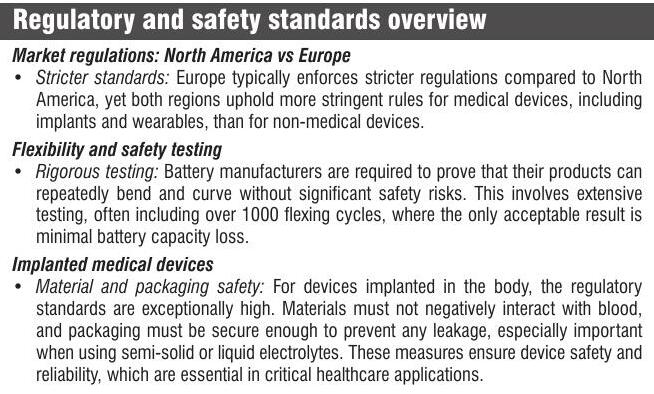 On the other hand, bulkier flexible batteries take a different approach by modifying traditional components to enhance flexibility. This often involves adapting the electrolyte, electrode, and packaging materials. For example, using a semi-solid or solid-state electrolyte within a flexible lattice structure helps maintain ion flow while allowing the battery to bend. Packaging innovations, such as pre-crumpling, are crucial for improving durability during flexion, reducing potential damage by prestressing the material.
Electrode and electrolyte innovations

このストーリーは、Electronics For You の November 2024 版からのものです。
Magzter GOLD を購読すると、厳選された何千ものプレミアム記事や、10,000 以上の雑誌や新聞にアクセスできます。
すでに購読者ですか? サインイン
Electronics For You からのその他のストーリー
Electronics For You
5 Interesting Reference Designs FOR ROBOTICS
Looking to build robots without starting from scratch? These ready-made reference designs illustrate how to make robots work faster and smarter.

3 mins
January 2026

Electronics For You
WHY 'MODERN ICS FAIL ‘SILENTLY And Solution To The Problem
When failure margins shrink to a few volts, ioniser performance reveals why ESD risks go unnoticed and how they can be addressed.
4 mins
January 2026

Electronics For You
How RFID And EAS Are Turning T-SHIRTS INTO SMART TOOLS
As retail grows more complex, intelligence is moving into the products themselves. RFID- and EAS-enabled T-shirts redefine how stores track inventory, prevent loss, and streamline daily operations.
4 mins
January 2026
Electronics For You
Hybrid SMART GRID
This system integrates traditional AC grids with DC systems, such as solar panels, batteries, and EV chargers, and coordinates them through software, automation, and cloud platforms.
4 mins
January 2026

Electronics For You
Why Automotive Innovation NOW BEGINS WITH IP
Both incremental tweaks and breakthrough leaps need protection. As electrification and connected vehicles reshape the automotive world, mastering IP strategy has become essential for inventors, engineers, and mobility builders.
5 mins
January 2026
Electronics For You
ELECTRONIC VOTING SYSTEM With Real-Time Authentication And Keypad
A secure electronic voting system with real-time authentication and keypad enables accurate, tamper-proof voting through identity verification and controlled access.
5 mins
January 2026
Electronics For You
Density-Based TRAFFIC LIGHT CONTROLLER
Efficient traffic management in urban areas remains a significant challenge as vehicle density grows and infrastructure struggles to keep pace.
5 mins
January 2026

Electronics For You
Inside The Race To Build QUANTUM-SECURE NETWORKS
If quantum communication becomes mainstream, our entire approach to digital security could change.
3 mins
January 2026
Electronics For You
SIMPLE OVERFLOW STOPPER For Water Tanks
Even though water covers two-thirds of the Earth's surface, less than 1% of it is fresh and easily accessible for human use. Preventing unnecessary wastage of this limited resource is therefore essential. Several methods are currently employed to address this concern, and one effective approach is to use an electronic or electrical system to prevent storage water tanks from overflowing. This also helps conserve electrical energy by ensuring the pump motor runs only long enough to fill the tank with the correct volume of water.
5 mins
January 2026
Electronics For You
Density-Based TRAFFIC LIGHT CONTROLLER
Efficient traffic management in urban areas remains a significant challenge as vehicle density grows and infrastructure struggles to keep pace.
5 mins
January 2026
Listen
Translate
Change font size