Prøve GULL - Gratis
INTEREST SUBVENTION SCHEME TO RBI SUPERVISORY ACTION FRAMEWORK AND PERFORMANCE OF COOPERATIVE BANKS
BANKING FINANCE
|August 2020
Abstract: The recent mega fraud of Punjab and Maharastra Bank has shaken the confidence in Urban Cooperative Banks (UCBs). For revival of these banks, constant monitoring of financial health of these banks by the RBI is a must for which Supervisory Action Framework (SAF) is an effective tool. Under SAF, monitoring of the financial health of UCBs is done through three trigger points namely, CRAR, Asset Quality and Profitability. This SAF is in existence since 2012. The present article studies of financial performance of UCBs since the introduction of SAF which reveals several concerns. While SAF seems to be an effective supervisory tool of the RBI, its benefits are yet to be derived. For this purpose, it calls for more seriousness on the part UCBs to improve their overall financial performance by ensuring the participation bank staff at all level.

Introduction:
Reserve Bank of India (RBI) introduced Prompt Corrective Action (PCA) for the first time in December 2002 when public sector banks were witnessing a high and increasing level of non-performing assets (NPAs) and weakness in their overall financial performance. RBI imposes the PCA if a commercial bank's financial condition worsens for which it specifies a 'trigger point' or 'risk threshold' of each of specified areas of financial health of banks. When any trigger point/risk threshold is brought to the notice of RBI, it intervenes with corrective actions/restrictions.
A bank would be placed under the PCA framework depending upon the audited annual financial results and RBI's supervisory assessment. Once the bank comes under the PCA, the periodical submission of reports by the bank to the RBI and its meetings with the supervisory authority are compulsory. RBI revised PCA guidelines from time to time. It is happy to state that there has been encouraging response to PCA by public sector banks which is evident that few banks are slowly coming out of PCA due to their overall improvement if financial health1. Encouraged from the success of PCA, RBI made this supervisory tool called as Supervisory Action Framework (SAF), to Urban Cooperative Banks (UCBs). Since SAF is in the larger interest of UCBs, it becomes necessary to create awareness of the recent revised SAF introduced in January 2020. Towards this end, the present article shares the relevant information. To begin with, let us examine features of SAF.
Features of SAF:
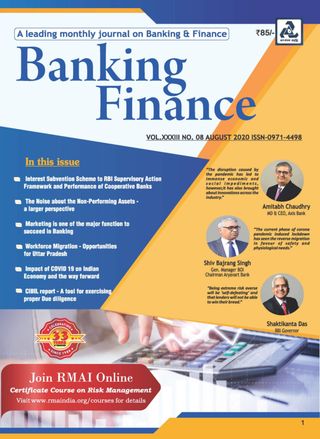

Denne historien er fra August 2020-utgaven av BANKING FINANCE.
Abonner på Magzter GOLD for å få tilgang til tusenvis av kuraterte premiumhistorier og over 9000 magasiner og aviser.
Allerede abonnent? Logg på
FLERE HISTORIER FRA BANKING FINANCE
BANKING FINANCE
Legal News
In a significant ruling on compassionate appointments, the Orissa high court has held that an adopted child cannot be denied employment benefits if the adoption was completed before the death of the employee, even if formal documentation or recognition followed later.

5 mins
February 2026
BANKING FINANCE
Credit risk failure and governance lessons: The Yes Bank case
Credit risk remains the most material risk on bank balance sheets, particularly in emerging markets where rapid credit growth often outpaces risk governance.
4 mins
February 2026
BANKING FINANCE
Metal, Magnetic, Mobile: The Journey of Credit Cards Across Generations
The journey of the credit card is a story of reinvention. From Western Union's metal plates in 1914 to today's Al-powered digital cards, every step-cardboard slips, magnetic stripes, EMV chips, contactless taps, and wallets on our phones-has solved yesterday's problems while shaping tomorrow's payments.
7 mins
February 2026
BANKING FINANCE
Mutual Fund News
SBI Mutual Fund launches SBI Quality Fund with quality-factor strategy
7 mins
February 2026
BANKING FINANCE
Why Indian BFSI and Fintech Firms Are Becoming Prime Ransomware Targets
Any downtime, even for minutes, can result in major disruptions. Ransomware groups exploit this dependency by designing attacks that cripple critical systems such as payment gateways, authentication servers, customer databases, and core banking operations.
4 mins
February 2026
BANKING FINANCE
Reserve Bank News
Sanjay Malhotra has welcomed the revision of base years for key macroeconomic indicators, stating that the exercise will facilitate more calibrated policy-making, support price stability and aid economic growth.
10 mins
February 2026
BANKING FINANCE
Industry News
The Securities and Exchange Board of India (Sebi) has announced a new digital signature facility for foreign portfolio investors (FPIs), aimed at simplifying and speeding up the onboarding process.
10 mins
February 2026
BANKING FINANCE
Tips and tricks to crack JAIIB and CAIIB examinations
The JAIIB and CAIIB examinations conducted by the Indian Institute of Banking & Finance are career-defining milestones for banking professionals in India. Beyond increments and promotions, these certifications deepen functional understanding of banking operations, risk, compliance, and financial management.
3 mins
February 2026

BANKING FINANCE
India's Gold Loan Ecosystem: Growth, Risk, and Regulation in a Time of Surging Prices
According to the World Gold Council, in the past decade (2015-2024), the global annual average demand for gold has been around 4,338 tonnes against the average annual supply of 4,771 tonnes, which was largely driven by 75% of mined gold and 25% of recycled gold.
15 mins
February 2026
BANKING FINANCE
India Exim Bank Creates History with US$ 1 Billion Dual-Tranch Bond Issuance: Prices First-Ever 30-Year Issuance by an Indian Banking Financial Institution
India Exim Bank has successfully issued USD 1 billion dual-tranche Senior Unsecured Bonds spread across 10-year (USD 500 million) and 30-year (USD 500 million) in the 144A/Reg-S format.
1 mins
February 2026
Translate
Change font size