
Gå ubegrenset med Magzter GOLD
Få ubegrenset tilgang til over 9000 magasiner, aviser og premiumhistorier for bare
Prøve GULL - Gratis
Choosing The Right Feed Mixer For Your Farm
Stockfarm
|April 2020
Providing a healthy and balanced ration for your livestock is certainly one of the key goals of every livestock producer. In order to facilitate this task, the right equipment must be on hand. And this is where a good feed mixer plays an indispensable role.

Livestock farmers want to ensure that their animals ingest enough nutrients to be able to produce and reproduce. The challenge, however, is ensuring that the ingredients of such a balanced diet or ration, which usually consist of different textures and quantities, are thoroughly distributed and mixed so that each animal receives the right amount of feed. For this purpose, the farmer needs a mixer that will guarantee that each mouthful is properly balanced and well mixed.
There are a variety of feed mixers on the market, each with specific features and functions. Stockfarm spoke to Marius Ras of Rovic Leers, Dick van der Westhuizen of Diamond Implements, and Aimee Russouw of Alltech to find out what a good feed mixer should look like.
What are the traits of a good feed mixer?
Marius: For any farm, large or small, the basic outcomes in terms of feed mixing traits are quality mixing, correct cutting lengths of roughage, and accurate mixing compositions. However, dairy and meat production units have different requirements.
For dairy production units the cutting length of roughage needs to be around 5 to 7cm. This matches the width of the cow’s mouth and is long enough to trigger the necessary rumen activity for increased milk production, but not so long that it leads to selective intake of only concentrates, which may lead to acidification. The mixer must be able to process roughage quickly and accurately into these cutting lengths during mixing. A cutting action rather than a tear action will ensure cleaner cuts, which will provide better rumen stimulation.
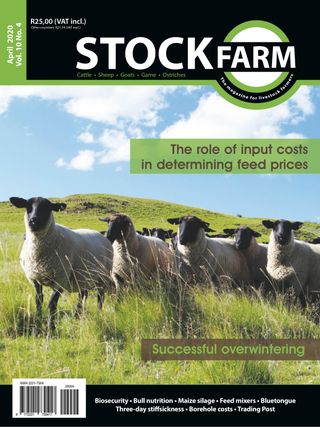

Denne historien er fra April 2020-utgaven av Stockfarm.
Abonner på Magzter GOLD for å få tilgang til tusenvis av kuraterte premiumhistorier og over 9000 magasiner og aviser.
Allerede abonnent? Logg på
FLERE HISTORIER FRA Stockfarm
Stockfarm
Tackle mastitis in dairy COWS
Mastitis is one of the most significant challenges in the dairy industry, reducing milk yield and overall profitability.

5 mins
February 2026
Stockfarm
Ewe nutrition for a healthy lamb crop
Producers widely acknowledge that the success of any sheep enterprise depends heavily on the potential and management of the farm’s female animals.
4 mins
February 2026
Stockfarm
Does chop length really matter?
Chop length is a critical factor in producing successful silage. Mistakes made during this initial stage can have lasting, irreparable effects.
2 mins
February 2026
Stockfarm
Place these ticks on your autumn watch list
Heavy tick infestations and an increase in the incidence of tickborne diseases such as redwater, gallsickness, and heartwater remain a serious challenge for livestock producers in South Africa, particularly when environmental conditions favour these parasites. Effective control strategies and sound management practices are therefore essential.
2 mins
February 2026

Stockfarm
The grazing paradox: Towards better data
Producers are often under pressure to reassess their grazing strategies and consider dramatic management changes aimed at sustainability.
5 mins
February 2026

Stockfarm
Shearer training for improved performance
Lungani Maqakalana has sheep shearing in his blood. Both his father and uncle were shearers, and from a young age he aspired to follow in their footsteps.
4 mins
February 2026
Stockfarm
Misuse of an employer's property
An employer's property is an integral part of the business infrastructure. Any loss, damage, accidental misuse, intentional misuse, or waste of this property constitutes serious misconduct, placing unnecessary strain on the employer to repair or replace it.
2 mins
February 2026
Stockfarm
The dynamics of the South African lucerne hay industry: Grading and quality
In the January issue of Stockfarm, part one of this series explored the role of lucerne hay in South Africa's animal feed industry.
5 mins
February 2026
Stockfarm
Functional efficiency in small stock
Functional efficiency, the combination of structural soundness, adaptability, mobility, mothering ability, and reproductive capability, is as important as genetic merit for economically important, measurable traits.
3 mins
February 2026
Stockfarm
Managing breeding stock and unsold weaner calves
Persistent outbreaks of foot-and-mouth disease (FMD) have dealt a severe blow to the South African cattle industry.
1 mins
February 2026
Translate
Change font size