Prøve GULL - Gratis
A Stoic Approach to Racism
Philosophy Now
|June/July 2021
Frank Thermitus says prepare for the worst to achieve the best.

Rather than imagining an ideal world, Stoics try to manage their emotions in order to deal with the world as it is. With this in mind, Stoicism would suggest that people of color should begin each day by reminding themselves, “I will face racism, I will be stereotyped, I will be racially profiled, I will face racial discrimination, and people will be culturally or racially insensitive.”
Although this idea of negative visualization – visualization of the inevitability of suffering – seems an odd approach in contrast with presently popular positive thinking psychology, it is rooted in a time-tested philosophy that started in Greece in the third century BCE. The original Stoic principles are based on the idea that we may not have control over the things that happen to us, but we do have control over how we respond to them. The Stoics also believed that one should cope with the real world while pursuing self-improvement through wisdom, temperance, justice, and courage. The best-known Stoic philosopher was the Roman Emperor Marcus Aurelius (121-180 CE), who in his book Meditations wrote, “Begin each day by telling yourself: ‘I shall be meeting with interference, ingratitude, insolence, disloyalty, ill-will, and selfishness’ – all of them due to the offenders’ ignorance of what is good and evil.”
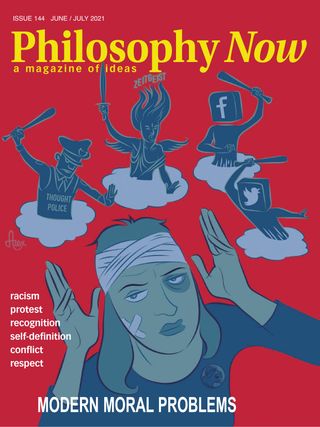

Denne historien er fra June/July 2021-utgaven av Philosophy Now.
Abonner på Magzter GOLD for å få tilgang til tusenvis av kuraterte premiumhistorier og over 9000 magasiner og aviser.
Allerede abonnent? Logg på
FLERE HISTORIER FRA Philosophy Now

Philosophy Now
The Possibility- Bearing Animal
Raymond Tallis explores a twilight zone.

7 mins
February/March 2026

Philosophy Now
Amazing Times at the Pub Agora
John Douglas Mullen is a philosophical bar fly on the wall.
8 mins
February/March 2026

Philosophy Now
Friedrich Nietzsche (1844-1900)
Hilarius Bogbinder considers the all too human life of the notorious iconoclast.
11 mins
February/March 2026

Philosophy Now
Heisenberg's Philosophy of Quantum Mechanics
Kanan Purkayastha explains how Werner Heisenberg's 1925 paper turned the quantum theory of the early 1900s into the quantum mechanics of today.
10 mins
February/March 2026

Philosophy Now
Cicero & the Ideal of Virtue
Abdullah Shaikh explores Cicero's ideas about the core Roman principle of virtus.
13 mins
February/March 2026

Philosophy Now
ROPE
Les Jones has a Nietzschean take on a Hitchcock thriller.
6 mins
February/March 2026
Philosophy Now
What Have the Romans Ever Done For Us?
Salve! This issue's theme is Roman Philosophy. But as the rebels in Monty Python's Life of Brian asked, what have the Romans ever done for us? The question seems relevant here; we are philosophers, not archaeologists.
2 mins
February/March 2026

Philosophy Now
Paul Guyer
Paul Guyer is an American philosopher and a leading scholar of both Immanuel Kant and aesthetics. AmirAli Maleki interviews him about Kant's political and moral vision.
9 mins
February/March 2026

Philosophy Now
Identity in the Age of Connectivity
Sara Asran explores the dynamics of identity online.
6 mins
February/March 2026

Philosophy Now
A Very Short History of Critical Thinking
Luc de Brabandere summarises a long history through key figures of thought.
7 mins
February/March 2026
Translate
Change font size