Prøve GULL - Gratis
Pugnacious In The Punjab
Philosophy Now
|October/November 2017
Seán Moran considers holy war in Lahore.
-

My photograph is genuine. The words on the boy’s back are real, and the cannon, outside a fort in Pakistan, is authentic. It dates from the Eighteenth Century and is embossed with the symbol ‘G3R’: ‘King George III’. He’s the mad king whose behaviour eventually led to the second amendment of the American Constitution – the right to bear arms – in case his troops should reappear with cannons and muskets. (I oversimplify a little here). What drew me to the scene was the incongruity of a peaceful religious motto next to a weapon of war.
Pakistan has certainly had its share of violence, and we hear much about Islamist aggression in the world at large, which the belligerents excuse by talk of historical injustices. Some people polarise the world into ‘Crusaders’ and ‘Jihadists’; but we can make few valid generalisations about 2.3 billion Christians or 1.8 billion Muslims. It claims too much if a small number of outliers are allowed to define the whole category. Unfortunately, many non-Muslims flinch when they hear the phrase “Allahu Akbar!” –“God is the greatest!” – because on the television news the shouted slogan is typically followed by a bang.
Religion has been behind certain conflicts. But it can also be a useful cover story to justify the unjustifiable, with no genuine link to faith. The troubles in Northern Ireland – now largely resolved, happily – were not a theological dispute. Religion can be like patriotism: the last refuge of a scoundrel. Yet some of the finest people have faith too. And a number of the most genocidal leaders in history felt no need to invoke God as an excuse for their crimes against humanity. Stalin in the Soviet Union, Mao in China, and Pol Pot in Cambodia, were all atheists; and self-worshipping Kim Jong-Un waits in the wings in North Korea.
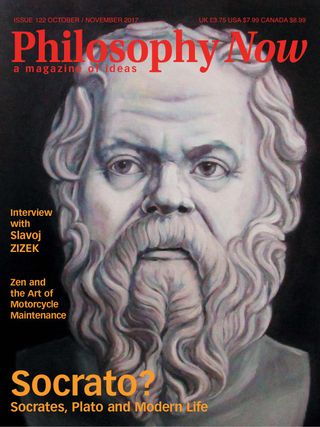

Denne historien er fra October/November 2017-utgaven av Philosophy Now.
Abonner på Magzter GOLD for å få tilgang til tusenvis av kuraterte premiumhistorier og over 9000 magasiner og aviser.
Allerede abonnent? Logg på
FLERE HISTORIER FRA Philosophy Now

Philosophy Now
The Possibility- Bearing Animal
Raymond Tallis explores a twilight zone.

7 mins
February/March 2026
Philosophy Now
Amazing Times at the Pub Agora
John Douglas Mullen is a philosophical bar fly on the wall.
8 mins
February/March 2026
Philosophy Now
Friedrich Nietzsche (1844-1900)
Hilarius Bogbinder considers the all too human life of the notorious iconoclast.
11 mins
February/March 2026

Philosophy Now
Heisenberg's Philosophy of Quantum Mechanics
Kanan Purkayastha explains how Werner Heisenberg's 1925 paper turned the quantum theory of the early 1900s into the quantum mechanics of today.
10 mins
February/March 2026
Philosophy Now
Cicero & the Ideal of Virtue
Abdullah Shaikh explores Cicero's ideas about the core Roman principle of virtus.
13 mins
February/March 2026

Philosophy Now
ROPE
Les Jones has a Nietzschean take on a Hitchcock thriller.
6 mins
February/March 2026
Philosophy Now
What Have the Romans Ever Done For Us?
Salve! This issue's theme is Roman Philosophy. But as the rebels in Monty Python's Life of Brian asked, what have the Romans ever done for us? The question seems relevant here; we are philosophers, not archaeologists.
2 mins
February/March 2026
Philosophy Now
Paul Guyer
Paul Guyer is an American philosopher and a leading scholar of both Immanuel Kant and aesthetics. AmirAli Maleki interviews him about Kant's political and moral vision.
9 mins
February/March 2026
Philosophy Now
Identity in the Age of Connectivity
Sara Asran explores the dynamics of identity online.
6 mins
February/March 2026
Philosophy Now
A Very Short History of Critical Thinking
Luc de Brabandere summarises a long history through key figures of thought.
7 mins
February/March 2026
Translate
Change font size