Gå ubegrenset med Magzter GOLD
Få ubegrenset tilgang til over 9000 magasiner, aviser og premiumhistorier for bare
Prøve GULL - Gratis
Slavoj Zizek
Philosophy Now
|October/November 2017
In a London café, Anja Steinbauer chats with the philosopher who invented the word ‘idiosyncratic’.

So Professor Zizek – Don’t call me professor if you don’t want me to kill you. I feel so uneasy when someone calls me professor. Where is the professor?
I have a deep problem with any official titles and so on. I’m not proud of it. When someone calls me professor I take it automatically as an irony.
A most obvious fact about you is that you are not just a philosopher but a famous philosopher – a rare thing. What does it mean to you to be famous? Is fame important?
First of all, fame is very relative. I have, as you know, many enemies: people who think that I’m just a clown, people who think that beneath my amusing nature there is some evil proto fascist or Stalinist dimension and so on. So I think my so-called fame is basically just a way to keep me at a distance and not engage seriously with what I am doing. What I’m really proud of is, you know my crazy book Less Than Nothing, the one that is almost the length of the Bible? It sold very well. That gives me hope that we nonetheless shouldn’t underestimate the public. The publishers put pressure on me to write a nice best seller on Donald Trump. But why should I? He’s not interesting as a person; he’s a boring idiot.
But are you worried about your books becoming coffee table books? You know, people buy them but don’t actually read them?
I am, but it isn’t just coffee table books that go unread. Take big best-sellers, classics; people buy them but nobody really reads them either. For example take John Rawls’
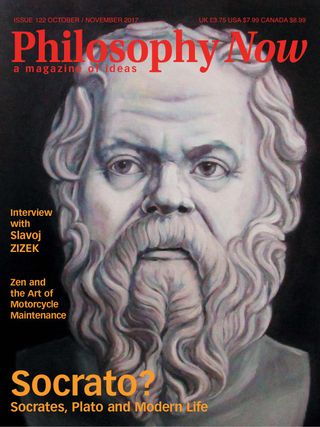

Denne historien er fra October/November 2017-utgaven av Philosophy Now.
Abonner på Magzter GOLD for å få tilgang til tusenvis av kuraterte premiumhistorier og over 9000 magasiner og aviser.
Allerede abonnent? Logg på
FLERE HISTORIER FRA Philosophy Now
Philosophy Now
Nosferatu
Stefan Bolea considers two very different artistic approaches to love and death.

6 mins
April/May 2025
Philosophy Now
Heidegger's Ghost
Raymond Tallis wonders where Heidegger's body went when he was philosophising.
7 mins
April/May 2025
Philosophy Now
Is Comedy Good For Us?
Damaris Stock has a laugh with Plato and friends.
10 mins
April/May 2025
Philosophy Now
In Defense of Idleness
Wendell O'Brien says, 'Just Don't Do It'.
10 mins
April/May 2025
Philosophy Now
Leaving Nothing to Chance by Carl Knight
LEAVING NOTHING TO Chance (2025) by Carl Knight, is an informed, proficient and lucid defence of luck egalitarianism.
3 mins
April/May 2025
Philosophy Now
Star Maker by Olaf Stapledon
THE 1937 SCIENCE FICTION novel Star Maker was written by philosophy professor Olaf Stapledon in the dark days as Europe awaited the onslaught of Nazi Germany. This casts a shadow over the whole book.
6 mins
April/May 2025
Philosophy Now
Love & Emptiness in the Sufi Tradition
Medha Ninad Tambe meditates on Rumi, love and self-negation.
7 mins
April/May 2025

Philosophy Now
The Hedgehog's Dilemma: A Metaphor About the Challenges of Human Intimacy
Krishna Chaubey explains Arthur Schopenhauer's poignant thought experiment.
4 mins
April/May 2025
Philosophy Now
The Mirror & the Flame
Rebwar Fatah imagines Attar's & Hegel's shared path.
4 mins
April/May 2025
Philosophy Now
Free and Equal by Daniel Chandler
DANIEL CHANDLER, AN economist and philosopher based at the London School of Economics, begins Free and Equal: What Would a Fair Society Look Like? (2023) by asking an intriguing question. How is it, he wonders, that the most influential political philosopher of the last century has had almost no practical impact on politics or policy? The philosopher in question is John Rawls, whose magnum opus was A Theory of Justice (1971).
5 mins
April/May 2025
Translate
Change font size