
Gå ubegrenset med Magzter GOLD
Få ubegrenset tilgang til over 9000 magasiner, aviser og premiumhistorier for bare
Prøve GULL - Gratis
Would Plato Allow Facebook In His Republic?
Philosophy Now
|October/November 2017
Jenni Jenkins argues, probably not.

What would Plato (428-348 BCE) have made of the Internet and social media? If the Internet had been around in his day, would he accept my invitation to be his ‘friend’ on Facebook? How many friends would he have? Would he even allow Facebook and other social media into the ideal state posited in his Republic?
In the Republic (written around 380 BCE), Socrates, speaking for Plato, deliberates with friends about what is needed to achieve the most just policies for the establishment of the ideal state. They consider the nature of the soul (this is important, because the ideal state will mirror the individual); what justice is; the nature of ‘good’; and, what knowledge is and how truth can be attained. After this, they go on to discuss how the state should be run to best achieve justice and political harmony. The ideal Republic will consist of three classes of citizens: the producers; warriors to protect the citizens; and philosopher guardians (or philosopher kings), who will be the rulers.
Let us imagine it is 381 BCE, and Plato is researching for his new book about a hypothetical Republic. Our question is whether he would allow the citizens of his Republic to have access to social media; whether only the rulers would be allowed access; or would he have banned it from the Republic completely?
My first thoughts are that he would have attacked Facebook and all social media on (at least) three grounds, which I’ll illustrate using examples from the text of the Republic. These grounds are:
1.The idea, common on social media, that one opinion is as good as any other.
2. The lack of identity, ownership and accountability of its users.
3. Plato’s views on censorship in the running of the state.
Relativism
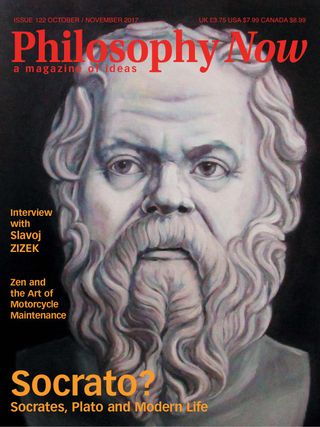

Denne historien er fra October/November 2017-utgaven av Philosophy Now.
Abonner på Magzter GOLD for å få tilgang til tusenvis av kuraterte premiumhistorier og over 9000 magasiner og aviser.
Allerede abonnent? Logg på
FLERE HISTORIER FRA Philosophy Now

Philosophy Now
Bilbo Theorizes About Wellbeing
Eric Comerford overhears Bilbo and Gandalf discussing happiness.

9 mins
December 2025 / January 2026

Philosophy Now
What Women?
Marcia Yudkin remembers almost choking at Cornell
11 mins
December 2025 / January 2026
Philosophy Now
Islamic Philosophers On Tyranny
Amir Ali Maleki looks at tyranny from an Islamic perspective.
4 mins
December 2025 / January 2026

Philosophy Now
Peter Singer
The controversial Australian philosopher defends the right to choose to die on utilitarian grounds
5 mins
December 2025 / January 2026

Philosophy Now
Another Conversation with Martin Heidegger?
Raymond Tallis talks about communication problems.
7 mins
December 2025 / January 2026

Philosophy Now
Letters
When inspiration strikes, don't bottle it up. Email me at rick.lewis@philosophynow.org Keep them short and keep them coming!
17 mins
December 2025 / January 2026
Philosophy Now
The Philosophy of William Blake
Mark Vernon looks at the imaginative thinking of an imaginative artist.
9 mins
December 2025 / January 2026

Philosophy Now
Philosophical Haiku
Peering through life’s lens God in nature is deduced: The joy of being.
1 mins
December 2025 / January 2026

Philosophy Now
Philosophy Shorts
More songs about Buildings and Food' was the title of a 1978 album by the rock band Talking Heads. It was about all the things rock stars normally don't sing about. Pop songs are usually about variations on the theme of love; tracks like Rose Royce's 1976 hit 'Car Wash' are the exception. Philosophers, likewise, tend to have a narrow focus on epistemology, metaphysics and trifles like the meaning of life. But occasionally great minds stray from their turf and write about other matters, for example buildings (Martin Heidegger), food (Hobbes), tomato juice (Robert Nozick), and the weather (Lucretius and Aristotle). This series of Shorts is about these unfamiliar themes; about the things philosophers also write about.
2 mins
December 2025 / January 2026

Philosophy Now
Hedonic Treadmills in the Vale of Tears
Michael Gracey looks at how philosophers have pursued happiness.
8 mins
December 2025 / January 2026
Translate
Change font size