Prøve GULL - Gratis
Biodiversity And Ecosystems - Financing The Future
TerraGreen
|March 2022 WSDS Special Issue: Towards A Resilient Planet (Ensuring A Sustainable And Equitable Future)
In this article, Namita Vikas opines that the world needs a significant investment to tackle the interlinked crises of climate, biodiversity, and land degradation. Research has shown this figure to be $8.1 trillion by 2050, with an annual global investment of $536 billion. An enabling ecosystem to foster partnerships between grassroots stakeholders, policymakers, and the private sector, can help biodiversity and ecosystem-oriented adaptation finance to flourish.

Ecosystems underpin the existence and functioning of all life forms by creating conducive environments for biodiversity to thrive in. In turn, biodiversity supports all the natural capital present in the world and consequently, the goods and ecosystem services they generate for humanity. An estimated $44 trillion1 of economic value generation, that is, about 50 per cent of global GDP, is moderately or highly dependent on nature. Consequently, the global resource extraction rate has risen from 27 billion tonnes in 1970 to 92 billion tonnes in 2017.2
The inherent interlinkages between ecosystems, biodiversity, climate, and human life reveal the implications of climate change on living environments. With climate change rapidly escalating into a crisis, biodiversity loss ranks as one of the top five threats3 to mankind by severity or impact for the third year in a row for FY 2022-23. If business as-usual' continues, then biodiversity loss will represent an economic loss of approximately $479 billion per year.
Climate discussions and negotiations are moving towards mobilizing finance for climate action and transitioning to a low-carbon economy. Global climate finance, inclusive of public and private finance, reached $632 billion in the year 2019–20,5 drastically falling short of the $5 trillion needed annually by 20306 to contain climate change. Moreover, over 90 per cent of climate finance in 2020—$571 billion—is largely skewed towards mitigation through renewable energy, green buildings. On the other hand, a mere $46 billion went towards adaptation and $15 billion to cross-cutting sectors covering both mitigation and adaptation.
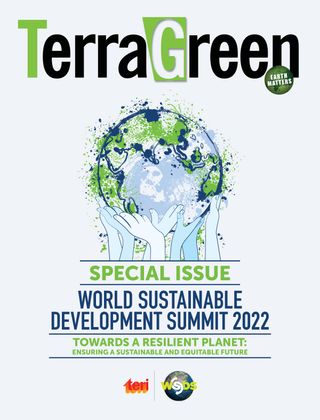

Denne historien er fra March 2022 WSDS Special Issue: Towards A Resilient Planet (Ensuring A Sustainable And Equitable Future)-utgaven av TerraGreen.
Abonner på Magzter GOLD for å få tilgang til tusenvis av kuraterte premiumhistorier og over 9000 magasiner og aviser.
Allerede abonnent? Logg på
FLERE HISTORIER FRA TerraGreen

TerraGreen
Motor Efficiency
The Silent Catalyst of India's Green Industrial Revolution

4 mins
January 2026

TerraGreen
Beauty That Betrays!
The Quiet Invasion of An Ornamental Plant
3 mins
January 2026

TerraGreen
Farming Innovation Addresses Food Shortages
Also Halves Methane Emissions
4 mins
January 2026

TerraGreen
Aravalli on the Edge
Saving India's Ancient Green Shield from Collapse
3 mins
January 2026

TerraGreen
From Orchard to Table
Apple Picking, Family Time, and Fall Colours
4 mins
January 2026

TerraGreen
Coral Reefs Could Feed Millions
If We Let Them Rebuild
3 mins
January 2026

TerraGreen
Resting on Deodars
How Fallen Trees are Being Reimagined as Urban Assets in Shimla
3 mins
January 2026

TerraGreen
India's Clean-Air Innovation at Risk
Nationwide Assessment by WeNaturalists
2 mins
January 2026

TerraGreen
CNFF-25
Highlights Environmental Concern Amid India's Cultural Heritage
3 mins
January 2026
TerraGreen
Green Farming through Circular Economy
Sustainable Practices for Waste Reduction
8 mins
January 2026
Translate
Change font size