Prøve GULL - Gratis
AT THE MERCY OF THE MONGOLS
BBC History UK
|April 2023
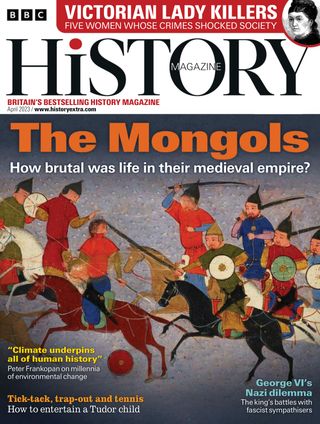
They pulled off one of the most astonishing campaigns of conquest in history. But how did they treat their subject populations once the dust had settled?

One curious and less-well-known impact of the Mongol empire’s explosive expansion was a huge surge in the hunting of owls – almost to the edge of extinction in some regions. And it all stemmed from a striking and powerful foundational myth.
According to legend, long before they embarked on their far-reaching campaigns of conquest, the Mongols lived on the far side of a mighty mountain range. It was impenetrable but for one single road running through an abandoned fortress. That castle, though, sparked immense fear: anyone venturing too close would be assailed by terrifying noises that caused them to flee in panic. So the Mongols remained hemmed in.
One day, the story goes, a rider engrossed in a hunt found himself unexpectedly at the daunting fortress, where he was filled with terror – until he spotted an owl on its gate. Emboldened, he ventured inside and discovered that those eerie noises were merely the wind whistling among the stones. Thus the only impediment barring the Mongols from marching forth was removed.
That legend was brought to the west by Dominican missionary Riccoldo of Montecroce in the early 14th century. Just how accurately his version reflects the tale told by the Mongols themselves is hard to say but it’s linked to a powerful economic truth.
In later years, the Mongols recalled the owl with reverence, as a divine messenger guiding them on their journey. For this reason, they wore owl feathers in their hats, paying a hefty price to merchants bringing them to their courts. Hunters began to kill owls in huge numbers, eager to sell feathers to the khans.

Denne historien er fra April 2023-utgaven av BBC History UK.
Abonner på Magzter GOLD for å få tilgang til tusenvis av kuraterte premiumhistorier og over 9000 magasiner og aviser.
Allerede abonnent? Logg på
FLERE HISTORIER FRA BBC History UK
BBC History UK
On the skids
Richard Rodgers and Oscar Hammerstein II's smash musical Oklahoma! opened on Broadway on 31 March 1943.

1 min
Christmas 2025

BBC History UK
Small pleasures
Memory is imperfect, but what if you could get a professional model maker to recreate a moment from the past?
1 min
Christmas 2025

BBC History UK
Bath in five places
In the Georgian era, Bath became arguably Britain's most fashionable destination. KIRSTEN ELLIOTT promenades five historic highlights
3 mins
Christmas 2025
BBC History UK
End times
Why do civilisations that dominated their epoch fail? In an era of autocracy, climate change, the rise of Al and a first-hand understanding of how deadly pandemics can be, it's a question that seems pertinent.
1 min
Christmas 2025
BBC History UK
What are the origins of the Yule Lads?
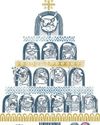
To learn about the Jólasveinar (Yule Lads), we must start with their mother, the terrifying ogress Grýla. Her name appeared in Icelandic texts as early as the 13th century, although it wasn’t until later that those 13 mischievous lads became associated with her. Folk tales and poems tell how she descends from the mountains with an empty sack to stuff full of children. Grýla owns the monstrous Jólaköttur (Yule Cat), which roams the countryside on Christmas Eve, searching for children to gobble up if they're not wearing new clothes.
1 mins
Christmas 2025

BBC History UK
Santa Claus v Father Christmas
The true identity of the white-bearded, red-robed figure who fills children's stockings at Christmas has long been debated. Thomas Ruys Smith sizes up the merry contenders
8 mins
Christmas 2025

BBC History UK
Frontier friction
Set in Washington Territory in 1854, The Abandons is a Western that's unusual for having two matriarchs, women whose lives become entangled, at its centre.
1 min
Christmas 2025

BBC History UK
The Last Days of Pompeii: The Immersive Experience
Delve into the culture of daily Roman life, witness the momentous eruption of Mount Vesuvius, and follow its fallout in Immerse LDN's new exhibition. In a blend of cutting-edge technology and vivid storytelling, this exhibition launches visitors into Pompeii's rich history with recreations of the ancient city's beautiful pre-eruption landscape, a 360-degree virtual reality Roman amphitheatre experience, and a digital metaverse recreating Pompeii's 'Villa of Mysteries'.
1 min
Christmas 2025

BBC History UK
Elizabeth Marsh The corsair's captive
Taken hostage by a Barbary ship's captain in the 18th century, a young Englishwoman found herself fighting for her freedom in Marrakech. ADAM NICHOLS introduces a brave captive who later wrote a book about her dramatic experiences
6 mins
Christmas 2025
BBC History UK
29 DECEMBER 1170: Thomas Becket is murdered in Canterbury
Knights loyal to Henry II rid him of the “low-born cleric”
2 mins
Christmas 2025
Translate
Change font size