
Gå ubegrenset med Magzter GOLD
Få ubegrenset tilgang til over 9000 magasiner, aviser og premiumhistorier for bare
Prøve GULL - Gratis
The Fire This Time
Philosophy Now
|February/March 2024
Tim Madigan on Ray Bradbury, Bertrand Russell and Fahrenheit 451.
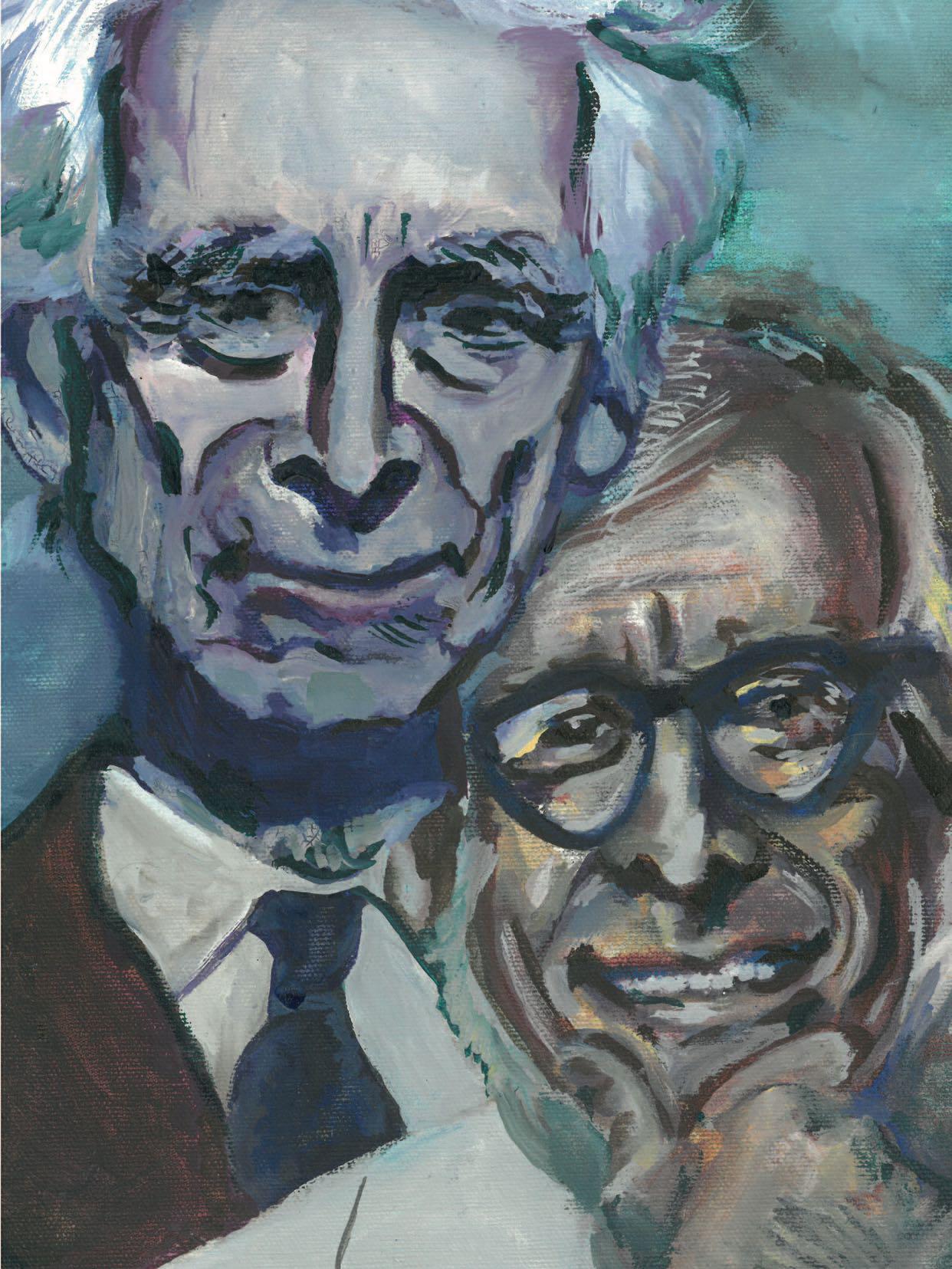
“If I were asked to describe my ideal ‘intellectual-with-a-small i’ I would do it thus: a person who can start an evening with Shakespeare, continue with [Fu] Manchu and James Bond, jog further with Robert Frost, cavort with Moliere and Shaw, sprint with Dylan Thomas, dip into Yeats, watch All in the Family and Johnny Carson, and finish up the morning with Loren Eiseley, Bertrand Russell and the collected cartoon work of Johnny Hart’s B.C.”
Ray Bradbury (1920-2012)
Ray Bradbury's novel Fahrenheit 451 was published over seventy years ago, in 1953, and yet continues to be a source of controversy, being banned by many school boards, libraries, and other institutions throughout the United States – an ironic fate for a novel about literary censorship.
On March 13, 1954, the philosopher Bertrand Russell (1872-1970) wrote a letter to Bradbury’s London publishers praising Fahrenheit 451, and enclosing with it a photo of himself, pipe in hand, with a copy of the book on the arm of his reading chair (the photo became one of Bradbury’s most cherished possessions). Russell wrote:
Dear Mrs. Simon,
Thank you for your letter of March 8 and for Ray Bradbury’s book Fahrenheit 451. I have now read the book and found it powerful. The sort of future society that he portrays is only too possible. I should be glad to see him at any time convenient to us both, and perhaps you might ask him to ring me up when he returns from Ireland and then we can fix a time.
Yours sincerely,
Russell
Unbeknownst to Russell, Bradbury – a Los Angeles native who hated to fly and seldom left the United States – was actually not in Ireland (where he had recently gone by ship from America to work with director John Huston on the screenplay for a film adaptation of

Denne historien er fra February/March 2024-utgaven av Philosophy Now.
Abonner på Magzter GOLD for å få tilgang til tusenvis av kuraterte premiumhistorier og over 9000 magasiner og aviser.
Allerede abonnent? Logg på
FLERE HISTORIER FRA Philosophy Now

Philosophy Now
Bilbo Theorizes About Wellbeing
Eric Comerford overhears Bilbo and Gandalf discussing happiness.

9 mins
December 2025 / January 2026

Philosophy Now
What Women?
Marcia Yudkin remembers almost choking at Cornell
11 mins
December 2025 / January 2026
Philosophy Now
Islamic Philosophers On Tyranny
Amir Ali Maleki looks at tyranny from an Islamic perspective.
4 mins
December 2025 / January 2026

Philosophy Now
Peter Singer
The controversial Australian philosopher defends the right to choose to die on utilitarian grounds
5 mins
December 2025 / January 2026

Philosophy Now
Another Conversation with Martin Heidegger?
Raymond Tallis talks about communication problems.
7 mins
December 2025 / January 2026

Philosophy Now
Letters
When inspiration strikes, don't bottle it up. Email me at rick.lewis@philosophynow.org Keep them short and keep them coming!
17 mins
December 2025 / January 2026
Philosophy Now
The Philosophy of William Blake
Mark Vernon looks at the imaginative thinking of an imaginative artist.
9 mins
December 2025 / January 2026

Philosophy Now
Philosophical Haiku
Peering through life’s lens God in nature is deduced: The joy of being.
1 mins
December 2025 / January 2026

Philosophy Now
Philosophy Shorts
More songs about Buildings and Food' was the title of a 1978 album by the rock band Talking Heads. It was about all the things rock stars normally don't sing about. Pop songs are usually about variations on the theme of love; tracks like Rose Royce's 1976 hit 'Car Wash' are the exception. Philosophers, likewise, tend to have a narrow focus on epistemology, metaphysics and trifles like the meaning of life. But occasionally great minds stray from their turf and write about other matters, for example buildings (Martin Heidegger), food (Hobbes), tomato juice (Robert Nozick), and the weather (Lucretius and Aristotle). This series of Shorts is about these unfamiliar themes; about the things philosophers also write about.
2 mins
December 2025 / January 2026

Philosophy Now
Hedonic Treadmills in the Vale of Tears
Michael Gracey looks at how philosophers have pursued happiness.
8 mins
December 2025 / January 2026
Listen
Translate
Change font size