Prøve GULL - Gratis
SAFETY IN CIRCULARITY
Down To Earth
|March 16, 2025
Global standards of water availability show that India is water stressed. Reusing treated wastewater can augment water supply while solving the problem of its safe disposal. FARAZ AHMAD and SUMITA SINGHAL analyse wastewater management practices of 16 cities in seven states to understand the challenges and potential areas of reuse
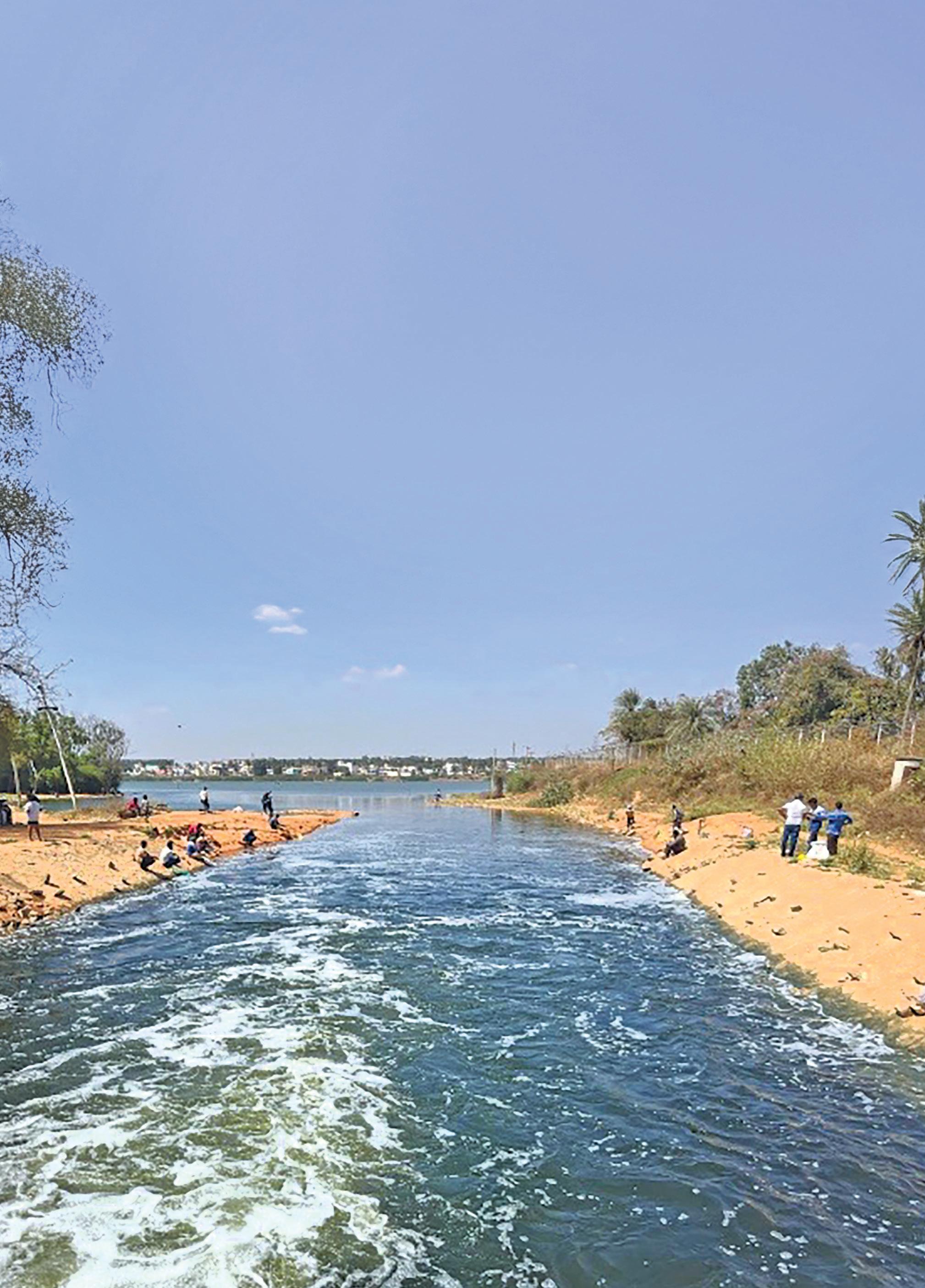
INDIA IS a parched nation. With an annual per capita freshwater availability below the international threshold of 1,700 cubic metres (m³), India ranks 132nd in the world with respect to per capita water availability. This makes the country "water stressed".
Between 1950 and 2024, there has been a decline of 73 per cent in per capita surface water availability in the country, as per the Union government's India Water Resource Information System (see 'Surface water scarcity' on p40). If no steps are taken to address this issue, India could become "water scarce", when water availability drops below 1,000 m³ per capita per year.
Cities such as Delhi, Mumbai, Pune, Hyderabad and Chennai, as well as many small and medium towns, are staring at a scenario where their sources will completely run out of water. Bengaluru faced unprecedented water shortage last year. As India witnesses rapid urbanisation-most of it seemingly unplanned-the situation will get worse, especially with climate change manifesting itself as an intensification of the water cycle, resulting in frequent floods, droughts and water stress.
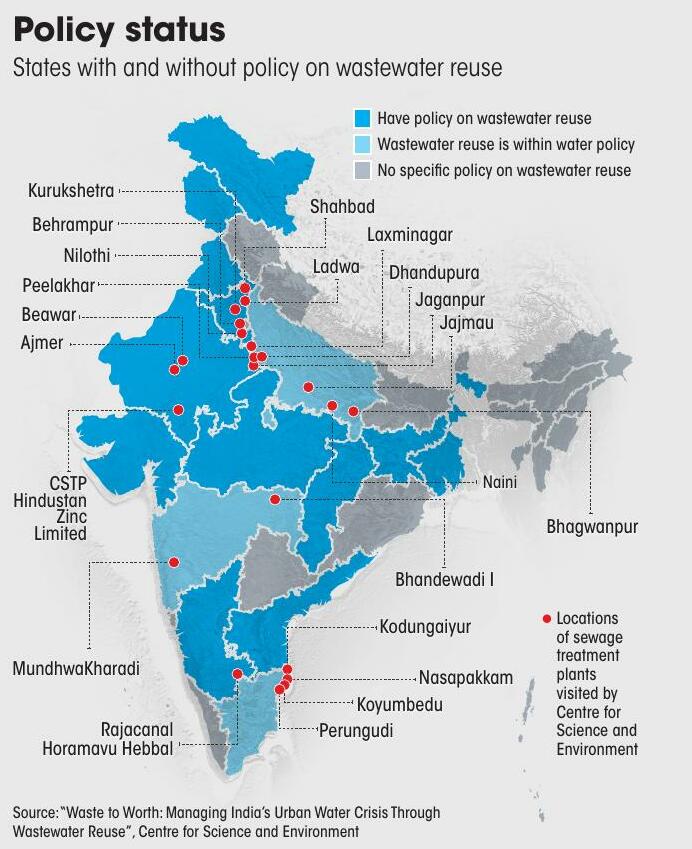 Reuse of wastewater is being seen as a new way of supplementing the water supply and mitigating the impending water shortage. Simply put, all used water is wastewater.
Its reuse will serve the twin purpose of augmenting water resources while reducing the environmental impacts of disposing untreated wastewater.

Denne historien er fra March 16, 2025-utgaven av Down To Earth.
Abonner på Magzter GOLD for å få tilgang til tusenvis av kuraterte premiumhistorier og over 9000 magasiner og aviser.
Allerede abonnent? Logg på
FLERE HISTORIER FRA Down To Earth

Down To Earth
KING OF BIRDS
Revered for centuries, western tragopan now needs protection as its forests shrink, human pressures mount

3 mins
December 16, 2025

Down To Earth
WHISKERS ALL AQUIVER
Climate change threatens creatures that have weathered extreme environments for thousands of years
2 mins
December 16, 2025

Down To Earth
GOLDEN SPIRIT
Survival of the shy primate is closely tied to the health of Western Ghats
3 mins
December 16, 2025

Down To Earth
RINGED EYES IN THE CANOPY
Rapid habitat destruction forces arboreal langur to alter habits
2 mins
December 16, 2025

Down To Earth
HANGING BY THE CLIFF
The Himalaya's rarest wild goat is on the brink of local extinction
2 mins
December 16, 2025

Down To Earth
ANGEL OF THE BEAS
Conservation reserves, citizen science, and habitat protection give the Indus River dolphin a fighting chance in India
2 mins
December 16, 2025

Down To Earth
UNDER MOONLIT SCRUB
Survival of this hidden guardian tells us whether our scrublands still breathe
2 mins
December 16, 2025

Down To Earth
SYMBOL OF SILENT VALLEY
Lion-tailed macaque remains vulnerable despite past victories
2 mins
December 16, 2025

Down To Earth
THE APE IN OUR STORIES
India's only non-human ape species is a cultural icon threatened by forest fragmentation
2 mins
December 16, 2025

Down To Earth
SENTINEL OF THE HIGH COLD DESERT
The bird's evocative call may not continue to roll across the cold desert valley for long
3 mins
December 16, 2025
Listen
Translate
Change font size