
Ga onbeperkt met Magzter GOLD
Krijg onbeperkte toegang tot meer dan 9000 tijdschriften, kranten en Premium-verhalen voor slechts
Poging GOUD - Vrij
Can Knowledge Graphs Revolutionise Pharma R&D?
BioSpectrum Asia
|BioSpectrum Asia Feb 2024
In life sciences, the adoption of new standards such as Study Data Tabulation Model (SDTM) and Analysis Data Model (ADAM) is proving critical for efficient and effective data management and sharing. SDTM provides a new way of organising human clinical and nonclinical study data tabulations, which is required for data submission to regulatory bodies like the United States Food and Drug Administration (FDA) and Pharmaceuticals and Medical Devices Agency (PMDA) Japan, while ADAM defines dataset and metadata standards for clinical trial statistical analyses, ensuring efficient generation, replication, and review of data. The Clinical Data Interchange Standards Consortium (CDISC) 360 is another important initiative that aims to implement standards as linked metadata to support metadata-driven automation across the entire clinical research data lifecycle, making it easier for researchers to analyse and share their findings. The digital transformation of pharma industry regulatory processes, hence, has started to make data a key tool. However, with the increasing volume and complexity of data generated in drug discovery and clinical research, life sciences R&D practitioners need better ways of organising, structuring and exploiting their data, at scale.
-

To address the increasing volume and complexity of data generated in drug discovery and clinical research, the sector is increasingly adopting an innovative data structure approach, the knowledge graph. Graph databases can tackle complex problems in drug discovery, multiomics, and clinical research by allowing researchers to store and analyse complex interconnected data such as relationships between genes, proteins, cells, and tissues, as well as help the sector get better at meeting standards like SDTM and AdaM.
The main advantage knowledge graphs offer is their basic design. Unlike traditional SQL databases that use fixed tables with rows and columns to store data, knowledge graphs represent data as interconnected ‘nodes’ (or entities) linked by ‘edges’ (or relationships).
This network (a graph is a mathematical name for a network) of interconnections holds the key to unlocking breakthrough insights. The power of knowledge graphs is evident in their ability to represent complex data relationships. In the Panama Papers work, for example, a knowledge graph helped uncover an intricate network of opaque offshore accounts, shell companies, and individuals allowing investigators to connect the dots and uncover hidden relationships. These insights would have been difficult to detect using traditional data analysis methods.
Owing to their ability to represent intricate data, knowledge graphs have many applications beyond financial investigations. One such area is biological science, where knowledge graphs can capture the intricate interconnections and correlations among diseases, genes, environment, diet, behaviour, and other factors.
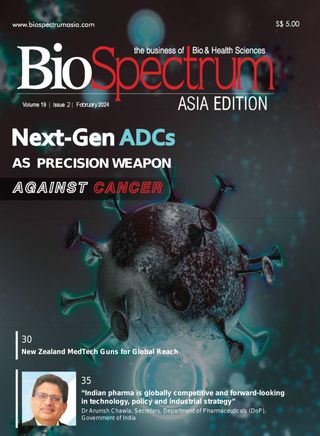

Dit verhaal komt uit de BioSpectrum Asia Feb 2024-editie van BioSpectrum Asia.
Abonneer u op Magzter GOLD voor toegang tot duizenden zorgvuldig samengestelde premiumverhalen en meer dan 9000 tijdschriften en kranten.
Bent u al abonnee? Aanmelden
MEER VERHALEN VAN BioSpectrum Asia

BioSpectrum Asia
Seeing Opportunity in Ophthalmology
Asia-Pacific is emerging as one of the most active regions for ophthalmology innovation. In recent months, a wave of cross-border partnerships and licensing deals has underscored both the scale of unmet need in eye disease and the region's growing ambition to play a larger role in treatment development. From glaucoma and retinal disorders to dry eye disease and childhood myopia, companies across pharma, biotech, and medtech are increasingly accelerating clinical progress.

6 mins
BioSpectrum Asia Jan 2026

BioSpectrum Asia
Reshaping Asia's Healthcare with mRNA Innovation
The COVID-19 pandemic acted as both a challenge and a catalyst, serving as a testbed that fundamentally reshaped the biotechnology landscape across Asia and beyond. What emerged during this period was not just a breakthrough moment for mRNA, but the early foundation of a broader transformation that is still unfolding.
2 mins
BioSpectrum Asia Jan 2026

BioSpectrum Asia
Momentum in Motion: What Will Shape APAC's Life Sciences Landscape in 2026?
Asia-Pacific's life sciences sector is growing rapidly, driven by its scale, diversity and resilience. Accelerating demographic change and strong investment in innovation position the region to outpace global growth and shape the future of healthcare.
5 mins
BioSpectrum Asia Jan 2026
BioSpectrum Asia
The Future of mRNA Is Being Built in APAC
Beyond scientific advancement, mRNA represents a strategic opportunity shaped by policy stability, public investment and regional collaboration. Across APAC, governments are increasingly recognising that supportive regulatory frameworks and long-term funding can serve as powerful competitive advantages, attracting global capital and talent. While political dynamics in the United States have slowed momentum, experts emphasise that the science underpinning mRNA technology remains sound. To fully realise its potential, the region will need greater coordination across borders, including regulatory harmonisation and joint development pathways, to build a resilient mRNA ecosystem capable of addressing shared health challenges and driving long-term innovation.
25 mins
BioSpectrum Asia Jan 2026

BioSpectrum Asia
How Precision Medicine Is Reshaping Cancer Care
Despite major advances in cancer detection and treatment, high recurrence rates and progression to advanced disease continue to challenge outcomes across Asia-making precision medicine a critical catalyst for shifting cancer care from disease management toward treat-to-cure. By leveraging molecular insights, biomarker testing and collaborative healthcare ecosystems, precision medicine offers the potential to deliver more effective, personalised and sustainable cancer care for patients across the region.
2 mins
BioSpectrum Asia Jan 2026
BioSpectrum Asia
Repligen introduces next-generation chromatography resins
Repligen Corporation, a life sciences company focused on bioprocessing technology leadership, has announced the launch of three new high-performance chromatography resins:
1 min
BioSpectrum Asia Jan 2026
BioSpectrum Asia
Hanahealth by DSS Imagetech launches GERI Time-Lapse Incubator in India
Hanahealth by DSS Imagetech, the authorised partner of Sydney-based Genea Biomedx, has launched the advanced GERI Time-Lapse Incubator pan India. GERI, the nextgeneration Time Lapse embryo culture system from Genea Biomedx, is ideal for IVF clinics, labs adopting digital transformation, centres working toward accreditation, and research-focused fertility groups as it enables them to modernise their processes and improve IVF outcomes.
1 min
BioSpectrum Asia Jan 2026
BioSpectrum Asia
Biotechnology to Drive Next Industrial Revolution: Dr Jitendra Singh
\"Biotechnology will play a defining role in shaping the next industrial revolution and will be a key driver of global and Indian economic growth\", said Dr Jitendra Singh, the Union Minister of State (Independent Charge) for Science and Technology.
1 mins
BioSpectrum Asia Jan 2026

BioSpectrum Asia
Cartherics names Dr lan Nisbet as CEO
Australia-based Cartherics, a biotechnology company developing off-the-shelf immune cell therapies focusing on high-impact women's diseases, with lead programmes in ovarian cancer and endometriosis, has announced the appointment of Dr Ian Nisbet as Chief Executive Officer, as part of a planned leadership transition.
1 min
BioSpectrum Asia Jan 2026

BioSpectrum Asia
Neurophet ropes in Josh Cohen as Head of Americas Business
South Korea-based Neurophet, an artificial intelligence (AI) solution company for brain disorders diagnosis and treatment, has appointed Josh Cohen, a veteran executive from leading global medical device companies, as new Head of Americas Business.
1 min
BioSpectrum Asia Jan 2026
Listen
Translate
Change font size